

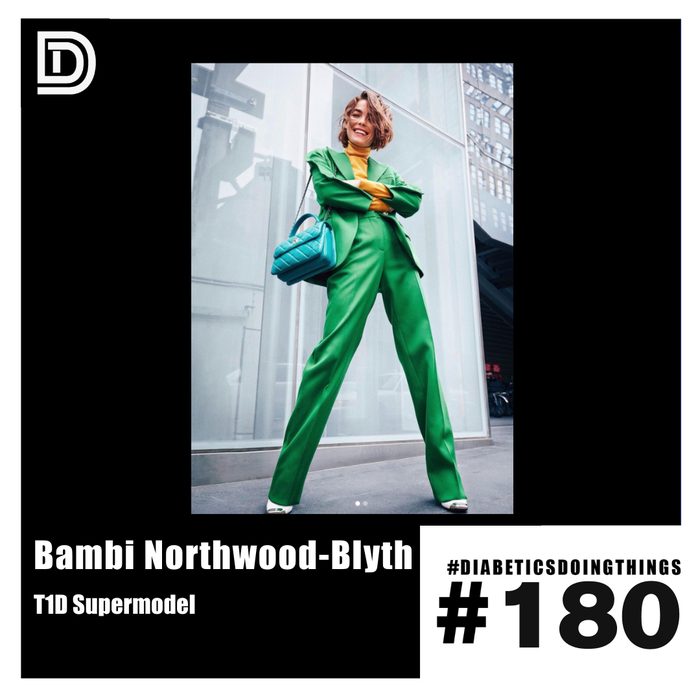
Bambi Northwood-Blyth - T1D Supermodel

Episode summary
Bambi Northwood-Blyth is an Australian supermodel who was diagnosed with type 1 diabetes at 12, after her mom noticed she was unusually thirsty on a family road trip and took her to the ER. She talks about learning to inject insulin, adjusting at a small all-girls school, and getting discovered as a model at 17 at a music festival before shooting a Harper's Bazaar cover and working with Karl Lagerfeld and Chanel. She describes managing diabetes through back-to-back shoots, odd hours, and constant travel, including a Dexcom mishap on a runway and a stylist cutting her pump cord. She also shares her experience at a Connected in Motion Slipstream camp and finishing a college degree just before turning 30.
Key takeaways
- Bambi was diagnosed with type 1 diabetes at 12, after her mom noticed she was unusually thirsty and tired on a family road trip and took her to the ER.
- She was discovered as a model at 17 at a music festival in Australia, shot a Harper's Bazaar cover the next day, and soon had a call with Karl Lagerfeld at Chanel.
- Bambi says she always packs extra insulin, pen tips, lancets, and snacks because shoots can take her to six different cities in a week.
- At a Connected in Motion Slipstream camp, Bambi says she learned practical day-to-day tips from other people with diabetes that she never got from doctors.
- Bambi promised her dad she'd finish a college degree by 30 and graduated a month before her 30th birthday, comparing the process to training for a half marathon.
Show notes
This week’s guest is Bambi Northwood-Blyth (@bambilegit on Instagram)
Rob and Eritrea are back on the intro and we fangirl HARD over Bambi and what an amazing chat we had with her on the pod. Her interview was a big get for the podcast, and talking to her was an absolute blast.
After the intro, Rob, Eritrea and Bambi discuss:
Bambi’s Diabetes diagnosis story
What’s it like to be a supermodel?
Wearing dexcom/devices in the fashion industry - and how Bambi approaches it
Discussion about what it was like to go to Slipstream with Connected in Motion
Is it challenging to advocate for yourself and for people with Diabetes in such a high pressure industry?
What would you tell your younger self with Diabetes if you could go back?
Favorite part of the Diabetes community
And much more!
Questions this episode answers
How old was Bambi Northwood-Blyth when she was diagnosed with type 1 diabetes?
She was 12. Her mom noticed she was constantly thirsty and needing to stop for the bathroom on a family road trip and took her to the ER, where blood tests showed type 1 diabetes.
How did Bambi Northwood-Blyth become a model?
She was discovered at 17 at a music festival in Australia, shot a cover of Harper's Bazaar the next day, and shortly after had a call with Karl Lagerfeld at Chanel that led to Paris Fashion Week.
How does Bambi manage her blood sugar while modeling and traveling?
She packs extra insulin, pen tips, lancets, and snacks like candy, dried fruit, and muesli bars for back-to-back shoots across different cities, and says she never underestimates how much supply she actually needs.
What is the Connected in Motion Slipstream camp Bambi attended?
It's a camp for adults with diabetes where Bambi did group activities like hiking and kayaking alongside other people with type 1. She says she picked up practical tips from fellow campers that she hadn't learned from doctors.
Full transcript Searchable, with timestamps
Rob Howe: Big interview alert. Oh my god, I don't even want to do the intro. I'm already like blushing. Okay, so there are people with diabetes like me and then there are people who are like upper echelon. Like they're, you know, even if they didn't have diabetes, you would know about them. They're like doing big, big stuff. the person who's on the pod this week, Bambi Northwood-Blyth, I would characterize as someone like that, like on the cover of Harper's Bazaar when she was 17, international supermodel and person with diabetes and friend of the pod. I have to say too, in your life, you come across people and the first one for me, I can think of, there's this guy who ran this NBA draft website and he still does it. He does it for ESPN now, but I was like the hugest stan of this guy on Twitter. I was like, wow, this guy knows everything. He's got all the video breakdowns. And when I met him, I had like hyped him up too much in my mind to, and I met him and he just like, wasn't as like dynamic in person. Or I was like, I was this huge fan. I'm like oversharing. I'm like, dude, I love this. This is this. He's like, oh, thanks. Cool. And so anyway, that really helped set my expectations for when you meet people, you know, you got to give them a chance to be themselves and like not project your own like thoughts of who they should be on them. Um, and those who have met Bambi, uh, you know, and we talk a little bit about her, uh, going to connected in motion, uh, at slipstream a few years ago. And those people know Bambi is so cool. It's so down to earth and such a fresh, like relatable, normal voice talking about diabetes in these rooms that she's in where, you know, she's, you know, for major publications for Vogue for fashion week. And, you know, above all that, like she has to deal with managing her diabetes, uh, within that. So, so cool of her to come on the show. And she was so giving of her time and some really awesome answers from her and some really like cool, relatable diabetes discussions. And also I got to see Eritrea get like blushing starstruck for the first time. I hate you. And it was really nice. I, um, first of all, she's beautiful like I know guys whatever but like this this person is just so unbelievably good looking and then just not even that it's just like her energy like you could tell she's pretty on the inside like it wasn't fake like she wasn't just like putting on this nice girl persona like she genuinely you know when you can tell someone's listening to you or they're just waiting for you to stop talking she genuinely like when I asked my questions to her because I was really nervous. And I feel like maybe you guys will be able to tell on the pod. Cause I like, don't really ask them until the end. But when I did, she didn't like interrupt me or try to finish it for me or she like would hear me out. And then she'd be like, Oh yeah, like totally been through that or no, I have or whatever. And she just, she was like my buddy, I know a famous supermodel. I can stop pretending that my biggest like flex is working with Rob. It's like, excuse me. I know a supermodel who knew Karl Lagerfeld, like get out of my way. It's Karl Lagerfeld. for sure. Um, man, I didn't realize that you consider working with you as a flex boy. We got to get you some better flexes. I need another therapist. I only have one. Does that get you laughed out of like most circles? You're like, Oh yeah, I work with Rob. I'd be like, who, who's that? Um, okay. So anyway, we, we had a lot of fun with this interview as you can see, uh, Bambi, thank you so much for your time. This was an incredible story and I hope you guys enjoy our very fun conversation with Bambi Northwood-Blyth. All right. Welcome back to another episode of Diabetics Doing Things. We're telling the amazing stories of people with diabetes from all over the world. And that's a key part of today's discussion because our guest, very special guest, while she's from Australia, she's calling today from New York City. You know her. Her name is Bambi Northwood-Blyth. Welcome to the show, Bambi. Thanks so much for joining us today.
Bambi Northwood-Blyth: Thank you, guys. I'm so excited to be here.
Rob Howe: Well, we are excited to have you. And we were kind of like laughing like off, like on the, before the episode, before we hit record that you don't do a lot of podcasts. So this is going to be our, your chance to kind of debut podcast, debut to the diabetes world. And, and also just have a
Bambi Northwood-Blyth: little fun, a little fun chat with us today. Exactly. I think it might be my Australian accent too. Some words get lost in translation. Well, we also have a lot of like, especially
Rob Howe: early on, I met a lot of people with diabetes from Australia and Ireland and the UK as well. I think like very early on the podcast was like very international and we had some like awesome guests. My friend, Jeremy Robertson, who's a pilot who lives with type 1 and many others from the Oz world. So I'm excited that we get to add another Aussie to our list.
Bambi Northwood-Blyth: Was he the guy that was the first person that allowed diabetes to become pilots?
Rob Howe: uh he was not but he was uh so that's uh Pietro Marsala and I have you met him before no but I've
Bambi Northwood-Blyth: heard the story which is incredible because I remember when I was diagnosed there were like three things you can't do is become a scuba dive instructor become a pilot and maybe an astronaut and I was like oh it's okay I don't want to be that but that's so cool but they he changed that
Rob Howe: yeah they did and uh the actually actually like shout out to all of the pilots with diabetes Some of them, it's like a very small community, but some of the most giving kind and courageous people like really trailblazing in that space to, so now, you know, other than scuba diving and being an astronaut, there aren't, there's one fewer thing that you can, uh, that you can do with diabetes. Thank you. Thankfully to those guys and all their hard work. So shout out to Pietro and Jeremy and, uh, and all of the other pilots, uh, who, who have given their time, Dr. Jerry as well. Awesome folks. So Bambi, let's talk a little bit about diabetes. you told us that you were diagnosed in 2001. What do you remember about like get joining the
Bambi Northwood-Blyth: diabetes family, so to speak? Um, so like, I think start like diabetes was not something I knew about. Like there was no one in my family. It wasn't something that ever really crossed my mind. Like I was 12 years old and I remember we were driving back. It was like a long weekend in Australia I've got two sisters mom and dad in the car and I was like oh can we stop I need to go bathroom I need more water can we stop I need more water can we sisters were like what is wrong with her like stop like they just started being annoying and then I was kind of super quiet we got back home and she's like something is up and my mom was like I'm gonna take you to the ER so we went to the ER and she was like I remember her saying listen darling this could be nothing it could be something like diabetes and that was just a weird thought she had and you know a couple of blood tests later and they were like she's got type 1 we had no idea what that meant and I remember going straight in an ambulance to the children's hospital where we spent seven nights in there and literally got a crash course on what type 1 diabetes is like it's crazy when you're diagnosed because you know when you meet someone in the street and you say I've got type 1 they're like what's that and then when When you suddenly have it, you're like an expert at it. Like it's, it's crazy. Like you do a degree overnight in this condition.
Rob Howe: And you talked about like the crash course and it's you and your family. And I think Eritrea and I had very similar experiences at children's medical center in Dallas, where I think I was in the hospital for three nights, but every day, like all day, different people were coming in nutritionists and endocrinologists and diabetes educators and people from JDRF and just teaching you about, like you said, the, like getting a degree overnight
Bambi Northwood-Blyth: and what diabetes is and how, how to treat it. I remember injecting like an orange trying to learn. Cause I remember at the very start, I was like, there's no way I'm having needles. And I would literally run from my mom, but I was like, there's no way. And then, you know, like three months after hospital, I remember like distinctly doing my first needle. Cause I'd be like to my mom, you don't need a runner like i used to think she like had a run up to the needle you know when someone else finger pricks your finger and it's always way way worse than you need to and i just and then once i started injecting myself i feel like i started getting in the flow of it but it's
Rob Howe: so crazy at the start yeah i remember i think my they gave us like the orange and then they also asked like my made me like inject my parents so that they could know what it felt like and so it it's just like this whole group thing of like, you know, and like you said, whenever somebody else is injecting you or testing your blood sugar, they always press a little bit harder. It seems like it's never, never a good experience. No. Uh, well tell us a little bit about like your adjustments. Like you said, you were 12, your family is all learning. You guys are all learning on the fly about type 1. And, you know, obviously like that's such an important time in a young person's life. Like you're going through so many changes already as a young person and then throwing diabetes in that. What do you remember about your kind of early days going to school and activities and friends and things like that?
Bambi Northwood-Blyth: I just moved to a new school at the start of that year and it was in November. So it was kind of lucky that that was the school I stayed at for high school. And I think that really helped in a way that there was only, I think, 70 of us at that time. And then by the time it gets to like grade seven, like high school it increases to like a thousand girls so it was kind of nice that I had a small circle you know your parents are close with parents and I was able to still like have sleepovers and things like that but I do remember I was always super active and just those little things where you could like run out the door and play netball or like I don't know run down to your friend's and jump on the trampoline like became a big thing i think it was like yeah that age it just the flexibility was lost a bit and it was just kind of like this is so unfair why me why can't i do that like there was just it was that sudden sense of like the spontaneity kind of goes and especially when you're at that young age you just don't understand why yeah and there's that like
Rob Howe: kind of emotional, I remember getting really angry sometimes about, you know, just having to take those extra steps and you sort of remember as well, like, Oh, I used to not have to do this. And it used to be so much easier. And, um, but I totally agree with you. And I, I relate as well. Like I was a very small high school. And so a very small community of people and parents and teachers, it really helps to add those people to the community. Cause they were kind of learning about how to treat someone with diabetes as well. I was really the only person in the
Bambi Northwood-Blyth: immediate area. Yeah. I just do remember the one annoying thing was I used to have to go to the staff room at recess and at lunch. And I would be like, I'm going to miss the start of the game, like whatever we're playing. And I would be like seven minutes late and recess was only 20 minutes. And that made me so angry. I'd be like, try and get in and out of that office so quick. um but yeah besides that I think it was just the adjustment period um but then going on through high school I think weirdly enough now I'm kind of grateful that I got it at that age because that's kind of like a formative time where you kind of like form your patterns like when I think back to it now I'm like if that wasn't kind of in my schedule of how I ran my life like if I got it at 25, I think it would have been a lot harder. Whereas like having it from that age and through my teens, it's kind of like, I can't really imagine waking up without having an injection or like having a breakfast, like kind of in that weird way, it really is like ingrained in
Rob Howe: how I kind of go day to day. Yeah. And I totally get that. And like, I think even recently on podcasts I was talking about, I don't really remember too much, even though I was diagnosed at 16. I don't really remember like the mechanics of just going to a birthday party when I was young before I had diabetes and just eating whatever I wanted and not having to worry about it. To me, it's just injections and testing and bolusing are just part of the routine now. It's just kind of how it seems like how things have always been. It's that old theory of like, if you're diagnosed, I think I've said it before on the podcast, like if you're diagnosed in childhood versus adulthood, because we have less to grief. I guess like as a child, your grief process is much different than as an adult. Like when you're little, when you're diagnosed in those formative years, like Bambi and I were, you don't really think about adult you as much. You're like, oh, well, we even get there. Right. But like, if you're diagnosed when you're 25, you're like, oh my God, will I have kids? Will I do this? Will I do that? Whereas for us, we were diagnosed so young that it's like already a part of your life. You have this chance to create routines and things that you like, Like, I know my diabetes will always be there kind of thing. So it's almost a little comforting, like Bambi said. Yeah. It becomes really normal. Right. And you know, you talked about the adult life, Eritrea. So I'd love to talk like, obviously like Bambi, you're, you're a supermodel. So let's just, let's call it what it is. Right. And you're like, you're on the go. You're, you're traveling, you're working probably weird hours, probably long days. And I'd love to, for you to kind of give us a you know how you know how you were discovered and how this became part of your life uh and then you know what's what's the life of a supermodel like give us a little bit of like behind the scenes of like you know what what you're going through on a daily
Bambi Northwood-Blyth: basis um so really being discovered it was it was pretty funny i was in australia i was 17 i was at a music festival and someone was like so then he was like i'm gonna shoot you for a job and i was like okay like I had no idea like I was like running around in denim shorts converse high tops like vintage t-shirts like just an Aussie girl and I went into an agency and they were like oh we want to put you on the cover of Harper's Bazaar and I was like okay cool like no idea still went and they shot a cover of Harper's Bazaar the next day I had a call with um Karl Lagerfeld from Chanel at the time and I remember like walking in a laneway on Skype like for my fasting video and I got put on the show in Paris and they were like, well, before you go to Paris, you should go to New York. So like kind of still like packed myself and I still didn't really have any idea of what I was doing. But I think in this sense of modeling, it's kind of a great way. It's not a job you want to want because it's such a fickle kind of industry. whereas like if you're rolling with what's happening it's kind of you can look at it from a different point of view I guess like I've had an amazing time in the industry and it's been it's just like I'm always like wow like I'm not like you know it's kind of it's more funny that this is my job and like I say it to people sometimes especially someone's like what do you do and if I'm like I'm a model and then people look at you like again you're like not still look the same you know it I find it a really funny job but it's it's definitely taken me like around the world it's really like it has put my diabetes to the test but it's just again it's crazy hours it's weird schedules it's new clients nearly every day like last week I was in LA Philly Nevada LA and that was like six days and then out upstate New York and that is just like when you're back to back you've really got to have kind of like your key pillars or stuff that you need for diabetes ready to go and that has been like just from experience to like just knowing that like when you open your suitcase and you can never have too many snacks I don't think you know like there's no way I could eat three muesli bars and four bags of candy on a plane. And you're like, you don't know what your blood sugar is going to do. Can't risk it.
Eritrea: Yeah.
Bambi Northwood-Blyth: You land somewhere and everything's shot or you're in Spain and there's nothing. And you're like, what do I do? So I think it's just like you kind of practice and really never underestimate
Rob Howe: how much you actually need. So like when you're going to go on a trip, like you're, you know, last, like, like you said, last week, you're in six different places. across the U S that are, you know, most of them not close to each other. So what do you, you know, at the beginning of the week or at the beginning of a trip, what do you make sure that you always have in your bag? What's your kind of, what's your checklist that you go down?
Bambi Northwood-Blyth: Um, so obviously like finger pricker insulin, like I always pack like pen tips, kind of realize that I need to not going to really going to change my lancet like that stuff. But then, um i guess like those little like annie's candies probably like 10 bags of them um dried fruit boxes and sultanas um muesli bars uh not too good and then like fresh fruit when you can but i think
Rob Howe: yeah just a good bag of snacks helps yeah just knowing you have back up i was gonna say it just feels good like having that bag next to you i remember when i was playing basketball on the road that was i had like a backpack and everybody else all my teammates just had their like it was called our game bag so if something happened to our regular luggage we'd still have enough to like go do our games and my game bag was like half snacks so it was way heavier than everybody else's it's crazy sometimes like when you used to have to take your snacks out of your bag and on the
Bambi Northwood-Blyth: next to be like who's this girl like it's literally like it's a it's like you're like a
Rob Howe: or in a deli right like you just got all of your you're putting that through security in that extra bag so funny yeah so like let's talk a little bit about that as well because i think like obviously in the fashion industry like you know and there's been a lot of things about body issues as well and i think like you are very outspoken about wearing your devices and you're photographed with your Dexcom on at times as well and being really open about wearing those devices. What is that like from a day-to-day perspective in the industry? How do people respond to seeing those things?
Bambi Northwood-Blyth: Again, it's been pretty good. It's like I did, I remember something the other day. I was just about to walk out on a runway and I was the first girl going out and there was a model behind me. I was in like a skin tight dress this model behind me she's like oh my god you've got something on your butt she tries to like pull it off and I'm like oh no that's like a dexcom and stylist runs up and she's like what I was like oh no that doesn't come off like and then she was so embarrassed the girl was so embarrassed and I was like then I was like embarrassed for them but I was also like I don't know it's more those things when people kind of like just like don't know what it is and then they get super embarrassed and then you're like no it's fine and then they feel like they need to ask you more questions it's those moments or I remember once when I used to have a pump I was on set and the lady was cutting tags off and she just cut through the pump cord thinking it was another tag and I was like oh no so like it's more like that um yeah like those times have being awkward but for me the Dexcom doesn't really get in the way like I have it usually on like my like my hip and you don't really see it um but I do like I love when I see someone else it's more being in America like you see people around the streets now and you're like
Rob Howe: like it's cool it's cool to like know what they are it is it's like I saw a woman yesterday uh the barista in the coffee shop that I went to and she had an Omnipod on her arm and she was wearing like a sleeveless shirt and she was wearing her Omnipod proud on her arm. And I like had my, my sensor was out underneath the sleeve of my t-shirt. And I was like, Hey, like I see you have an Omnipod, like I have diabetes too. And it was just like, especially in masks, it was a little bit weird because you can't really see each other, you know? So it's somehow, I feel like it's, it's easier to not be embarrassed because you're just like, no one can see you. And so, but she was like very surprised that I asked her about it. It was just, I don't know, it's always such a fun moment when, cause there's two sides. There's the person who has no idea what it is and you have to explain and kind of do the same story over and over and over. But then there's the moment where you see somebody and you're like, Hey, like, I know, you know what this is. Let's just have this quick moment and then we'll be on our way.
Bambi Northwood-Blyth: Yeah. It's so cool. Running into like a diabetic in the, in the wild. Like it's like your instant best friends i know i've like bumped into someone and then you start talking and you're with your friends and you're like what was that like was that english like you just start rolling off just like oh my god how's your that was which insulin you on, Lantus, you on like and you just like and you like just instant like it's like your secret code it's crazy it is it's like yeah it's like a
Rob Howe: little fan club like a secret you know behind the scenes language so much fun yeah being part of a set all over the world well that's how i feel but maybe that's the gangsta in me i'm like oh we real recognize real so when rob is like pulling up his sleeve i'm just like oh this is very i don't know it's like community gang whatever i like it yeah and it's sort of you just like automatically know that person know like whatever whatever they use they you know they know what you're going through you talked about like you know running it we talked about running into people A few years ago, I remember seeing on social media, you went to a slipstream, uh, at a connected emotion camp with some other friends from the, uh, the Northeast diabetes community. What was that like? What was that like to kind of just like go to diabetes camp as an adult and just like have fun with other people with diabetes?
Bambi Northwood-Blyth: It was so cool. It was, um, besides meeting some amazing people, I just say, I think Connected in Motion is one of like the best organizations in terms of like even in line with like your podcast just like being able to do what you do in a day-to-day and whether that's hiking kayaking like you do a lot of adventure activities and then just being all together I remember one of the coolest memories was being at a dinner on the first night we're just all and it's such an opposite to what real life is like because we're like what do you get bolusing like what do you think like how much is this and like on the dinner menu it'd be like half a cup of beans is one serve and it was kind of all out there and then I remember the next morning well you know firstly in the night there was a girl in the bunk beds and she was like 2 a.m pv and she was like eating a yogurt in bed and you know that's such only diabetics get that like stuffing your face with something at 2 a.m like no one else really does that and you're like oh I get it do you need anything else and she was like no and then we had yoga the next morning and I run in and I was like sorry I was low I was like but everyone's like I can't get away with that excuse here like it wasn't like it was just cool but there was no it was also weird that there's no like backstory you know a lot of the times being a diabetic you've got to like be like oh sorry I can't have this or this or this and then you've got to do it you completely remove all of that because everyone that's already like your common ground and so you kind of can just start a friendship from like five steps ahead yeah you
Rob Howe: get to skip all of the like explaining and all the exposition right you just get to jump right into like oh hey how you doing like and like you said walking into yoga being low everybody's like yeah i get it like no need to explain yeah it was really cool yeah the vice is beeping everywhere
Bambi Northwood-Blyth: And it's always like, is that an Amber? No one was like, whose phone is that?
Rob Howe: Everybody like wakes up like their brain, like wakes them up and they think it's them. Right. Like, you know, you're, that was when I went to, I got to go to a diabetes camp in Colorado and my cabin was like, I was in a cabin with a bunch of other counselors and all of them had diabetes. And so I think somebody, we were all wearing the same pump. And so in the middle of the night, somebody's pump was going off. We all woke up thinking it was us. and then you know we figured it's like oh who is it they're like oh it's me it's like okay cool we're good uh you know we found it i'm obsessed with diabetes camps i didn't know that they made them for adults i need to go because i like half of my friends are from childhood diabetes camp i totally understand what bambi's saying like there's no exclusion because everyone's just doing the same thing and if you try to come up with an excuse like no one cares because we're all dealing with the same thing yeah me so it's like just a great group i like to call it diabetes communes. That's why I call it when there's more than two diabetics in the room together. We just share supplies, share vibe, share it all. Yeah. And I think it's so different too. Oh, sorry. Go ahead, baby. Oh, I was just saying it's like so different from our everyday life where we're just sort of isolated and, you know, kind of, uh, I don't know. I never had a friend at work in all my years, all my career. We actually just hired two women at my agency who have diabetes. And so it's nice to just be able to have somebody downstairs who's like, Oh yeah, yeah, like, Hey, I woke up high this morning. And so I'm in a bad mood. And they're like, Oh, yeah, I get that. But that had never happened to me before. It never, you know, I never really in college or, or any kind of like experience in my professional life that I ever have somebody with diabetes who was around a lot until I met some friends through Dallas comedy house a few years ago. But yeah, before that, it was just like very isolating. And you know, the camps are such a great
Bambi Northwood-Blyth: way to, to get on the other side of that. I think the other really big thing I learned from camp is like I think I've learned some of the best things about diabetes from diabetics like as much as medicals and like endocrinologists are great you know a lot of the time they don't have diabetes whereas we're the people that are like doing it and I think at the camps is where I've learned like the biggest like tips and tricks or like people being like you know because we're like kind of mastering the game we're the ones that are like I don't know why is it high do you go high even when you have black coffee in the morning or something like it's just like those little things that you don't really know are key things until you find someone else experiences the same they're like well have you tried this have you tried this like i've definitely learned a lot of
Rob Howe: great things from other diabetics oh man it's like and that's i think for me probably my favorite part of the diabetes online community is like you said like the really niche like really like nitty gritty details like coffee, or when you wake up in the morning and like feet on the floor morning, you know, morning spiking or, uh, like bolusing for protein, even though you didn't eat carbs and just like understanding how all of that works and like exercise and, you know, just normalizing, eating a bag of gummy bears in your yoga class, uh, and just being able to laugh about that. And like you said, a doctor and a diabetes educator or an endocrinologist can like get you prepared for situations, but talking to somebody who really knows and is like tested and learned and, you know, made mistakes and had successes. It's just such a great like life hack. I just love, like it's leveled me up in so many different ways. Yeah, for sure. I get to learn stuff on this podcast all the time. You guys will come on here. A guest will say something. And then like the next week, me and Rob will be like, wait, didn't someone still say that two weeks ago? We're like, oh my God, mind blown. So I think that you're right. Conversation breeds growth. And if you talk to someone who's living a similar experience as you like even just like another girl like I remember you know Bambi I don't know if you've ever dealt with this but like I remember I couldn't figure out like my periods with my diabetes and that was the toughest thing and it felt like all the representation online was all men so just those conversations can help you grow so much in your own personal care and just how you deal with things yeah a thousand percent it's
Bambi Northwood-Blyth: like we're the ultimate product testers and like doing this day to day and like we get we get it
Rob Howe: yeah and i think it's cool too like you said you don't change your lancet every day which makes you just like everybody else because like i think the last time i changed i was thinking about that the other day i was like wow it's probably been six months i probably should get back and change
Bambi Northwood-Blyth: this lancet yeah that's one thing i don't need to bring like i bring a box every time and i'm like
Rob Howe: why or so so many yeah swabs and like the lancets yeah so like extra we we definitely talked about of like the high points of like getting involved, uh, you know, with the diabetes community and running into people, you know, around the world. Can you think of a moment where diabetes kind of got in the way of, of your career or like, you know, kind of was, was present in a time where you really needed to be focused on, on the work or on travel or any, any kind of times that where you had to deal with diabetes, um, you know, in a working capacity and, you know, what was that like?
Bambi Northwood-Blyth: um yeah I think I think that what one thing that diabetes is can be super annoying is how like little sicknesses can become big things quite quickly like even I was saying this morning I was at the dentist and he's like got something on your gums he was like oh you've got diabetes right oh that's a side effect diabetes like the amount of times you go to a doctor and like we have a mosquito bite and it gets infected and they're like oh yeah that's diabetes the amount of little things like that that then become big things super quickly that is super frustrating and I think especially traveling so much and like not getting enough sleep it's just I know that like you've got to really stay on top because those stupid like little like a little sniffle turns into something bad so quick unless you're on top of it and you seem like a hypochondriac because you're rushing to a doctor to get a prescription just in case but it's just like from experience there's been times when i've been like i know it's okay and you're like i knew i should have done something earlier because yeah again just things can go you can get sick so quick um and that's been hard and then you know then in times like that then your sugars are high and then you're just frustrated and then you're just like i don't want
Rob Howe: this yeah um do you do you find it like in in moments like that do you find it like discouraging or like difficult to advocate for yourself uh you know in situations like that or like how have you faced those challenges kind of over the years um it can be it's more like
Bambi Northwood-Blyth: because in terms of advocating for myself you know there's times like that when you probably around the same time you run into someone who tells you that their cousin cured it by eating vegan it's a really boring diet but they've cured themselves and you're just like please like give me a boring diet like over six needles in a cgm every day like cool but you know then then there's those moments that probably come at a similar time they're like oh no my friend cured himself he went to the gym every day like i don't think all of us would be doing this if there was a cure like that um and it's kind of you've got to learn whether whether that person is so naive like do you stick up for yourself or do you let them just have the monologue and go with it and just just close your
Rob Howe: mouth you know so so here's what i'm thinking here's what i'm hearing international supermodel Bambi Northwood-Blyth still gets people who are cure mongers who talk about cinnamon and diet and exercise curing diabetes so even even international superstar gets the gets the uh the the same kind of things that we all deal with either from family or from just unsolicited opinions from strangers
Bambi Northwood-Blyth: man yeah well like when people mentally unload on you like my auntie had it she died you're like okay um i'm really sorry but like you know and you're just like i don't know what to do with that
Rob Howe: yeah it's like how do you follow up to that in a conversation it's so difficult yeah it's yeah
Bambi Northwood-Blyth: there's yeah yeah it's just yeah when high opinions and I guess because you're living it and you're dealing with it it's so it can be really tricky in those moments to like stay level-headed but like states and facts back totally yeah and I think
Rob Howe: those conversations are just tough I mean you know you just get into those moments where you make that decision like is this a time for me to educate and advocate or is this easier for me to just kind of let this go and move on to the next thing. Totally. So one of the things I was I think Bambi, oh, sorry. Go ahead. Go ahead. I was going to say Bambi can probably give them to them, give them like either a nice answer or a mean answer. Cause I, I know this about her, but she's a Gemini. So I was like, I wonder how those interactions go. Yeah. Sorry. I'm kind of a fan anyway. So I wonder how those interactions go when they catch her maybe on the wrong day but maybe maybe doesn't have the wrong days i don't know yeah no there's can be
Bambi Northwood-Blyth: some short answers you know it's more like do you have the bad type of a good type oh you've got a really bad type like i don't know just one like that i'm like well that just there's just sometimes it's just or when it continues you know and it goes on and you're like okay get it and then you're eating candy later in the day and they're like oh that's why you have it like how much did you eat on the day you shouldn't be having that like are you having an attack and you're like
Rob Howe: you could just wiggle your bambi eyebrows at them and they'll go away what like speaking of you know like one of the things that i think is so interesting about you bambi and i i really didn't know until we were we connected over i guess over the holiday season or kind of this winter and you were talking about a project that you were working on and And at that time, I think you had recently graduated from university as well. And you had been working remotely in 50 countries and on different time zones and in airports and all over the world in your off time spending this time investing in yourself. What was that like? And how did you, in those moments where you're traveling, you've been working all day, you've been, you know, doing these amazing high profile, you know, publications and work and spreads. And, and here you are, then you're doing like homework at 2am in an airport, you know, talk to me about that process. I mean, like, cause there's so much more to you than meets the eye. Um, and, and here you are, you know, maybe a year later from that, like looking back, like what is, what is, what stands out from you or to you from that time? Um, it was, it was definitely
Bambi Northwood-Blyth: crazy it was super grounding I'm one that really sticks to my word and I promised my dad when I went away at 17 to go and do Chanel I was like he was like I can't believe you're not going to college he's so disappointed he was like you're gonna be a model right and I was like we had a deal that I would get a degree by the time I was 30 and I turned 30 last year and I graduated a month before and so I got to 26 and a half and I was like well I gotta do this and so I looked online I found a college I wanted to go to I applied got in and I was like I didn't know what it was going to be like and honestly I kind of I ran a half marathon a couple of years before and it was a lot kind of like training for a run in the sense of like the first time you're on a treadmill those first five minutes are like you're like oh I can never do this so hard this is impossible and you kind of build up stamina and I feel like studying was a lot like that like me sitting in front of a book at the end of the day reading about like Porter and Pestle's like business plans you're like whoa I can't do this and even just writing an essay and I think getting through that and that sense of like completion and you know every essay at the start is like you're like I'm gonna do this and then you still hand it in you get in on time it's just like it's super rewarding and it was something that I guess I hadn't really like yet invested in myself and kind of in my brain like that for a while and it was it was just a really it was a great process and I say that probably more so in retrospect because I remember finishing even last year I was like, yeah, again, but it was really rewarding. That's so cool. And I love the comparison to
Rob Howe: like training because yeah, at first it's really exciting for the first few minutes and then it gets very difficult and there's those kinds of peaks and valleys throughout. That's, that's just a great comparison. Um, and congratulations to you as well. Thank you. Super congrats. So relatable. Those first five minutes are absolute hell. You just want to jump off the treadmill and forget all about it. So yeah. Yeah. Yeah. We've been doing a lot of running interviews recently with like people who run ultra marathons, air tray is like running every day running is just like existing in, in our like atmosphere right now. It's just a very, uh, it's very consistent part
Bambi Northwood-Blyth: of this podcast. Is anyone doing the marathon? We aren't, but I did, uh, I did, uh, over the
Rob Howe: weekend hang out with Jesse Levine. Who's a friend of the podcast who is, uh, is going to run, uh, the New York marathon on the beyond type 1 team. So, uh, excited to see everybody do that.
Bambi Northwood-Blyth: Yeah. I love seeing them run for it. It's such a cool thing. Yeah. So Bambi, I have two more
Rob Howe: questions for you, uh, before we kind of, as we kind of wrap up the time together today. Um, the first one is like going back to a 12 year old Bambi, you're diagnosed with diabetes. Like, what is one thing if you could go back to and tell yourself something, what would you tell your younger self with diabetes if you're able to go back um i remember the doctor telling me
Bambi Northwood-Blyth: when i got it he was like listen you've got a medical condition but it's not a life sentence like you can do pretty much what you want to do as long as you take this seriously and like look after yourself it's totally manageable and you can live a normal life and I think that kind of really stuck with me because yeah it is true like you can live a totally normal life but you've just got to like you know take that extra whatever percent of care over yourself so I think that was um that really stuck with me just like and everything is possible you've just yeah got to
Rob Howe: go a little bit further yeah you just got to work that plan and keep coming back to that treadmill
Bambi Northwood-Blyth: yeah and then i guess just having people in your corner and knowing when to ask for help because you don't or you shouldn't have to do it all alone and i think you know even how slipstream is called slipstream because of the idea of cycling you know if someone falls back there's still the group to keep pushing you up i think that's really helpful in diabetes because you do have those down days and you do have the days when you want to throw your cgm out the window and you're just like you need someone to be able to be like oh or just like not getting really your blood sugar's high and just be like cool i'm just not gonna just gonna let it go for the day and so tomorrow's a new day i think yeah so have a group a good group of people around you that can understand it or you can vent to and then knowing that you can live a normal life
Rob Howe: totally agree and you know i think it's so important because not everybody gets that like encouraging word from from their doctors at diagnosis and that's i think the biggest thing i've learned from you know doing over 200 interviews now with people is that there's generally two types of diagnosis you get the one with where you don't get any information at all And then there's one where you get very similar to the three of us where, you know, somebody says, Hey, this is a lifelong condition, but it's not the end of your life. You just have to make sure you take care of yourself and you can do basically anything that you put your mind to. Um, and I think, you know, a lot of people also can, can kind of get discouraged from that sometimes because it diabetes is hard and it's it, and it is, you know, a chronic illness and it does take a lot of work and management and it is with us kind of everywhere we go. So the next question I have, and this is kind of the last one, is that you are a highly visible person. And I know that there are many kids and parents and adults and men and women who look up to you as a role model of somebody with diabetes who is truly living beyond and living the life that they want and kind of living to the max and chasing their dreams and accomplishing their goals. Like what, you know, for people who look, look to you, like what, what word would you give to them to say, you know, a word of encouragement to somebody who's out there who, you know, looks up to you as a role model.
Bambi Northwood-Blyth: Um, say thanks guys. But also that, um, I think diabetes does give you a bit of an extra force at the same time because you're like, if I've got this and I can do this, like, what can't I do? Like it does. I think it's driven me a bit more um and yeah it's just it's you do get that extra discipline you're super organized you're it gives you a little bit more of a drive I think um in terms of that I think yeah just you gotta keep going use it as fuel is what I'm hearing
Rob Howe: yeah use it as your fuel like what makes you less what you think makes you less stronger can make you like more powerful than beyond your wisest dreams because like you've somehow figured out a way to be like this international supermodel and all I'm thinking about is like a low on the runway ma'am like what do we do oh my god it's happened so many times really so dumb like yeah like and then you
Bambi Northwood-Blyth: know you've got stupid lipstick on and you try and run that to your dressing room like eat some candy and you're all just sit there and be like what are you doing you're like like sweating through your makeup and everything right just yeah there's just you know or like injecting through a dress because you can't take your dress off and then you're like i do that and i can't take the phone off but like yeah there's definitely times like when you're just like oh there's just so many funny kind of things that happen on the road or you know especially your Dexcom alarm going off and i was shooting like a vogue thing the other day and we were recording and it's like and they're like who's far is that and i was just like that's what maybe playing is not me
Rob Howe: you know it sounds like someone's robbing a bank right like yeah it's just a crazy
Bambi Northwood-Blyth: and then it goes louder and you still like haven't been up to it you just like what is that
Eritrea: you sit through it then you grab it later and oh yeah that was me I know um Rob's gone to the end of his questions but I have like a one fangirl question that I just like because I guess I used to want to be a model so when I think about you modeling like I ask myself like even me like at work I try to find an ally somebody I can tell my stuff too that will like help me out and be discreet about it so do you like find an ally do you or do you just grip you grit yourself and you're like I got to do this and I got to do it by myself like what do you do when you're on set
Bambi Northwood-Blyth: um yeah it's interesting because you definitely have to get in kind of like a modeling mindset like last week seven new clients every day like I've kind of been out of the city for a while and like the minute you land on set you're like kind of like you're in their hands for the day you don't really know what you're going to do they're super excited because they're pulling you in like you know I mean you've got to be the best version of yourself every day which can be kind of exhausting because you're like hey i'm so excited to be here no matter if you've just like flown on the red eye from la to philly pain was cancelled you have one hour of sleep you turn up you have no shower you're right on set at 5 a.m and you're still like you're going to bring the energy and i think you kind of it's hard because you know this is a lot of people's dreams so you've got to really think about how you say it but my little sister lived with me for a while in New York and I guess she started to get it she was like well like I don't she was like I cannot believe it like the more you model kind of like the the the crazy like you just you have half a haircut you've got like no nails you're like eyelashes are falling out because you've just had so much stuff on and off and you're like you just want a day off to like wash your clothes and it's not complaining because I've been so grateful but you definitely need someone that you can be like oh that kind of gets it and sees you get home at 3 a.m and leave at 5 a.m and do that again and again and again and again it doesn't sound like complaining it sounds like
Eritrea: it's a job like from all the interviews that we've done it's not to me what I hear is like you're performing at a very very high level what a lot of people are also doing but you're literally at the highest available level so you're like an athlete like you're going from game to game arena arena place to place and that can be very like tiring and exhausting so I guess my last fangirl question is how do you keep yourself bambi because you seem really like you seem like a very grounded individual like you like you got the life that you have because you got super lucky this one time and now you work so so so hard to keep it but like how do you relax how do you stay so cool because you're really cool.
Bambi Northwood-Blyth: That's so sweet. How do I relate? I'm kind of a homebody, I think. I like, you know, I'm a big advocate for early nights, early mornings, big walks or like exercise good music. Like can Spotify come out with some new songs? Because I don't know if lockdown is what it's done to the music industry, but there's nothing. Music, just like, just, yeah, really getting outside, fresh air um yeah just like moments to clear your head um what else yeah cooking i think you know getting into clean just like yeah ways to get creative and
Rob Howe: yeah music music what's your what's your like your favorite like home body meal to cook for yourself
Bambi Northwood-Blyth: um depends where i am but you know what it sounds kind of really boring but i love like a good big like if you go to the farmer's market on like a sunday and you get some of the good like fresh produce and just making like a super yum like roasted veggies and like some nice like spicy quinoa and that kind of stuff is really yum
Rob Howe: oh yeah just throw it all in a pot and let's like yeah or a bowl like a really fresh bowl like that's that's my jam roasted chickpeas all day yeah chickpeas and like i love hot sauce anything okay okay now i have my last bango impression for real what's your favorite hot sauce tabasco cholula louisiana texas pea what kind of what kind of that green one which is that one there's a lime sabasco like there's a lime jalapeno tabasco sauce that's pretty good that one yeah chili flakes are good i don't like sriracha is not my favorite
Bambi Northwood-Blyth: um tabasco is good but you can overdose really quick on that yeah all of a sudden it's like a big vinegary spice yeah oh um i actually got one in costa rica the other day and i don't know what
Rob Howe: is cold but it's really good oh post it can you can you post it because i literally will i literally get it i'm like a hot sauce crazy person i'm surprised you like hot sauce because australians like hot things i didn't even know like i didn't know if they do but somehow it's come with me on the road it's right it's what you picked it up somewhere no i love it uh bambi thank you so much for your time today. And for like, I, I, I want to echo what Eritrea said, like, this was such a cool, like down to earth, casual, like interview. Thank you so much for like being vulnerable and just talking about your life with diabetes and going on the road and taking us behind the scenes.
Bambi Northwood-Blyth: It's been, it's been really great. Thank you. Thank you guys so much. It's so nice.
Rob Howe: Yeah. It's so cool to just have like a middle of the, like this, a great way to start the week on a Monday, great conversation about diabetes. And, uh, you know, thank you for all that you do to inspire people and to tell your story. And I know that people are going to love to hear this interview and love to hear from you. So thanks so much for, for giving the time and for, you know, giving part of yourself for people with diabetes. So cool.
About Bambi
Bambi Northwood-Blyth is an Australian supermodel who has worked with Chanel, walked in Paris Fashion Week, and appeared on magazine covers including Harper's Bazaar. She lives with type 1 diabetes, diagnosed at age 12.