

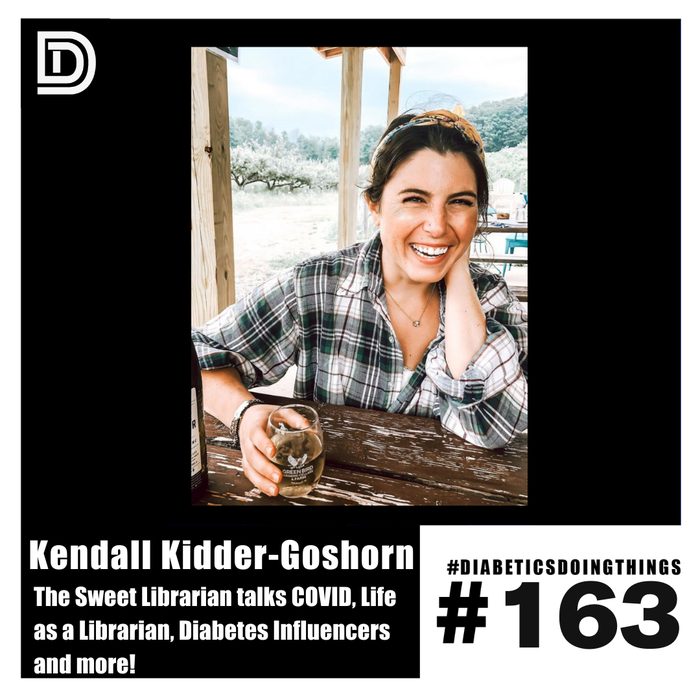
Kendall Kidder-Goshorn the Sweet Librarian
Episode summary
Kendall Kidder-Goshorn, known on Instagram as the sweet librarian, is a public librarian for Chicago Public Library and has lived with type 1 diabetes since age three. She describes working as an essential worker through the pandemic, including the social-service gaps her branch ended up covering. She also walks through testing positive for COVID-19 in October 2020, the exhaustion and brain fog that followed, blacking out once in the shower, and a case of mono the illness triggered afterward. She explains how her insulin needs dropped sharply during recovery. The conversation also covers her Diabetes In Real Time Instagram series, setting boundaries against unsolicited advice, turning down brand deals for products she doesn't use, and pushing diabetes companies toward more diverse representation. They close on insulin access and her favorite gluten-free bakeries in Chicago.
Key takeaways
- Kendall says she tested positive for COVID-19 in October 2020, blacked out once in the shower from exhaustion, and started FaceTiming friends during showers afterward so someone could check on her.
- She says the COVID illness later triggered a case of mono, and together the two kept her sick for months, with her first fully 'normal' week not arriving until February 2021.
- Kendall says her insulin needs dropped so much during recovery that her long-acting dose fell by five units and her A1C dropped from 6.4 to 5.9, a shift she and her doctor treated as a dangerous imbalance, not an improvement.
- She started DIRT (Diabetes In Real Time), a day-long Instagram series posting every diabetes-related moment, after talking it through with fellow creator Marie.
- Kendall says she now turns down brand deals for products she doesn't actually use and asks companies to commit to more diverse representation before she'll work with them.
Show notes
Kendall Kidder-Goshorn (@thesweetlibrarian on instagram) joins the pod for the first time!
This is a big moment for the podcast, because Rob first asked (and Ken agreed) to do the podcast in 2016, but it has never happened until now.
Ken and Rob discuss, among other things:
Kendall’s experience with COVID-19 and mono, along with managing her Diabetes
What DIRTs (Diabetes In Real Time) are and where they came from
The responsibilities of a public librarian
Insider discussion on Diabetes influencers
Kendall’s favorite gluten-free treats in the Chicago area!!!
This is a really fun, entertaining and informative interview, so I hope you enjoy! it was nearly 5 years in the making!!!!
Questions this episode answers
Who is Kendall Kidder-Goshorn, the sweet librarian?
She's a public librarian at Chicago Public Library, known on Instagram as the sweet librarian, who has lived with type 1 diabetes since she was three.
What is DIRT, or Diabetes In Real Time?
It's an Instagram story series Kendall started around 2018 where she posts every diabetes-related moment over a 24-hour span, to show how often diabetes comes up in an ordinary day.
What happened when Kendall got COVID-19?
She says she tested positive in October 2020, dealt with severe exhaustion and brain fog, blacked out once in the shower, and later developed a case of mono that the COVID illness triggered.
How does Kendall handle unsolicited diabetes advice online?
She says she stopped engaging with unsolicited advice, now posts diabetes content less often than she used to, and only responds when someone directly asks for help.
Full transcript Searchable, with timestamps
Rob Howe: Welcome back to another episode of Diabetics Doing Things. I'm your host, Rob Howe, and I am trying to brand myself as the host with the most insulin on board because I think that's just a weird, funny way to introduce myself. And I wanted to do that on camera to get the reaction from my very special guest, my friend and co-diabetes community member who I've tried to get on the podcast for almost five years. I asked her for the first time in 2016. So here we are finally at the starting line of the pod, the finish line of a saga. Kendall Kidder-Goshorn, the sweet librarian. Welcome to the show.
Kendall Kidder-Goshorn: Oh, thank you. Thank you. Long time coming. I know.
Rob Howe: I feel like you did a fair job of vetting out if I was a sus person or not to make sure that it was okay to come on the pod.
Kendall Kidder-Goshorn: Yeah, half a decade. Sounds pretty normal.
Rob Howe: Right. It seems like now you're comfortable, just now comfortable enough with me to get on the podcast, which is good. I'm glad I didn't stop doing the pod between the time I asked you and the time, because that would just be a tragic story. Yeah. Awful. I do want to, I do want to read. I have an email pulled up because I'm just that person. I found, I sent out my outreach email when I was, when I was in summer of 2017, really like grinding, trying to get people out. And your response was so sorry for the delay. This is 10 days after I sent the email. So, so sorry for the delay. It's been a weird last couple of weeks. And then you kind of go on and then you say, I could do Saturdays, but I'm usually at work and I'm exhausted at the end of the day. So the interview would be my angsty diabetes side, which I try quote to keep at a minimum as to not scare newly diagnosed people. So that's, that was your, do you, do you want to talk at all about what was going on in your life at that
Kendall Kidder-Goshorn: point? Yeah. Well, so first of all, it's like fascinating, right? Because I said that I was like 26 years old and now I'm 30 and I say the exact same thing. So I guess, you know, I'm not having a lot of personal growth happen, which is fantastic. But yeah, it's actually, at that time, my boyfriend had been in the hospital because he was like having heart issues. And then in between that is when you messaged me and I was like, yeah, I'll get back to this whenever I get back to you. You and I plan a legitimate time to like sit down and do the podcast. And then that boyfriend I found out had been cheating on me. And then like four days prior, I was in a Cosmopolitan article. We had a full page spread about our successful long distance relationship and it had just come out and yeah I was getting bombarded with people being like oh my gosh you guys are in Cosmo and first of all I don't even know people actually read Cosmo I agreed to do it because I didn't think anyone actually read Cosmo anymore but lo and behold lots of people do right hundreds oh my gosh it was insane the issue came out and I was like he was off with his new lady friend I was crying on my couch eating sushi and it's like all of a of a sudden my phone is just getting bombarded with people. And then you were like, Hey, yeah. So how's Sunday for the podcast? And I was like, well, fuck men. I'm not going to do this podcast. Like screw you. And then, yeah, I very professionally ignored you. And then I think reached out like a year and a half later and was like, Hey, um, had a lot going on. My bad. Sorry
Rob Howe: about it. Right. And then we set another day to record, which then also got pushed. So this is a saga. It's been a long time in the making. We met in person in Chicago at a Xeris pharmaceutical event in 2018. And I remember being like, hey, it's me. Want to do a pod? Very fun.
Kendall Kidder-Goshorn: Well, we're here now.
Rob Howe: We are. We made it. And I'm excited. And so thank you for doing this. So you're the sweet librarian on Instagram. You are a librarian in real life.
Kendall Kidder-Goshorn: Yes, this is true.
Rob Howe: And I think an interesting thing that I've been following and talking with you about this year is librarians are essential workers and librarians are really important places. And I think I have learned more just from osmosis of being around you about what libraries bring to people. So what are libraries like during COVID?
Kendall Kidder-Goshorn: Yeah, that's a great question. So I am a public librarian. So I currently work for Chicago Public Library. And the duration of my career has been spent in public libraries. And I have spent all my time working and managing in branches that serve predominantly underserved populations. And so a lot of these populations, they come to the library. So public libraries are usually cooling centers. So we're a cooling place when it's really hot outside, or then we're heating centers when it's cold. So whenever you see like that Chicago is getting like we're in the middle of a blizzard, you can rest assured that the library is still open because I'm there. And the same thing in the summer, you know, people are coming in. And so a lot of people come to the library because they don't have access to computers. And of course, nowadays, you need to do almost everything on the computer. So people come in because they're filling out housing applications, trying to get information about, you know, taxes, especially recently with the stimulus checks. Like so many people are trying to come in because they don't have, you know, bank accounts that have been linked to a stimulus check. So they're coming in and we're helping them figure out, you know, how can they get in touch with like the IRS to figure out where their money is. And so especially during COVID, I think it's especially within larger cities like Chicago, it's drawn a lot of attention to the lack of social services that we have within our communities. And so a lot of the brunt work of social work has been placed on the shoulders of librarians and the libraries of physical space, which isn't the best because I'm not trained as a social worker. So my professional training isn't in providing those services. So I'm and, you know, almost legally, I can't because I don't have that training and I shouldn't be doing it right because I could lead someone astray. um not intentionally but so that's been you know it's been kind of hard because obviously I have diabetes and we were back working with the public I think we were the first made we were the first major library system to do that so we were back serving the public in June and we've been open ever since and I know it's because we need to have the building open to be able to have like a safe space for families, for kids, just to be seven days a week.
Rob Howe: Well, and, you know, I think it brings so many things because of COVID-19 have come to light in terms of inequity and lack of resources, especially across different socioeconomic classes. So here in Dallas, a couple of years ago, I remember reading an article. We at the time were officing near the Dallas Public Library downtown, which is also a polling place and it's like a very large like community um center which i imagine there are branches of the chicago library that are very similar um and at the time it's also in a very like central location to a lot of homeless shelters uh that are in the area that protect unhoused people but during the day they have to leave the shelter so they can clean and kind of refill uh you know all the resources and etc and there was no place for them to go and the library became that place and they put programs together to help people apply for jobs, to give them computers, much like you've been talking about, PO boxes, like places for them to collect mail and use addresses and things. And it was championed in Dallas, at least, as a real big step forward into addressing a huge issue in the city, which is people who are unhoused, they don't have a place to go. And as they're trying to continue to move their life forward and find a way to improve their life and just live and be a person, the library became the place that they went. Yeah. And I think that's
Kendall Kidder-Goshorn: what's, you know, been very emotionally draining working in a public library currently is that I went into librarianship because I like to help people. And I like that what I'm doing, I'm not really like, that's just my job, right? I help people. And I like doing that. I like being able to come home from work knowing that like, okay, I helped someone send off this document that was really important. I helped someone do this. And it's been really hard with COVID because as a librarian, your natural inclination is to sit with someone at the computer for like 30, 45 minutes to help them get through this application. And we can't because of all the protocols in place. And it's also a safety issue. And so that's been really hard for me to kind of fight, right? Because I have diabetes and we are higher risk. And I did, I got COVID and I I got COVID from work and I found out that I didn't have antibodies from it. And so it's been even tough like now because it's like, if I get it again, it's going to be awful.
Rob Howe: Well, let's talk about that because I do want to dig deep into your COVID saga because I think it's super, A, super important to talk about. I've had a guest on the podcast early on in COVID who was basically asymptomatic and was able to get through and heal from COVID very quickly. and, you know, having a little bit more knowledge about your story. I think it's important to hear that, but I want to go back to, you know, feeling, you know, being, you know, helping people and that being your core ethos behind what you do, then also the layer of diabetes on top of that. And I think for many people, myself included, who feel able-bodied in a lot of ways, there still is that layer of, well, clearly diabetes is a comorbidity and there's a lot of unknowns about how people with diabetes, even diabetes that's in control will respond. And that's sort of always sort of
Kendall Kidder-Goshorn: lingering and hanging over everything. Yeah. Yeah, absolutely. And I, right. And I think just professionally it's tough, right? Because we look okay. Obviously diabetes is an invisible disease, but it's really kind of hard to advocate for yourself at work when every, when you present as an able-bodied person and I'm not, and you're not, we're just not. And, but I think part of having diabetes is that you, I, you know, you work so hard to present yourself as you're okay. You're fine. People can't tell when you're high. They can't tell when you're low, even though it's really when you're good, like be dying at work, right? Like literally dying. And I think that has been really tough and it's been hard for me because you feel like you are stepping on toes. But I found myself like so many times within the past, I don't know, whatever, six, seven months, like having to call like HR just to make sure that I'm getting what I deserve because what people expect me to do is not fair in light of what I'm dealing with on the inside. And it's just, it's been really draining, I guess. Yeah. Because it's like, you don't, And that's hard to explain right to patrons as well, because patrons will get upset if I'm saying like, I'm so sorry, I can only work with you for 10 minutes and I'm going to stick to this because I have XYZ going on. But patrons don't know that. And they might interpret that differently. And that makes you feel awful, right? Because then I feel like an awful person because I can't help them for more than 10 minutes. I can't, you know, kind of be sitting on top of them, walking them through what they need to do. and but my co-workers will like they'll fight that rule because they feel more comfortable doing it but I don't and that's been a really kind of big emotional struggle for me during this whole thing
Rob Howe: yeah I I agree I mean I lead a company of able-bodied people for the most part but at the same time I'm not privy to the chronic things that are going on in their lives and yeah you know I I think it was clear to me early on, just from a culture standpoint, to be like, hey, I have to set this example and say, we're going to be remote. And I think talking over with Erica and with my business partner as well, it's amazing how little decisions throughout your life can influence how you view things. And if I was working for someone who wasn't my employer, who was an anti-masker, which could have happened, would my perspective be affected by that? right you know and um i think those we it's easy to see how those things trickle down um you know it's quick to see how you can change your perspective based on that but um thank you for sharing that because i think it's really important to know people who really care and put their heart into their work that this is also a burden that is is not health related it's not work related but it's something that you bring into every interaction with every patron in the library you know for the last 11 months yeah so let's go back because I know you guys went back to work fairly quickly, like you said. And I remember you
Kendall Kidder-Goshorn: talking about that and sharing that. And then you also contracted COVID. I did. I did. So I went back to work and I was, so I'm in Chicago and Illinois has done a really great job of providing COVID testing sites. And so I just took it upon myself to get tested every like 10, 14 days. So I was getting tested regularly since I went back to work. And in the middle of October, I felt fine. I just scheduled the test because I, it was my, you know, time for me to schedule my test. And it was on a Monday that previous Sunday. So the night before I'd actually found out that I had a UTI. So I'd been prescribed like emergency antibiotics. And that Monday morning I went, did the test, like at a drive-thru at Walgreens. And I happened to call my PCP and schedule an appointment because I was like, I have a UTI, but I really don't feel well. And I'm worried that maybe it moved my kidneys. You know, I was kind of starting to panic, not even thinking that it was COVID related. And then I was at work and I got the test result and it was like, you've got COVID. And I burst into tears because I am a very anxious ridden person. So I burst into tears. And luckily I was actually upstairs because I felt so sick. And I was like, the building was really hot. Our heat was on. AC wasn't working. So I was sticking my head out the window because it was, and then I was like, oh, maybe this is indicative that I have COVID and it's not like a UTI related thing. And I left for the day. Everyone at work. So this, I worked for the city and they've been really good. So everyone was given two weeks off. They did like a thorough cleaning of the branch and then we had to reopen because we were a drop-off ballot location for the election in a community that needs a drop off ballot location. So they are keeping us open no matter what. And then the next day I went to the, I called my doctor and just, cause I'd just been like, I don't know. I don't know what to do. Right. Like, I felt like that was the interesting about COVID was like, is this all you're hearing was like, you'll get COVID. And then you were hearing all these terrible stories, but you weren't actually hearing about how to treat it. And I didn't, I knew I didn't want to post about it on the internet because I did not want to be overwhelmed with people coming at me with information or questions. And so I did reach out to a friend that I know through the DOC, who is a nurse with type 1, who had COVID back in March. And so I called her and she gave me some pointers, which was really helpful. And then I reached out to my doctor just to be like, Hey, I'd actually scheduled an appointment to discuss UTI, but I just found out that I've COVID. I don't know what to do. And he was like, well, I want you to come in immediately because I want to make sure the UTI is taken care of. And I kind of was a little bit resistant. I was like, that's so stupid. I don't need to go in. And my parents really encouraged me to go. And I'm glad I did because I went and it turns out that I had like the highest level of ketones you can have before you go into like DKA. And he was like, I don't think this is related to the COVID, it's related to the UTI. And obviously the day before I'd been so stressed out that, you know, I hadn't been eating. So I hadn't been getting my, like my regular insulin intake. So it all made sense, but it was great because I was able to stay in there. I got like, I was in about six hours up to an IV getting like IV fluids, IV antibiotics, um, and Zofran, which is good because I was really nauseous. Um, yeah. And then I just had an awful, awful, terrible experience. I was sick for a full like three weeks. I ended up having to take about six weeks off from work. And then the COVID triggered mono that I had when I was 20 years old. It triggered mono. So I actually just got over with the mono about a week ago. So this is honestly like the first week that I felt like it's the first week of February. And this is the first week that I've actually felt like myself since October 19, which is crazy nuts. So.
Rob Howe: It is. And I think, I mean, I use you as an example when I talk to people about my COVID concerns because it affects everyone so differently and just hearing some of your symptoms. And I'd love for you to share some of those. Uh, just, I remember you, something stood out to me in particular, you taking your phone into the shower, like FaceTiming people because you were losing energy. It required so much energy and effort for you to shower that you were afraid you might pass
Kendall Kidder-Goshorn: out. Right. Yeah. So when I, I had COVID and I never had, um, I ordered immediately like an X oximeter to test my oxygen levels. And then I had a thermometer obviously. And I tested that every day because kind of the rule of thumb was like, if your numbers, if your temperature, your oxygen levels hit these two numbers, you should probably go to the emergency room. And I, my oxygen levels were fine. I never had a temperature. I never had my feet. I never had a fever for me it was just like this complete incredible exhaustion and brain fog so I would like spend all day kind of just like on the couch either sleeping or watching movies and then the next day like one of my friend had told me you know like every single day because you live alone I want you to FaceTime someone so they can just see you so that they can make sure that you look okay because you might not be of sound mind to like be making decisions on your own right past the eye test so to speak exactly yeah and so like I would call my friends maybe like I mean like one day my sister was like well you had such a good day yesterday you watched like five movies and I was like no I didn't she's like Kendi yeah you did and I was like no I no I didn't watch anything yesterday she was like yeah you did Ken like you watched Enola Holmes you watched 10 things I hate about you and I was like I don't know what you're like and I had no recollection and it was just like I was so drained and I think I had did have so much anxiety that I was going to go into DKA like I was almost less worried about having COVID and more worried about what was going on with my blood sugar. And so any moment that I was awake and was fully there, I was spending that time hyper-focused on my diabetes. So like any energy I had, I was spending maybe that like five, 10 minutes eating carbohydrates. So I was making sure I was still maintaining like my regular insulin levels. And I was lucky. I didn't have any sort of resistance. I had a bit of resistance initially. And I, that was due to the UTI. I had no resistance the entire time that I had COVID. So I wasn't worrying about that, but I wasn't hungry. I had awful nausea. So I was taking Zofran way more than anyone should take Zofran, which is like an anti-nausea medicine. But I, like, I had to do it. I just felt like any waking moment, it was like, I have to spend this time eating food. And then, yeah, you're right. I showered and I blacked out in the shower and then came to and was like this this isn't okay like this is unsafe and I started just like facetiming my friends and being like I need I need a shower like can you I need to contact you and so I would like facetime them and then there was also a period where it was like four days where I didn't shower because I just freaked out I mean blacking out in the shower is scary like and I just was like this is really this is really scary and then you know I couldn't read my parents had bought me the illustrated Harry Potters as like, you've got COVID, here's something to do gift. And I couldn't read any of them. I just couldn't focus the words were blurring together. And about three weeks after, you know, I was diagnosed with COVID, I had a negative test result. And so my parents actually drove down to Chicago and picked me up and brought me back to their house. And which was great, because it was kind of just a relief, like, I don't have to take care of myself. Like someone can help me. I still was struggling. Like I, I would go on a walk and I would fall asleep in the car and like, I couldn't, I lost my sense of smell, you know, like that was really disconcerting. Um, but then even just like, I'd be sitting, you know, on the couch, like scrolling through, you know, Reddit or Twitter and like seeing things and like reading it a lot to my mom, like, Oh my gosh, mom, look at this. And I couldn't read words.
Rob Howe: You know? And that one to me is what stood out as like, obviously the shower blackout and like the lack of energy, but you are like a voracious reader and probably one of the three or four, five people in my life that I would say like, these are probably the most well-read people that I know. And you're obviously a librarian. So reading is fundamental. That taken away,
Kendall Kidder-Goshorn: what did that feel like? It was awful. I mean, it was just so depressing. It was just hard not to be depressed because it was like, you're right. I read all the time. and like I read as like a coping mechanism just as a way to relax and then so it's like to have that taken away was really stressful because it's like okay I can't even sit here and just like relax and read because I literally can't read and it's not like I can't read a really thorough text I can't read Harry Potter which I've read like 30 40 50 times since I was nine years old right like I basically have this memorized and I couldn't follow what was going on and I couldn't we piece words together. And then that in and of itself created anxiety of like, well, how long is this going to last for? And if it does, like, what am I supposed to do when I go back to work? Because I can't really help people if I can't read. And so that.
Rob Howe: So just compounding anxiety, like you're worried about euglycemic DKA because your blood sugar is fine, but you maybe haven't taken the amount of insulin that you need. You've got COVID, You're worried about blacking out in the shower. You're worried about, can you do your job if you get back? And just like the sort of impending doom of holding all of that in your brain.
Kendall Kidder-Goshorn: Yeah, it was terrible. And then to get mono afterwards, I was just like, cut me some slack. And then I also, when I had mono, my body was still responding to COVID and my insulin needs completely decreased. So I had this incredible increased insulin sensitivity and I dropped like my long acting insulin by about five units. And my A1C went from a 6.4 to a 5.9 with no work on my own. That's just how many lows I was dealing with. And I spoke to my doctor about it and she explained it in doctor's terms, but she said it was, she was like, this isn't a normal response. It's awful. And it's going to be terrible for you, but it's going to, it'll eventually subside and you'll probably, you'll go back to normal soon, hopefully soon. But she was like, unfortunately, I can't give you a timeline for when that will happen. And we're just going to make note of it because this is something that we're documenting as, you know, diabetics experience COVID. And, you know, it was nice about two weeks after my diagnosis, I did post about it on Instagram just to be like, Hey, I, you know, consider myself a relatively like good person when it came to following like social distancing and wearing a mask and all that stuff. And I have COVID and this is what happened. And this is how I'm dealing with it because I hadn't seen a lot of diabetics talking about it. And I, and I knew there was a lot of fear and a lot of people did reach out kind of in the weeks after that, because I would say like, Hey, I'm dealing with some really awful, these terrible low blood sugars. I don't know what to do. And it's kind of scary seeing your insulin needs just decreased levels that I've, you know, had never used. And that's, that's stressful as well, because you're like in your head, you're like, well, I don't, I need more insulin than this. Like, this is going to make me sick. And then all of a sudden it's like, no, this is still too much insulin. And that was really, that was really scary. But so many people reached out and said, yeah, I'm dealing with the exact same thing where my child is dealing with the same thing. And so that was reassuring, you know, to know that I wasn't the only one, because for a while there, I was like, something really bad is going on. And I'm the only one experiencing this. And this is just awful. And I can't talk to anyone about it. And then, you know, not many, but enough people did reach out and say like, no, I'm dealing with that too. And that was, you know, a huge relief to hear.
Rob Howe: well hey i'm glad you're feeling better uh i remember and for those listening like uh i'm very lucky erica and i have a group chat with sarah diabetic cactus and and kendall because we're nerds and we play video games um but i i just remember having those conversations with you over that period of time and like running out of things to say and and i remember i remember you being like, yeah, like I have mono now. And I was just like, God, like, I don't know how, like what to say here as a friend of like, man, keep, keep at it. Like, keep trying, you know, like, I'm so sorry to hear that. And I just, you know, feeling very, I just can't imagine like how isolating that was during that period of time. So that's so funny. Cause I actually, when I told
Kendall Kidder-Goshorn: Sarah, you know, diabetic cactus, I was like, Hey Sarah, like I've got, I have something I need to tell you. And I just, I need you to not react. And she said, okay. And I said, I have COVID. And she goes, cool. So did you see the most recent animal crossing update? And I was like, so grateful because I'd been calling people like in tears, like panicking. Cause I was like, so panicked. I got my coworkers sick. Like I was like convinced that the people in my life were just going to start dying because I'd inadvertently given them COVID. And it turns out none of my co-workers had COVID you know my sister who's the only person I see and her husband they were completely fine um but everyone I was talking to was like well what how what are you gonna do what's gonna happen next and I was like I don't I don't know and so it was just so nice for Sarah to be like yeah okay anyway so video games and it was fantastic because like that whole two weeks she'd check in like once a day and be like hey do you want to play Mario Kart or like hey and you did too like I we spent so much time just playing video games and it was so nice because we weren't talking about it, which was great because it was like, you know, I talked to my parents who'd be like, okay, we need to run down everything that's going on, which is obvious, right? Because they care about me and they love me. And like a lot of my diabetic friends, same thing. And they need that information too, I think just to call their own anxiety, but it was so nice for you guys to be like, Hey, do you want to play Luigi's mansion for an hour and just like hang out and not do anything. And so that was a relief. Well, I think too,
Rob Howe: and this is a great transition into sort of diabetes community and peer support, because at some point with both diabetes and your situation with COVID and mono, like we can't do anything. Like there's no impact that we can have. There's nothing really to solve. And I think that has been, you know, for me, cause I'm a fixer. That's my nature is to, there's a problem pops up and whether it's my business or not, my brain goes into overdrive to try to fix it. And so to be in a situation where they're like totally powerless is a new, I don't know, mentality for me this year is like, I'm so out of, this is out of my control. I can't control it. And to say, okay, well, let's just, it's not like we pretended that it didn't exist or didn't happen, but we're going to have to focus on other stuff and we're just going to be a community. And I think that's, you know, so crucial in healing of any kind, especially, you know, with things, obviously like there's the physical wellbeing, but the mental, emotional, psychosocial part of it, it's important to have community members and friends.
Kendall Kidder-Goshorn: Yeah, absolutely. Absolutely. I think it's also interesting too, in regards to diabetes, because I feel like there are people that really thrive so much on talking about it. And then there are people that don't. And shockingly, even though I have an account called the sweet librarian, I would consider myself someone who thrives on not being right talking about diabetes. And that's what I think actually is really interesting about the, you know, diabetes community. And I'm so glad I found it because I found people that are of kind of that similar mindset, which has been helpful for me. And, but there also isn't. And so people are able to fulfill that need as well, like just through like interacting online, which I think is
Rob Howe: really fantastic. Yeah. I mean, it's been, obviously it's the reason that you and I know each other. Um, and I don't know. I mean, it's such a, it's a weird, it's weird to think about like life before diabetes online community as part of my life, since it's such a big part of my life now. But like you said, just conversations with people about insulin needs and understanding that there's people going through the same thing that you're going through. I'd love to transition now into your account, your public persona, the sweet librarian, diabetes in real time, which is such a cool thing. And I think just shows, especially for people who don't have diabetes and are following you for, you know, the host of other reasons and like that are just your friends. I think for me, it just shows how often diabetes pops up in an everyday life and just interrupts your workflow or work day or fun or exercise or sleep. And I think just creating awareness about that and like the true, I don't know, burden of a chronic illness is such an important thing to share. So where did that come from? Where did dirt diabetes in real time? What was the, what was the impetus? Like the defining moment, where did it come from?
Kendall Kidder-Goshorn: So my parents, I was diagnosed when I was three and my parents every year, we wouldn't really necessarily celebrate my diabetes birthday, but I would get like a little pat on the back. Right. And so then as I got older, just based on my personality, I would like throw myself parties when it was my diabetes birthday. And so like, this was just a thing. Like my friends from high school all knew, like, it was just like, Oh, it's April. Kendall's diabetes is turning whatever age. and so like when my diabetes turned 23 I like superimposed my face on Michael Jordan's pec body because it was my 23rd year yeah like you do naturally of course and I personally thought that was hilarious and then I also put myself on like the hot chick from the Blink-182 um album because like no one likes you when you're 23 and like no one likes diabetes correct I thought these were just like seller comedic aspects of myself um back then but then when my diabetes was turning 24, I was actually talking to Marie, Nerds Can Fight, because she was like, so what are you doing? And I was like, honestly, I was thinking about doing like 24 hours in the life of a diabetic. And she was like, that's a great idea. And I was like, actually, it is a great idea. So I, then I was like, yeah, actually, I'm going to do this. So I, the first one, I must have been 2017 or 2018, 2018. And my diabetes was turning 24. So I was like, I'm going to do a diabetes in real time and just talk about everything I'm doing diabetes related over the span of 24 hours, which people were doing in the sense that they'd be like, oh, this was my morning blood sugar and I'm doing this, but no one had done like a full day. So I was like, I'm going to do it. I'm just going to post my story every time I do something diabetes related or even think about diabetes. And I remember seeing this to my friend, Laura, who, you know, does, you're just my type. Laura, friend of the pod. Yeah. And Laura was like, are you sure I can? Because that sounds like really overwhelming. Like, are you sure you can do it? And I was like, oh my gosh, Laura, you're being so dramatic. It's going to be fine. And then I did it. And by the end of the day, I was like, I hate diabetes. I hate my Dexcom. I hate, I, it had never occurred to me how many times I was thinking about it because I realized as I was going through my day that I couldn't post about every time I thought about diabetes because I was thinking about it so frequently that it just would have been like every three or four or five minutes. And that was a really interesting conclusion to come to. It was also very interesting because I received a lot of positive feedback, but a lot of negative feedback in the sense that people didn't like the way that I was managing my diabetes and kind of
Rob Howe: like, yeah. Well, I raised my hand. So you, so that's why you paused, because I think this is an important thing because I, I only, I get very little of this. I get very little a, maybe it's because I don't share like, Hey, I'm not sharing how many carbs I'm counting for this. And people don't feel the need to comment on it. But I think this is something you and I've talked about before being a woman public figure in anywhere, but in health, healthcare, diabetes, there's a lot there's more women than there are men first of all because i think women are better about sharing what's going on in their lives and blogging i think comes a little bit more naturally to them and they're better storytellers in that capacity um but also there's a lot of people who feel the need to tell you what to do or like comment on what's going on right so let's talk about because i think this this is plays perfectly into that you know unsolicited feedback
Kendall Kidder-Goshorn: well do we have more than an hour because i could talk about this for 24 um maybe we are maybe we
Rob Howe: have maybe we got an episode two lined up now i can get you back on the pod in four years
Kendall Kidder-Goshorn: yeah the unsolicited advice is overwhelming and not just when i do dirts i have been talking about it honestly a lot more frequently i have a few friends who have diabetes who maybe don't interact with the DOC as much, but they've talked a lot about how to set boundaries on the internet, which I thought was really interesting because I think initially when I first started my account, it wasn't to be a diabetes person. It was, I was called the sweet librarian because I want to talk about books, but I realized, you know, more people engaged with the diabetes content and it was fun to make friends who had diabetes. And with that came a lot of people giving unsolicited advice, but I felt as though I had to take it because, you know, we're all diabetic and we're all in this together. But I realized that a lot of the unsolicited advice, especially in like 2018, 2019 was having such a negative effect on my mental health, where it was like affecting me outside of social media. And just, you know, I think one, I think some unsolicited advice is coming from people who are trying to help you, right? Some of it is coming from people who are trying to help you and maybe they don't follow me regularly. Like maybe they mute my stories or maybe they only see one post every now and then because I'm not coming up when they log on. So when I say something, their gut reaction isn't, oh, this is Kendall. She's pretty on top of everything. She knows what she's talking about. It's just, oh, this is Kendall. She doesn't know her in a way that maybe isn't the most polite way. And it's like a double-edged sword because we
Rob Howe: rely on the community for those types of things like learning through osmosis, normalizing certain situations. So it's kind of a, it's a weird place to be sometimes.
Kendall Kidder-Goshorn: Yeah, it is a weird place to be. And so what I, but I think the more that I found was that people were getting really upset with me because I wasn't doing what they wanted me to do, which is something that I really struggle with because how I manage my diabetes and has nothing to do with another person. And I've made a huge effort the entire time that I've had this account to not tell people how to do things. Like everything I do works for me. That doesn't mean it's going to work for you. You know, these are low snacks that I want. These, this is the way that I manage my blood sugar when I'm working out. This is not what you should do. This is just what works for Kendall. And I have started, you know, one in my stories talking about diabetes oriented things so much less. Like now I just prioritize what's going on in my life or books I'm reading, like stuff that actually makes me, me aside from the diabetes. Because if I post one thing about diabetes, I'm getting a couple of comments that are like, yeah, hang in there girl, you're fine. And then triple that is like, well, you messed up and you need me doing this because you're not, you know, working hard enough, or you haven't tried this. And it's like, well, I have, but just because I talk about my health on the internet doesn't mean you're privy to every aspect of my health. And I don't owe you that. And I don't need to tell you that. And I think that is a really hard boundary to set because it's like, you'll say something health related, and then people come and they ask you such private questions. And I want to think that they don't mean it in a cruel way, or because they're nosy, I want to think that they just assume they can say that because I, you know, I do talk about my health, but sometimes I'm just flabbergasted at the comments that people leave me and the questions that they ask that I just, I would never ask someone. And I, I try to do that too. Right. Like, cause I know, like, I'll see people post about something and I'll be like, oh my gosh, they should really try this. And I realized like, I'm just doing to them what I hate when people do to me. Especially like in the past year, like I've been really trying to reel myself in and be like, no, no, no, no, no. Keep those little fingers away from the keyboard and just, you know, swipe through the story. And if they say I need help, like if they have a text box or they're saying like, Hey, I will someone offer me advice then absolutely. But I've kind of taken the initiative of like, if they're just venting, I'm just gonna let them vent. And if they're not requesting help, then I am just going to shut my mouth and go about my day. And that's what I've really kind of tried to do in my stories as well. Like, I'll just be like, I'm not asking for help. So please don't send me comments. And I know it can come across as being rude, but it's just like, I, ever since I started doing that, I realized that I've been able to interact with social media in a way that's much more healthy because before it was like, I would get on there and read people's comments and I would just get so depressed because I'd be like, these people are so mean. And I, I don't know how to respond. And this is just taking up so much mental energy and it's not worth it in the end. Well, I think it brings up a healthy conversation
Rob Howe: about boundaries in general, because for me personally, emails are, I associate them with needing a response and being important because in my day-to-day work life, people that email me have specific asks, they have specific needs and they're often timely. So I need to get back to them. On the diabetes side, my emails are less timely, less important. And I control, like this is my podcast. It's my platform. You know, your sweet librarian is your platform, your space. And while, you know, I think that I struggle with frankly is being rude to people because I have huge anxiety about people's opinion of me. And I literally told my first therapist years ago, I actively try to make every single interaction that I have with a person the best interaction that they've had that day. And that's just who I am. And I was holding so much of my personal value in that happening, whether it was somebody that I held a door open for that I'll never see again, or somebody that's really important to me. And I've had to work through those boundaries over the last six or seven years because it's not sustainable. And I think coming back to the boundaries thing is it can seem rude and I have a hard time turning things down. I have a hard time saying no because I have been in that position, like we talked about earlier, where I'm reaching out to you to try to have you on the podcast. And it's hard to not get your feelings hurt by those types of things. And I think it, you know, it is, it really is a boundaries issue. It's a time issue. I think getting older to like, you know, we're in our thirties now, so, you know, we're not maybe as available or maybe don't have as much energy or have more responsibilities. And I think it's hard sometimes for me to, man, I really wish I could spend an hour talking to this person about their diabetes journey or wherever, you know, they're inspired by this podcast or they have this idea or they need to be heard. And I just don't always have time. I mean, that does feel bad. And I'm sure that there are people that are like, yeah, I emailed Rob Howe or I messaged him and he like gave me a one word answer and blew me off. And now I hate him, but you know, it's not personal. It's just hard. 100%. There are people that say about me
Kendall Kidder-Goshorn: too. And that's why I also struggle. I think, especially with Instagram where so much is just text and my personality. I'm on like a spectrum. I'm either sending you like a million exclamation points at once because I'm so excited or I'm completely dry because I have a really dry sense of humor, which makes sense when I'm like a human in front of you, but it doesn't translate well to communicating with me if you don't know my personality. And so much nuance lost in a text message. So much nuance. And I think I really struggle with that because I'll send responses to people and I'm like, yeah, that was fine. And then I look back on it like an hour later, I'm like, oh my gosh, I need to resend them like a smiley face or some sort of emoji because the way I text might come off not friendly and that's not what I'm trying to do and then I get into like this circle of like okay well now this person is going to think that I'm a horrible person and I'm not a horrible person I'm trying to help them and then this happens and then it happens like 10 times over because there's so many dms and I'm trying to get to them all so now just try to tack on emojis all the time um just just for levity right just to make it seem a little bit more like less serious. And then I'm like, smiley face because I'm like, I, at least it just, they know, okay, she put a period at the end of the sentence. That doesn't mean she's mad at me. Like, it's just like, no, it was just the end of a sentence.
Rob Howe: Yeah. I love, I love that. I think, and it's so hard, like context is everything. And I think there's so much lost in just a text message. And yeah, we send a lot of them and now we sound old because we're talking about technology and phones and those types of things. But I think there's, you know, take a breath. Sometimes when I get like, because I have like notable trigger responses with emails and they're usually because I'm late on something and there's a deadline that I missed and I just have to like deep breath, put my phone down, like push away. I haven't had notifications for social media on my phone in like four years. I deleted the Twitter app off my phone. So now I log in through the browser. Huge life hack, just lifesaver. That's great. And that's not with
Kendall Kidder-Goshorn: Twitter with Instagram is something that Sarah recommended I do too. Cause I was just kind of saying like, I find, you know, I really like Instagram and I find the whole thing overwhelming. And I just spent a lot of time wanting to delete my account. And she was like, well, why don't you just set times throughout the day? She was like, it sounds ridiculous, but just check it, you know, mid morning and check it, you know, while you're eating dinner and then that's it. And don't go on it again. And I healthy boundaries. That's so great. And I was like, that's actually fantastic. And that's something that I, you know, I, it took me a while to implement it, but I have found that to be a little bit helpful is that I'll just spend like two sections of the day, like responding to people's DMs. Cause I do want to, you know, aside from all the unsolicited advice, there are people in there who are asking genuine questions and who are just reaching out because they saw me post about something or, you know, they're reading a book and they want me to see it. And like, I love that. I love interacting with people. And so I do want to respond to those, but I definitely have found a lot of benefit in setting aside time to do that and like responding to comments on posts as opposed to kind of like doing little bits of that throughout the day, which was just way too overwhelming.
Rob Howe: It's something that I just read this book and one of my friends, Nick Cornell, who basically kicked me into gear this year. He like, we have a small group of people and he was like, I want us to read a book a month. And I had so many reasons to say no to it. And I didn't want to. What I'm describing is a book club, but it's dudes. So it's like personal development, but it's a book club. He actually did call it that. He's like a book club of sorts. And I didn't want to do it. And I didn't feel like, you know, even the books that we recommended, I was like more, you know, more performance and more, you know, self-improvement. And I am a huge self-improvement book nut. I love them. I've read so many of them, but I read it. And a lot of it was about setting intentional time and about the book was called deep work and exactly what you're talking about. I'm considering now like setting my, every single thing I need to do during the day and writing it down and checking it off just so that it's purposeful and intentional and there's less floating time and there's less anxiety around what to do. And so, yeah, I think it's really cool. And shout out Sarah for being ahead of the curve and not needing a book club to do those things. This brings up a good conversation and I want to, I don't want to spend too much time on it because I know we're, we're short on time and I got to get to your favorite gluten-free foods because I know you live with celiac and I love seeing some of your bakery recommendations and things, but, um, diabetes influencers in 2020, 2021. First of all, I think like neither, obviously when you start a diabetes public facing account, you have big dreams and you want to be popular and you want people to like you and you want to get the brand deals and all that stuff. Right. I don't know. I think so. Like you start out with the best intentions. Like you want to, I don't know. I can only speak for myself, but I saw that I was like, oh, there's no dudes like me that are in this position. And I would love to have that someday and be able to... I think if I had to go back and find the vision board, that same group of guys that I'm in the book club with, we took this trip in 2016 to... We call it the summit. and the four of us sat around and we prepared PowerPoints and we had an agenda and we had two days where we talked about what we wanted to do with our lives and what was holding us back. And it was this really like platonic bro business, you know, friendship that just like was super valuable. But at the time I saw, I found that presentation earlier this year when I was cleaning off an old computer and I found the slide and it was like, you know, there's, there's no like diabetes influencers are a new thing and you know, there's brand opportunities and there's opportunities to lead and speak and help people. And I want to be part of that. And so I remember like looking back, I think context is everything, right? Like there's so many opportunities now, there's good and good ones and bad ones. And there's things that we've learned, but I try to evaluate everything with like, would I have been excited about this when I started on day one and especially with volunteer opportunities and almost always the answer is yes. And that's kind of a hard place to operate from, like when we're talking about boundaries. But I don't know. I think ultimately, again, the goal for me was to help one person. And if I have an opportunity to do that, even if it's an inconvenience, I try to do it. But back to what we were talking about, now there's a lot of people like us and who are our friends in a lot of cases who are being criticized. And I think sometimes rightfully so for some of the things that we say or some of the things that we don't say. And so, you know, where do you think that responsibility falls for people who are in the public eye with diabetes and sort of in a leadership position? And like, this is a great week to talk about it because there's that Super Bowl Dexcom ad with Nick Jonas, our five, six leader, I suppose. And our short king with diabetes. And, you know, I think it's a great example on a large scale about what we deal with as diabetes influencers in this space?
Kendall Kidder-Goshorn: That is like a multi-layered question.
Rob Howe: There's so many questions in there. So what's our responsibility? How can we be better? Like, I think some of the criticism we get is deserved.
Kendall Kidder-Goshorn: 100%. I think also, obviously you and I come from a place of bias because we both currently have relationships with large companies within the diabetes world. We do. I think that is important to acknowledge. But I think I, I guess I struggle with it, right? Because I never made my account to be a diabetes person, I made it to talk about books. And so I kind of fell into the diabetes world. And I am not someone who has wanted to speak on panels or have these more like forward facing roles. and I really don't like them because I have pretty severe social anxiety. But the community makes me feel like I should want them, right? Like as if that is determines how well I'm doing as a content creator, whether or not that content is something that is paid for, if that makes sense. Like I know I really struggled a couple years ago because I would see like everyone that I interacted with on the internet like they're all getting invited to speak at these panels and I'm not and I couldn't help but take that as like well I'm not doing a good job or my voice isn't worthy or you know I'm not doing anything worth talking to other people about
Rob Howe: well and like just fear of missing out right like what am I doing wrong right like what am I doing
Kendall Kidder-Goshorn: wrong and like it just for me it just like just kept adding on because it's like I'm not getting invited to these like award things I'm not doing these and it's like what about what about me as a failure in these people's eyes and I think and that in and of itself is something that I tried just completely draw away from because I was like this feels more like a popularity contest and I'm never going to win that and that's got nothing to do with me and that's just what I have to keep reminding myself and I think in regards to like the sense of an influencer you know I think when When you start an account and you're talking about health, especially all of a sudden you're getting kind of bombarded with like companies are like, try out my low carb drink, or here's my low carb protein, or, you know, here's a fun protein bar. Like, do you want to try it out? When you're first starting, you're like, oh my gosh, wow. This company wants to send me a case of protein bars. Like I'll take them even though I'm in. Yeah. I don't like protein bars. I hate them. Why am I agreeing to this? but it's just kind of like, whoa, someone wants me and thinks I'm worthy. And I think when you first start out, and you can see, right, people are like, yeah, I've got this discount code. And it's for something that maybe they're not using regularly. And so I think for me, what I've found over the past couple of years is that if an organization or a company is reaching out to me and asking me to post on their behalf, if I don't use their product, or if I am not someone who interacts with that organization regularly, then I just say no, because it just, right. Like ADA has reached out and said, Hey, we'll pay you if you talk about this. And it's like, I've never done anything with you guys in the past. I'm not going to start posting about you guys now for the sake of a paycheck. And like, you know, a lot of companies want to send like they're carrying cases. And I always say no, cause like I've been using cosmetic cases since I was in high school. Like, I'm not going to use your diabetes case, no matter what. And for a while, part of me was like, well, I should be posting about these things because I do have a decent amount of followers. And a lot of those followers, I'm the only diabetic they know, right? Like they're not in the DOC the same way that I am. And so if I post about it, then maybe they will have this insight into a product or an organization that they didn't have prior. And then I kind of got over that and was like, it's just not worth it to me, right? Like, I think it's really, I don't like seeing people within the community post about, especially tech that they don't use regularly. That makes me really uncomfortable. I think that just seems to be like, I don't know. That just makes me-
Rob Howe: Yeah. Well, I think because tech specifically is such a deeply personal preference. Right. So I think for me, you know, where I, cause I am a tech person and I, I wear Medtronic tech and they pay me to talk about it. And I tell people when they're like, tandem is better. And they comment on my ads or whatever. They're like, tandem is better. And like that. And that's, that's fine. Like I respond with, listen, there's probably no one size fits all solution. whatever works the best for you, I would recommend doing that even if it's a mix of brands or it's because of insurance. And I think there's, it comes back to a big, another part of the responsibility is to be conscious of the access discussion. And I think you were talking about paying for deals. You and I both have jobs that pay our bills and diabetes, we don't rely on for our lifestyle. I don't want to speak, I don't put words in your mouth, but if all of my diabetes stuff went away, I would still have a job and I would still be able to live my life. So there may be people who are, it's their full-time job or they rely on it to pay for their medical supplies and that's their decision. And I don't want to judge them for that either. But at the same time, tech and you talked a lot about giving medical advice. My perspective on that always has been, I'm a pop star, not a doctor. So follow me for fun and funsies. But if you have to make a medical decision, I can tell you what works for me. But it's a deeply personal decision and you need to look at that. And then on the other side, access. I have lived a very privileged life in the United States as a white guy who had great parents, who had a lot of resources that a lot of other people don't have, who a lot of doors got open for that wouldn't have been open for other people. And so was I super conscious of that when I started my diabetes account? Absolutely not. But it's something that I've learned since then. And so now what is that responsibility? And I think you actually in 2019, was it maybe, we were on a panel together at an event and you raised the flag and you said, hey, there's no people of color or there's no black people on this panel. And this location that we're at is representative of a lot of African-American and black diabetes patients. And we're not going to be able to speak to them. And so again, learning of like, oh, wow, well, there's an opportunity in the future to do that. And even still, I messed that stuff up, like going and moving fast and not setting the right boundaries and not giving myself enough time to think about opportunities. I miss those things. still, even though I know it's important and I say it's important. Well, that's what I think.
Kendall Kidder-Goshorn: Right. So that's kind of the approach that I've taken since. And I, I've done that with JDRF. And I've also done that at the Xeris event and the Xeris event I was really happy about because I did stand up and say that. And I said, I'm going to speak for everyone and say that you can pay us less if you want to bring in more people and, you know, we interact with the community and we're more than happy to tell you who else should be sitting at the table. Because right now we all look the exact same, say for like maybe three people out of 45 or whatever the number was. And so I was really happy. Xeris did a second event. And, you know, as they're talking to us about it at the bottom, they said, Hey, we're trying to have them, you know, more equally representative face of the diabetes community, who would you recommend? And who do you want? Who do you think should be here? And I was like, whoa, cool. Like I helped do that. Like, this is, this is awesome. Like, this was my idea. It's like, it's happening. And I think for me, in regards to, you know, panels and like events with people, I've just kind of taken on, it's like, I'll bring it up, right? If I notice that something's going on, this will be the first thing I say, like, if you want me to work with you, I need to know who else is on this campaign. I need to know who else you're working with to make sure that like, when everyone logs in on Thursday, and there's a bunch of ads for XYZ, that we all don't look the same. And that you've got like, a variety of people on here that look like people with diabetes. And if the organization or the company can't do that for me, then I just say like, thanks, I'm going to say no, specifically for this reason, I'd love to work with you in the future if you can make some adjustments with, you know, either internally with who you're, you know, hiring to make these decisions or, you know, and whoever you're asking to work as influencers. And kind of the same thing with organizations as well. It's like, if they can't give me names or they're not going to give me the opportunity to be like, hey, I need to find people of color within Chicago or Cincinnati or or wherever, then I'm just going to say, look, I'm not going to work with you guys in the future until you fix this. And that's something that I really try to do. And it's, I mean, it's not hard at all, but a lot of it's behind the scenes, right? And you don't, I'm telling you this right now, and it's going to go on a podcast, but it's not something you went out to the world. You just say, no, I agreed not. I'm just not doing this. So I'm not going to participate in this event. And then, but then going off that, right, like kind of what you said about how for both of us, like this isn't our full-time job. And that's kind of funny because I was going to bring that up too, when I was thinking about things that we could talk about because it isn't, but I think there is something to be said too. It's like, if a company comes to me for a product that I'm already using and they want me to create content on their behalf, I do think as a creator, you are entitled to compensation. I sound like an ad. But I do think you're entitled to, you deserve to get paid, right? And I think, especially if I'm like, well, you know, don't worry about it. I have a full-time job and I use this product anyway, and I'll just do it for free. I think that is setting kind of like an unfair precedent. So then when people come and they're like, no, I'm not going to do this for free. Like I have a blog, this is my full-time job. And you know, I'm a foodie blogger. I really operate in that space, but I also have diabetes and I'm, are you sure I'll post about your product? And they say, well, we're not going to pay you because.
Rob Howe: Well, I think at that, at that point though, you know, and there's been a lot of conversations about labor for free. And I think it comes back to like working class and it comes back to like, Hey, whether, you know, and volunteerism, I think, you know, we talked about JDRF. I, they've been very upfront with me throughout the entire time I've worked with them that But they don't pay people to speak the way that I speak in the small breakout groups or even on the keynotes sometimes. And I was okay with that. Because for me, I was getting my name out there and building roots in the community and offering myself and my time and donating that. And I wanted that. And I think my position on that today might be different, but I've already been through it. And, you know, my views on celebrityism and influencerism and that sort of world that we live in have also changed a little bit. And, you know, I think it's fair to criticize people like us for doing things that seem inauthentic or seem out of context or seem tone deaf because that's what we've asked to do. I mean, we're out there, you know, and we've got people in the community. But I also think you mentioned Xeris, a pharmaceutical company that I work with. You mentioned that specific time in 2018 where we had a very contentious, like not contentious, but very tense conversation. Cherise Shockley on the More Than a Diabetic series, she talked about the conversation we were having. I talked about it. You talked about it. And then immediately after the event, they sent an email out to everybody and said, hey, we want to get more diverse. We want to do this again. please tell us who else needs to be here yeah and just it's like that relationship right there i think cemented for me oh like they really are listening to what we're saying because there was no like reason for them to do that other than we said it was important yeah and i i don't know that was that was an influential moment uh for me that stands out like over the last five years of all of this sort of up and down in the community. Absolutely. And I think I've been able to have
Kendall Kidder-Goshorn: similar conversations like with Abbott and just be very explicit and say, hey, like we've worked together for X amount of years and I don't feel comfortable continuing to work with you unless this is addressed or if you can do X, Y, Z. And with them, I was really happy because they were like, yeah, we've already, we've got these wheels in motion, you know, we're, we're bringing in more people into like, you know, our influencer program. Um, and I was like, cool, you know, like that to me felt really great. But then I've also told that to companies and they've said, you know, it's not within our bandwidth right now. And I say, okay, cool. Then.
Rob Howe: Yeah. That's a neat, those are easier decisions. Right. And I think like it comes back down to principles, you know? Um, and did I have a set of principles when I started this that like, like, oh, well, this is how I'm going to determine how to work with companies. No, I didn't, but I had to develop that. And I still don't have super concrete. It's probably an opportunity for me to get a little bit more rigid on that because it would save me some legwork and conversations that I have on a weekly, monthly basis with different companies. But like you said about Abbott, I feel the same way about Medtronic is when I feel heard when I bring up things. And I think that is another reason why those relationships matter. And also this world is super small. the diabetes, you know, A, the diabetes online community, and B, the diabetes sort of corporate world, medical device, pharma, et cetera. Everybody knows each other. And, you know, so I try to make sure to treat people with respect. And even when I'm turning them down, not burning those bridges and just voicing those concerns and making sure that they're heard. Yeah. So, yeah, I mean, to answer the question that I put in our calendar invite, do we suck yeah we do we suck and I think there's like this idea that no one wants to be
Kendall Kidder-Goshorn: referred to as an influencer right like whenever people are like well you're an influencer I'm like no I'm fucking not what are you talking about like I'm that is not me and I think part of that to me is like the shame of that I'm giving in to this horrible thing right and I'm just a cog in the machine that maybe isn't running as well as I would like it to be. And so that's something that I've kind of had to come to terms with. And like kind of what you're saying too, it's just like, these are the things that I kind of do behind the scenes that make me feel like maybe I'm not doing as sucky of a job as I would have been otherwise.
Rob Howe: Well, I think too, something that I really talk about a lot is compound interest and like a little bit over time goes a long way and being consistent and showing up. And something that stood out, uh, my friend from the diabetes community, his name's Peter and he's a gay man. And for many years, he thought that his rights as a gay man in this country would never be the same as somebody who's not. And, you know, little things over a long period of time. And he and I had a long conversation during the, you know, very out in the open discussions about diabetes influencers this fall around insulin for all around advocacy. And he was like, you know what, for 30 years, we did our work and we never thought anything was going to happen. And then one day it started to happen. And, you know, I, that for the first time for me, what put it into context, Like I've only really been even aware of what advocacy needs to happen around insulin access and healthcare access in this country for like four years. Right. And that's not a very long time in the grand scheme of things. So, you know, continuing to monitor and set boundaries and like show up and do the work over a long period of time and not get disheartened when it doesn't go the way that we want immediately. How do we regroup? How do we, um, you know, continue to push forward or find a new way around things and stay together. And I got, you know, criticized heavily for like, um, saying that we shouldn't have infighting in the diabetes community. And I was probably, it was probably fair to criticize me for that in the moment, uh, over the summer. But, um, yeah, I really do believe that like, we're stronger together. If we can just agree on like what things are important and, um, access to insulin, first of all, access to healthcare, access to insurance for people with diabetes is top of the line for me. And so I'm going to make sure that I hit those boxes. Yeah. And I think also we could go
Kendall Kidder-Goshorn: back to that Nick Jonas thing, because maybe we can all collectively agree that his Super Bowl ad is the stupidest thing to ever happen in the world of Super Bowl ads, because there's been a lot of talk about that this week. And that I think is very interesting, right? Because I very strongly believe that everyone's going to talk about diabetes in a way that makes them feel comfortable, right? Like, until I was in my mid 20s, like, yeah, I had diabetes, but it wasn't something that I was actively talking about. And I if you'd ever told me, like, when I was 18 or 19, that I would have an Instagram account where I talk about it, I would have said, you're crazy. You that is not a thing that I'm ever going to do. And I do. And I think everyone is entitled right to discuss their diabetes at a level that feels comfortable to them. And that's something like in the past when Nick Jonas has been criticized for maybe not, not even access to insulin, but just diabetes in general, he's been criticized for not talking about it enough. And I've always kind of been like, well, that's not fair. You know what? Like none of us asked for this. If he became a pop star and if he doesn't want to talk about diabetes, you know, like he doesn't have to, but I have a lot of frustration with seeing someone who only talks about diabetes when they're getting paid to do so do that and that and that's really interesting right for like to be so frustrated with a celebrity who you know like he doesn't know me like I mean that actually I did meet Nick Jonas and he dedicated a song to me like when I was like
Rob Howe: 16. Wow. Did you literally pass away in that moment? And we're really, actually, this was
Kendall Kidder-Goshorn: kind of an interesting side story. My friend and I, so like my only diabetes friend that I knew growing up, we were seniors in high school and her mom worked for the ADA and due to her like lobbying work, she was able to get us on DC, but then she also lobbied for us to get tickets. We got like backstage passes to a Jonas Brothers concert. And like he had, Nick had just been, we're on a first name basis, obviously he had just been diagnosed and it had only been like maybe one year, two years maybe. And so we went, we met him and we were like, we have diabetes. And he was like, oh my gosh, really? You could just see it on his face. Like he was like, oh my God, diabetics. And we talked to him and then that was it. And then he'd written a song about his diabetes experience. And I'm a horrible fan because I don't even know what it's called, but there is one. And we're like at this huge stadium. And he's like, I just want to dedicate the song to two special girls in the audience. And you guys made me feel like we're not alone. And my friend Devin and I were like, holy shit, he's talking about us. And then he did the whole thing. Anyway, yeah. So I will talk about Nick that way. He does know who I am. But I think with Nick Jonas, it's kind of, it is frustrating, right? Because it's like, dude, you have diabetes and you, it's awful in our country, but celebrities have a really, their voices are very strong and he can capture the attention of a lot of people that those of us who are here doing like more grassroots advocacy work just simply can't, right? Because we don't have as many numbers. And so, you know, as someone who always like stuck up for Nick Jonas and was just like, if he doesn't want to talk about diabetes, he doesn't have to. Like, I feel really disappointed seeing him only talk about it when he is getting paid. What I can only imagine is a lot of money. And it's like,
Rob Howe: Oh, yeah. I mean, he's like a top 10 celebrity earner. I mean, a big star. And I mean, you know, he started, he's a co-founder of Beyond type 1, and they do a lot of great work. And I'm on, you know, and I have stood by them and taken heat for being on board with them. And they have connected, I think, are really responsible for a lot of the connection in the diabetes community. But I agree with you. It's hard. It's a hard, it's a bad look. And for me as an ad guy, nobody paid me to say this. So I'm not going to do free work. But I was like this, the brief on this ad was flawed. there was uh you know there's a lot of questions that i have there but you know at the same time yesterday i came to this conclusion and nick jonas is just five six he's doing the best he can i mean when you're five six when you're five six as a as a as a man you just can't you know you
Kendall Kidder-Goshorn: can't expect him to carry that all the five six dudes that are listening to this don't don't
Rob Howe: listen to rob i love my short kings i love my short kings i'm just giving nick jonas a hard time
Kendall Kidder-Goshorn: yeah you just say that because you're like 10 feet tall i yeah i decided to start trolling
Rob Howe: nick in like a really happy way like every time he posts a workout video i'm just like keep it up
Kendall Kidder-Goshorn: little dude that's here oh my god it's awful i'm the worst please cancel me i'm the worst toxic masculinity um very toxic yeah i don't know i guess i just was like like come on nick like spend that money and make your own do an ad about how much like people are rationing insulin i guess that's just what's so frustrating it's like i can't even imagine how much dexcom paid to have you in a super bowl ad in year one advertising for one of the what the most expensive cgm on the market right now which so many people struggle to afford and have to reuse multiple times because they literally can't afford what we should be allotted a month and put themselves at risk for like skin infections by doing that and then like you what dude like you he can then say once like yeah one four people are rationing their insulin but who gives a shit because he can just walk into any pharmacy and like could buy vials and vials of it and it doesn't
Rob Howe: matter to him well i think it gives what what a great bow to tie on this conversation it gives us a little bit of probably what people who follow us or have seen ads with us in it feel like about
Kendall Kidder-Goshorn: some of the products that we push oh that was that was slick that was slick you're totally right it
Rob Howe: just occurred to me. I mean, it's just like, I'm not, I can't, I can't have, I'm not smart enough
Kendall Kidder-Goshorn: to have planned that out, but I'm going to be wallowing in some self-hatred. Don't we? I mean,
Rob Howe: and I think about it, I'm like, man, I just did a video and it has nothing to do with insulin access, but maybe there's an opportunity to mention it or, you know, we've got to at least have the conversation about in the, in the briefing, in those like approval submissions, like what can we talk about? Like, is this, are these real conversations or is this performative? And I think that's what I try to ask myself about our quote unquote online advocacy work is, is this really making a difference? Is this performative? You know, if somebody who is struggling and I have, you know, I've been there without, and I've said her name on the podcast before, without Chris, this woman from DFW, who was sort of a guardian angel when I needed it. I would have had to pay out of pocket for insulin in a way that would have like debilitated me financially. But, you know, I didn't have to because this person helped me. And so I try to always put myself in that position of like, there are more of us like where Nick Jonas is an exception. There are most of us with diabetes are a couple little simple decisions, whether it's a car accident, getting laid off from our job, losing our insurance coverage away from not being able to afford the medicine and the technology that keeps us alive. And that's just a harsh reality of America.
Kendall Kidder-Goshorn: Yeah. And like, I mean, even last year I was using the Omnipod and I couldn't afford it. Like it just was. And I, I mean, I went back to injections because I do genuinely prefer injections, but it was also kind of getting to the point where I was like, okay, I'm frustrated by the system, but also this is draining my bank account in a way that I can't maintain. and you know I have a job and I have health insurance and I still have to get like my long acting insulin from a girl named Kendall who I met on Instagram after just posting like hey I my insurance refuses to cover my long acting no matter what I do and I'm beyond frustrated and I can't go to Canada to get some because COVID's happening so what do you what am I going to do and it she was like if you pay for shipping I'll send you some that I just have stocked up and And I mean, I think that I'm not grateful for the online community in this way, but I've been really lucky in the past to have, to be able to take in a lot of insulin just because I manipulated like the amount that I was getting on each prescription or, you know, I continued to fill scripts even after I wasn't using those things anymore. And I do spend a lot of time, like even at the beginning of this conversation, I was like, oh, I've got pods that I need to give to people like from, you know, because I don't use that Omnipod anymore, but I've got remaining pods and I need to get those out to people who need them. And so I'm happy that I've been able to be put in that position and at least like using my online presence, like when people reach out and say like, Hey, Keppel, I'm really struggling. I don't have XYZ. I can post about it. And every single one of those people has been able to get what they need, which is good, but it shouldn't be what's happening. Right. Like, and yeah, it's just awful and I think too I also get really frustrated with myself because sometimes I just get overwhelmed with how terrible it is that then I just like shut down and don't think about it but that's such a huge sign of how privileged I am because there are people that can't stop thinking about it because it is literally life-reduced for them and that's something that I'm trying to be better about because even when I put myself in the shoes of like oh I didn't have insurance coverage, it's like, I still could have gone to my parents. I still could have talked to my sister, you know, like there were avenues in my life where I would have been okay. And I'm, and I know that, and I can't imagine what it's like for someone who doesn't have that sort of landing pad then when they're anxious or stressed about, you know, how they're going to be able to access these resources.
Rob Howe: Right. Like I was just thinking, I don't think I've ever said this, but like, you know, did I have to make hard decisions right before I was about to run out of insulin? But that hard decision for me is I have an emergency credit card that I could have gotten it. Other people don't have that. And I think that's just so many different levels of privilege and struggle. And I agree. I mean, I think the criticism is fair. If capitalistic healthcare, if your beef is with capitalism and healthcare, yeah, I feel you. I live that life. Like, you know, um, in my insensitive couple cocktails in moments, I'm like, you know how much easier, like, or how much cooler my life would be if I got to spend the 10 to $15,000 I spend on insurance and diabetes care every year on like cool stuff. Like, you know, I would have like really cool jackets.
Kendall Kidder-Goshorn: Yeah. Or like, I don't know. I just think of how much money, like, I like, so I, my first job I was living in New York city and librarians don't get paid a lot let alone when you're living in New York and I had I like went into DK like within a week of moving to New York and then I did I had things happen where I needed to go to the hospital and my like credit score tanked because I had to charge everything to a credit card because I genuinely did not have the money to pay for it and it's kind of just one of those I don't know it's just so frustrating right it's like I'm I was okay like I had a salary and I had, I had benefits and I was still struggling. And it just makes me so frustrated, like thinking, like looking at my financial history, which I think is something that as you get older, you're like, Oh, I need to, I need to take note and see what's going on here. But, you know, looking over and just realizing like how much money is spent on the insurance premiums and not even that it's like every, everything that we have to do just to like
Rob Howe: be healthy. And it's just... Just table stakes. I think running a company early on, my business partner and I were having discussions about things that are important to us and we wanted to create a company that we wanted to work for. And I was like, a big challenge for me is every time an insurance plan changed at a company that I was working at, I panicked because I didn't know what medicine was going to get switched over to generics or what insulin they were going to cover and how that was going to work. And that's really important to me because insulin is like a tier four drug on insurance companies. And it's like the most expensive category. And I was like, you know, if I want people, like, I'm not, I'm not saying we have to hire a bunch of people with diabetes, but if we do, I want them to know that we're going to pay a pay for their healthcare premiums and be that the insurance is going to be good. And so we've done that, but then you look at that number and it's like, good Lord, like that's so much money every year. And I'm happy to pay it because I think it makes people's lives better. But that's one of those things where, you know, like I said, like, I think a lot, especially around election years, people are like, oh, well, the economy and like, you know, fiscally conservative or whatever the case. And I think like, they're so confused by that. They don't realize how most of us are close to be more closer to being unhoused than we are to being affected by tax laws and tax hikes in the
Kendall Kidder-Goshorn: us. Right. I also think like how many of us too would not be beholden to our jobs if it wasn't for the fact that we needed them for our insurance. Like, I think I would be living a much more bohemian lifestyle, right? If I didn't have to have insurance. And I think about that a lot because I love my job, but a lot of times I think I'd be happier doing something else. Maybe it's like something a little bit more low key, like, and it really frustrates me that I'm not going to be able to live the life I want because I have to have health insurance. And that just kind of drives me insane. And I imagine there's a lot of people out there, like how many more of us would be like artists or just more like creatives.
Rob Howe: I think about that all the time. That's like, that's my demo. like people that are entrepreneurs, they want to try something and they're not sure if it's going to work, but they don't want to put themselves in a difficult or dangerous situation because of it. So, you know, I'm passionate. Those are my people. You know, I mean, how many years I was basically like reading and now, you know, now I know like the double-edged sword of like reading books about people like Elon Musk and Jeff Bezos and like who are, you know, billionaire elite people that I'll never be the same as, but, you know, reading about them being like, oh, they're starting these companies and they're like innovating. And I want to be part of that, but it's, ah, I'm not ready. I'm not, I'm, I like in my insurance. I like my, my insulin pump therapy. I want to keep that. I could do it, but it would be a huge inconvenience. And, you know, I don't know if that's what I want to do right now. And I know that there are people out there thinking that, and, you know, I want to find a way to create a, an avenue for them to have a little bit more support, uh, to try that idea because, you know, one of the things that breaks my heart is that I know there's people living with diabetes who have talked themselves out of something that could have been the greatest adventure of their life because they're in a position where they have to choose care for my diabetes the way that I like to care for it and is comfortable and is safe or take a huge risk with my health and my finances. And that's, you know, a difficult, difficult, difficult thing to do.
Kendall Kidder-Goshorn: Yeah, it's terrible.
Rob Howe: okay well now that we've had that super uh intense discussion this has been such a great um time i'm so glad that you came on the pod i'm so glad that you know we've we've uh managed to stay friends somehow over all this time uh so before we go give me your like your you have celiac disease as well you live so give me your favorite like gluten-free snacks foods uh drop the bakeries
Kendall Kidder-Goshorn: drop the brands like what what are what are your favorites okay so the best bread is canyon bakehouse which can be found at Whole Foods slightly hefty price tag but that unfortunately is what happens with all gluten-free items um big news in gluten-free world within the past two weeks is that now oreos have a gluten-free option so they've got regular oreos and then the classic double stuff they're fantastic they just taste like regular oreos and i know that because my sister ate a full sleeve of them unknowingly because she likes all my gluten-free stuff.
Rob Howe: It can just happen like that when you don't have diabetes, stuff like that can just happen.
Kendall Kidder-Goshorn: Oh yeah. I mean, it's just inadvertent, right? You see cookies, you eat them. Um, but yeah, Canyon Bakehouse Oreos. And then if you're in Chicago, check out Defloured Bakery in Andersonville. Um, that's actually a really great spot. So they're a Chicago bakery and the entire bakery is gluten-free, but the chef doesn't have celiac. She's just a chef who wanted to create gluten-free options for people, which I think is actually a really interesting approach because she's making things to specifically taste like what she's used to tasting. Because I think a lot of times gluten-free foods, it tastes good, but not as the thing that it's supposedly an alternative for. right and she does a fantastic job so if you're in chicago check out Defloured Bakery and you will be very happy because their stuff is fantastic i ate a whole loaf of hollow bread like three weeks ago fresh bread too oh my yeah and i have not had a fresh loaf of bread in over a decade which is insane to think about right and they had one loaf and i said you know what i'm gonna try this and i brought it to my sister because i always make her eat them with like gluten-free stuff with me because I like to hear what she thinks about it. And I mean, I like house the whole thing over the span of three hours and awful blood sugar, awful. I wasn't going to ask, but I'm glad you said it. I was like, this will be fine. I only need like one Afrezza. And then I ended up using like, I think eight cartridges of Afrezza.
Rob Howe: been there erica makes a homemade pizza that i used to just it was basically i just like take four like a whole sleeve of Afrezza packets and just knock it out blood sugars were smooth though
Kendall Kidder-Goshorn: but rip to those Afrezza cartridges okay yeah so check out that and if you're also in chicago the mozzarella store does a wood-fired gluten-free pizza that tastes exactly like pizza and not
Rob Howe: gluten-free styrofoam well this has been like a really great like closing because i'm going to link all of that in the show notes and kind of maybe even post it as a blog, like this we librarians, gluten-free favorites. So thank you so much for that. Hey, and you know what? Thank you for just, you know, being you, being a friend and, you know, continuing to do great work for people with diabetes and also great work in the public library system. So thanks so much for your time and for coming on the show.
Kendall Kidder-Goshorn: Yeah. Well, thanks for having me.
About Kendall
Kendall Kidder-Goshorn is a public librarian at Chicago Public Library who runs the Instagram account the sweet librarian. She has lived with type 1 diabetes since age three and also has celiac disease.