

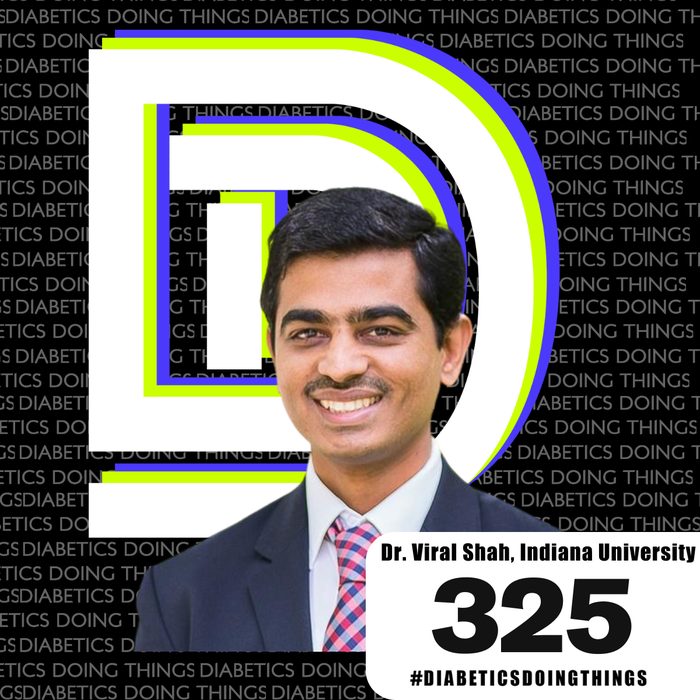
Dr. Viral Shah, Professor of Medicine of Endocrinology Indiana University


Episode summary
Dr. Viral Shah, a professor of medicine in endocrinology at Indiana University, led the ADJUST T1D trial testing semaglutide as an add-on to automated insulin delivery for adults with type 1 diabetes who had a BMI of 30 or higher and an A1C above 7%. He explains why insulin alone has not solved weight gain and cardiovascular risk in type 1 diabetes, and why GLP-1 drugs looked more promising than metformin, DPP-4 inhibitors, or SGLT2 drugs. He walks through the trial design, the composite outcome of time in range, time below range, and weight loss, and the results: more than a third of the semaglutide group met all three targets, A1C and weight dropped, and insulin doses fell, with no DKA and low discontinuation.
Key takeaways
- Dr. Shah says 36% of participants on semaglutide hit all three trial targets (time in range, time below range, weight loss), compared to zero on placebo.
- Dr. Shah reports no cases of diabetic ketoacidosis in either group and only two severe hypoglycemia events per group, both judged unrelated to the drug.
- Participants on semaglutide lost about 8.8 kilograms more than the placebo group and cut their insulin dose by roughly 30%, Dr. Shah says.
- The trial used a 1 milligram dose of semaglutide, lower than the doses currently approved for weight loss, Dr. Shah notes.
- Dr. Shah says the drug is still off-label for type 1 diabetes and hopes future data will support insurance coverage.
Chapters
- Introduction to the Adjust T1D Trial
- Understanding Type 1 Diabetes and Treatment Options
- Results of the Adjust T1D Trial
- Safety and Efficacy of Semaglutide
- Implications for Type 1 Diabetes Management
- Future Research and Community Impact
Show notes
In this episode of the Diabetes Innovators Series, Rob interviews Dr. Viral N Shah discussing the Adjust T1D trial, which investigates the effects of semaglutide, a GLP-1 agonist, on adults with type 1 diabetes. The trial aims to explore adjunctive treatment options beyond insulin, focusing on improving glycemic control, weight loss, and overall patient outcomes. Dr. Shah shares insights on the trial's design, results, safety profile, and implications for future diabetes management, emphasizing the need for continued research and community support.
Chapters
00:00 Introduction to the Adjust T1D Trial
03:06 Understanding Type 1 Diabetes and Treatment Options
05:46 Results of the Adjust T1D Trial
08:54 Safety and Efficacy of Semaglutide
11:45 Implications for Type 1 Diabetes Management
14:52 Future Research and Community Impact
Resources:

Questions this episode answers
What is the ADJUST T1D trial?
It's a randomized, double-blind, placebo-controlled trial led by Dr. Viral Shah testing semaglutide as an add-on therapy for adults with type 1 diabetes who were already using an automated insulin delivery system but still had an A1C above 7% and a BMI of 30 or higher.
Did semaglutide cause diabetic ketoacidosis (DKA) in people with type 1 diabetes in this trial?
No. Dr. Shah reports zero DKA events in either the semaglutide or placebo group over the six-month trial.
How much weight did participants lose on semaglutide in the ADJUST T1D trial?
Dr. Shah says the semaglutide group lost about 8.8 kilograms more than the placebo group, roughly a 10% difference, using a 1 milligram dose.
Can people with type 1 diabetes get semaglutide prescribed now based on this trial?
Dr. Shah says it remains off-label for type 1 diabetes since this was an investigator-led study rather than an FDA approval trial, but he hopes the results support future insurance coverage.
Full transcript Searchable, with timestamps
Rob Howe: Welcome to Diabetes Innovators, a special series from Diabetics Doing Things covering the 85th Scientific Sessions. We're held in June 2025 in Chicago, Illinois. You're going to hear interviews from leaders of tech companies, people with diabetes, diabetes creators, researchers, and more on this podcast. If you want to learn more or hear more from this series, visit DiabeticsDoingThings.com slash Diabetes Innovators. Enjoy the episode. Okay, let's talk about our partners who help support this podcast. Today, I'm going to talk about Type Zero, which is typezerohealth.com. It is a business run and founded by a person with type 1 diabetes, John Jensen, who's been on this podcast a couple of times. I've been using this product since 2018. I started training for a half marathon, which I ran in Dallas in December 2018. I was looking for a workout supplement, a pre-workout that I could trust not to spike my blood sugar. And so that's what I've got here in my hand is the clean pre-workout. I use the stim-free version, which doesn't have caffeine. And I trust it. And I've used it now. So 2018, it'll be almost seven years for me using this pre-workout. It really works for me because I can drink it late in the day. And most of my basketball leagues that I'm playing in now are late at night. So I might have a game from 7pm, 8pm, 9pm. and I can make sure that I'm able to get up and play and also be able to fall asleep later that night so I can wake up in the morning, go to work and meet the demands of my life. Type zero has gone a step further this year in our partnership and they've launched the Rob Howe stack, which also includes a couple of my other favorite products, creatine monohydrate, which I've been taking the past two years. And if you want to look up all of the good reasons you should be taking creatine, many scientists and performance coaches say if they could only take one supplement, creatine monohydrate would be the one that they chose. I agree, not only for the physical benefits, but also the mental focus and clarity. It's good for your brain. Do yourself a favor and add creatine monohydrate to your stack. Something I've also added is this clean hydration and electrolytes pack. I'll show you one of the little sticks. These are a lot smaller than some of the leading competitive brands because they just don't have as much salt in them. And there's no additives either. So you're not looking at any carbohydrates, nothing that you need a bolus for. And hydration is an essential part of anyone who has diabetes should be making sure that they're hydrated. And it's not just about drinking water. You need salt, you need magnesium, you need a little bit of the vitamin C and some vitamin B. There's a ton of zinc, selenium, chromium, all of the good electrolytes in this supplement. You mix the stick pack with, you know, 16 to 20 ounces of water, helps you get hydrated. I've been doing mine in the beginning of the day to start my day and make sure that I'm hydrated. And it helps with your insulin sensitivity. It helps me have some clarity and make sure that, you know, I'm not a very disciplined hydrator when I'm sitting at my computer all day. It's good to be reminded to make sure that you're getting your hydration in. And it's a little bit more interesting to drink than just water. So you can get these as part of the Rob Howe pack, or you can get them on your own. You can get them on Amazon or directly from typezerohealth.com. And when you order from typezerohealth.com, if you use code Rob Howe, that'll save you 20%. So they've got some great sales going on really regularly. So if you can't save more with a promo that they're running, use code Rob Howe, and you'll always get that 20% off. and your support helps them support the podcast. So if you are a person with diabetes who's looking for a reliable supplements company that's not gonna spike your blood sugar, that's gonna get you into the mode to be the higher performer that you are, I recommend and I take Type Zero. I wouldn't recommend a product that I don't use myself. So please support typezerohealth.com, code ROBHOW, and search the Rob Howe stack to see which supplements I take and get a good deal on those as well. Okay, let's get to the episode. I also wanna take this opportunity to promote Diabetes Legends Basketball Clinics. As you guys know, the last couple of years, we've started to do basketball clinics all throughout the country under our Diabetes Legends Basketball Clinics name. We've gotten to introduce over 100 campers with type 1 diabetes to diabetes legends like Lauren Cox and Gary Forbes and more. We've got three clinics coming up this year, a very special event at Friends for Life Conference on July 11th, and then later in September, we're gonna be returning to Denver. If you're looking for more information on the events themselves, you can visit diabeticsdoingthings.com slash events. And if you're interested in learning more about the Diabetes Legends Foundation, which we formed in 2025, to better support our ongoing initiatives and creating opportunities for kids with diabetes to have a great day with diabetes via one of our clinics, please connect with us and fill out a
Viral Shah: form on our website, diabeticsdoingthings.com. Hello, everyone. My name is Viral Shah. I'm a professor of medicine in the division of endocrinology at Indiana University. I also direct a diabetes clinical research program within the IU Center for Diabetes and Metabolic Diseases, both at Indiana University School of Medicine in Indianapolis. You should take this
Rob Howe: as a badge of honor. You had the longest title of anybody I interviewed on this series. So anytime you're combining diabetes clinical research and metabolic diseases, the characters in the title sort of expand. Feel free to shorten it if you would like. No, it's great. So today we're here to discuss the results from the ADJUST T1D trial outcomes. And that study was showcasing the result of a semaglutide, the GLP-1 agonist, treatment in people with type 1 diabetes. So let's talk a little bit about the study and the participants and what you and your team discovered. Yeah,
Viral Shah: and I will start a little bit with the background too, so that the audience can understand why we did that part. So if you think about 100 years after insulin discovery, I think we have focused a lot initially on insulin purification and then how to deliver that insulin in a best way. That's pump followed by automated insulin delivery system. But that doesn't address what people with type 1 diabetes need. Like for example, the system, even though it's best not able to really help everyone with type 1 diabetes to achieve the targets doesn't address the cardiovascular risk. It does not address the increasing prevalence of an overweight and obesity in this community, right? And so I think it's a time for us to really think beyond just the insulin delivery. And if you think about type 2 diabetes landscape, you know, we call now an ominous octet or probably noxius 9, meaning by that there are nine different defects that people are trying to address. And look at the remarkable number of different drugs and options available in type 2 diabetes versus type 1 is kind of left with just the insulin. So I and a lot of researchers like myself are very interested in trying to use the adjunctive medications that could help beyond insulin for type 1 diabetes care. And if you think about the past research over a decade, I think the metformin, yes, a lot of publication, but not as good. Just the one to two pounds of weight loss is not enough. Doesn't do a lot in terms of reducing insulin needs and other things. DPP-4 inhibitors has been neutral as well. SGLT2, I think it's a good future promising, but I think we need to figure out how to reduce the risk of DKA. That's a diabetes ketoacidosis. And I think once those continuous ketone monitors will be available, I think I'm optimistic that the drug will come back and resurface for using type 1 diabetes. So I think the GLP-1 at this moment sounds the most promising molecule because of various effects. And we did a lot of small real-world studies that has been published, found that it really appears to be safe and effective in lowering A1C, improving time in range, and weight loss. Of course, in a science, we need a large kind of a randomized control trial, that's the best way to really say that it works and it's a safe, right? So that's why we did this study. Now, what is this ADJUST-T1D trial? So we, in this trial, we included people with type 1 diabetes, of course, all adults, 18 and above. They were already using an AID system that were available in the market at the time of this trial, but still not meeting their glycemic targets. That's an A1C less than 7% and had BMI of 30 or higher. So those people were randomized to receive either semaglutide or a placebo. 36 people were randomized to semaglutide, 36 to placebo, and were followed for six months. Now it's a double blind placebo control, so investigators or the participant did not know what kind of drugs that they are receiving. That's the best way to do randomized trials. What we found is that, And I want to also have your audience to really understand the outcome in this trial, because this is the first time to my knowledge in the history that we use the primary endpoint, which is a composite of all three. So it's not like patient has to meet one out of three. They have to meet all three. So it's the most rigorous way to really analyze the primary composite endpoint. What is that? So time in range, which is 70 to 180, of more than 70%. that's a recommended glycemic target, time below range of less than 70, not exceeding more than 4%. Again, that's a recommended target not to have too many lows and having a weight loss of more than 5%. And why we decided to have that composite outcome? Because let's say, think about that as an individual with type 1 diabetes. If you have a really good A1c, but you have a lot of lows, that's not good either. Or if you achieve good A1c, not many lows, but you gain weight, That's not good either, right? So we wanted to have a very holistic approach of caring an individual with type 1 diabetes as a success in this, you know, trial. So that's why we had this composite outcome. 36% of participants in the semaglutide arm compared to the placebo achieved the primary outcomes. And there was a zero in a placebo that achieved all three and 36% in semaglutide. That was a highly statistically significant primary outcome. Now, there were a bunch of secondary outcomes that were glycemic as well as the weight-related. So we saw a significant improvement in A1C. That's considered still a gold standard for clinical trial because regulatory agency still looks at that. Again, I want to remind people that these are not in adults with type 1 that had an A1C of 9 or 10. These are like already on AID, and the baseline A1C was 1.8 in semaglutide and dropped to 0.7%. That's huge. In a placebo, it was 0.4. So the difference was 0.3% adjusting for between group difference. So it's pretty profound. Improvement in time and range by almost an 8.8%. That's almost more than two hours of time spent in good glycemic targets. And if you think about that very interestingly, that most of the improvement in time in range was due to improvement in time in a normal glycemia, which is time in tight range, or now we want to call it a ting, time in a normal glycemia. That was almost a 6.9%. So it's a huge, if you think about that, a lot of time above 180 shift directly to time close to 140 or even below that. That's a huge difference in those glycemic metrics. And then the most important thing is that did it come with the risk of hypoglycemia? Absolutely not. Both group, because again, they were on AID, spent time below less than 70, almost 1% or less throughout the trial. So very minimal, acceptable, 1% is equal to about 15 minutes per day. So not even 15 minutes throughout the trial is pretty remarkable. And if you think about the weight loss, and I want to again repeat this part here, is that we didn't look at the percentage change in a weight loss, because that's sometimes difficult to understand. And we look at absolute change in a weight loss between two groups. So it's an 8.8 kilogram adjusted group difference in a weight. If you want to convert that into percentage, then it will be roughly about 10%. So that's it. And we used one milligram semaglutide, not currently available 2 or 2.4. So that's also important to keep in mind that it was a relatively lower dose than what's
Rob Howe: available now. That was actually what I was going to ask is, did all the patients receive the same amount of semaglutide and what was the dosage. So like you said, that's not compared to what's being prescribed for people in the market now, just in the weight loss segment. That's not a high dose, and you're still able to, you know, look at all these results and say, wow, this really did make
Viral Shah: a marked difference. Yes. And why one milligram? I think that's a commonly asked question as well. And I think I want to say that for a lot of people, as a researcher, I want to tell you that The research is a slow process. So when we started writing this grant about four to five years back, we have to obtain a funding. It will be reviewed by external reviewers. So it takes about two years plus to really get the grant, and then you start the trial, right? So at the time when we did that, you have to think about the back time where we could only obtain one milligram successfully. I wish we could have done two, but that's what it is. Another thing that people do think about that, and it's a common kind of a perception, I would say, is that the people with type 1 diabetes, the weight loss is not as profound as people with obesity without diabetes. And I feel like our trial, it's not an apple to apple comparison. But if you think about the step one trial that was published in New England Journal of Medicine using currently approved Wegovy, semaglutide, higher dose. And if you break down that curve at about week 12, meaning by that it's a one milligram dose, not beyond one, you know. And if you look at the percentage of weight loss in that trial versus over, it's very similar. Again, take that with grain of salt. I'm not comparing, you know, apple to apple here. So at least we can say, and we cannot prove that at this moment, but we can say that there is a possibility that the semaglutide-related weight loss could be as good as people without diabetes. And also what we found, it's going to be very interesting in type 1 community is that the insulin dose reduction was almost a 30%.
Rob Howe: Getting those results, better time, tighter time and range, better A1C outcomes, weight loss, and lower daily insulin dosage. I mean, you had explained that at a, forget the data, if you're having a conversation with a patient with type 1 diabetes, would you want those things that would be a yes across the board?
Viral Shah: I agree. I think most people would say, wow, we haven't seen that with just the insulin only kind of a system, right? So yeah, and in terms of safety, is that did we saw any kind of a safety issue? And I would say that it, again, relatively small sample size, a shorter duration. So take that with a grain of salt. But still, we did not observe any DKA, which is diabetic ketoacidosis in our trial. So zero event in either placebo or semaglutide. Six months, that's not a shot in one way. The second thing is that we saw two severe hypoglycemia events in the semaglutide group and two in the placebo group. And I also want to take an opportunity of your podcast to mention that those two events were unrelated to semaglutide. So what exactly happened on those two participants is that the one participant actually completed the trial and we had two weeks of an observational period, where we want to make sure that these people transition back to their insulin and everything safely. Now, during that observation trial, after about a week or so, this individual developed in hypoglycemia. So not on a drug, off drug for a week plus, so highly unlikely that it's a drug related. And the second hypoglycemia was, that's, you know, people with type 1 diabetes knows this very well, that life with devices sometimes could be uncertain, right? Where individual had a pump failure, sensor was not treating right, and everything that you can imagine, and then, you know, end up in hypoglycemia at middle of the night. So both events were unlikely directly related to the drug. So I think in terms of the safety, we think that it was safe in our trial. Now, if you think about the discontinuation, how many people could not tolerate the drug because of those GI issues? Only two participants out of those 36. So that's about 5%. Very similar to if you think about the obesity trial, even with the higher dose of semaglutide. And I was asked this question also in the past where like, oh, you know, but in real world, if you think about some of the literature that the discontinuation rate is pretty high and why it's like that. And I think my personal opinion around that part is that in real world, all discontinuation are because of insurance costs and unrelated things, not just the tolerance, right? So in our trial, we selected the population that I would have in my clinic every day. It's not like a highly picked, you know, and specifically chosen population. And so I feel like if you're given free drug access to everybody, then I think you might replicate that, hey, about two out of 36 or probably six out of 100 approximately may not be able to tolerate this drug, which can happen with any drug. So overall, summarizing safety, it appears to be safe, of course, was effective, but safe as well. Sure. You touched on insurance. And so I want
Rob Howe: to ask you a kind of a bigger question, but I want to go back first, because you mentioned in type 1 diabetes, historically, we've talked almost only about insulin. Over the past 10 years or so, I would say the pendulum has swung over more on the technology side, right? We're talking about AID systems, looking even forward to the fully closed loop systems that are being studied right now where patients don't have to signal for a mealtime bolus and they still are able to achieve those 70% time and range type of metrics. And we're looking at time and tight range. I got some feedback over the course of this meeting at scientific sessions that people who had been in the industry for a long time felt like the pendulum was swinging back a little bit more towards the drug market, which would work in tandem with the AID systems and technology. And GLP-1 is obviously at the forefront of that. And so for patients who have type 1 diabetes and either have been maybe curious about using it off-label with a compounding pharmacy or something of that nature, or have another specialist who's prescribing it either for weight loss or something else. Like what does this, what do the results of the ADJUST T1D trial do for those patients who are, would really benefit from a protocol like this?
Viral Shah: Yeah. And I also want to say, Rob, is that I think in type 1 diabetes, I want to be very clear that unfortunately insulin is still going to be the mainstay of it. Sure, sure. The best way to give in insulin is the automated insulin delivery system. And so I would encourage all people with type 1 diabetes in my clinic as well, that the AID is a life-saving. It's amazing. And I think we should use that first before considering the alternate, like an adjunct therapies, because it would be a safe way to do that, right? Now, coming to the point that I think our trial reassures that GLP-1 as an adjunct therapy could be beneficial for people with type 1 diabetes. And as you already mentioned this rightly, is that it's still going to be off-level because this is not, I want to say, that the FDA approval trial because this was not done by sponsor. This was done by an investigator with a grant from a breakthrough T1D, formerly JDRF, right? So I feel like we have done our part and now the onus is on the, you know, Novo Nordisk and other industry to really do a regulatory trial because it's a very different ballgame. But now and by that time, we're on an off-level. At least we can now assure to both the providers as well as the community that it's a safe option. Also, remember that part that in our trial, we integrated people with BMI more than 30. And now, can that be applicable for someone with BMI less than 30? The answer could be, right, but we haven't tested those things. Just a couple of things that, you know, that I think still would be interesting to understand for different type of type 1 diabetes population to make sure that it's safe. But I'm optimistic that it should translate, but that's my personal opinion.
Rob Howe: Well, and I think you've done a really nice job in this conversation of setting the expectation for listeners. It's like this is very, it's a ladder, right? Like this is step one. We've established a safety. We've gotten the results from a population of people on automated insulin delivery with a BMI over 30 with the right beginning A1C outcome, right? More than seven. That's step one. Now there's more research and studies to be done before it becomes some of those things change. So I don't know if you'll be able to speak to this question as part of the study, but I'd love to hear your opinion on it because semaglutide also addresses other comorbidities like cardio, kidney, and more that are closely associated in like high percentage comorbidities of type 1 diabetes. So when you think of the long-term benefits that the results of the study will show, there's so many other factors. You mentioned earlier all the different factors of type 2 diabetes, but also the disease of too many inputs for type 1. What long-term benefits do you think that this data will show for people with diabetes, even beyond the three metrics that you tracked in the study?
Viral Shah: Thank you so much for asking this question, because we are going to address that question shortly. And why I say that. So in this ADJUST-T1D trial, we did have a subset of participants undergoing a cardiac MRI. We did look at the arterial stiffness. We looked at the MRI liver fat contents between the semaglutide group and the placebo group over six months. So baseline and at six months. So we are currently analyzing those data. And in a couple of probably months or so, I'm optimistic that we'll be presenting at another meeting with some kind of publications. And my fingers crossed that I think we will generate that evidence that the surrogate cardiovascular and renal, as well as the hepatic outcomes with semaglutide would be. And again, it was a subset population. So I don't want to say that we have adequate power to because these are costly things. We can do that in a larger scale, right? So we are mindful of the grants, the finances, you know, also the people because it's hard for people to go through all these procedures, right? But we appreciate the community support that people really did that. So through your platform, I want to say thanks to everyone with type 1 diabetes that believes in our hypothesis, believes in us, that we are trying to really help and advance the science. But yeah, maybe in a future podcast that I will be able to share those results with you and hopefully that would be good.
Rob Howe: Yeah, I was just going to say, it sounds like we're going to have to keep an eye out and have you back on the podcast to talk about those things. As I age, I'm 36 now and heart disease runs in my family and I've lived now with diabetes for 20 years. I'm much more aware of the different comorbidities that go along with a long life with diabetes and also that I can't outrun my genes, so to speak. So really being mindful of those things. And I think having that perspective and I think people with type 1 diabetes, they look at, especially maybe at first at diagnosis or, you know, when they encounter someone in the community of like, oh, yeah, well, I really do need to be making sure that I'm up to date on my labs and my lipid panels and those types of things on the cardio front. So I think they'll be excited to see that a drug that's designed for weight loss and type 2 diabetes can help them with type 1 and then also address some of those other comorbidities. You mentioned the quantitative data from the study. Were there any qualitative measures that you and your team took on the patient population? And what did those look like? And does anything stand out to you that you remember of how the patients felt at the end of the study compared to the beginning?
Viral Shah: Yeah, that's a very important question. We did collect some of the patient reported outcomes called PROs. We haven't analyzed those data yet. So I think once we analyze, then we will share that with you as well. and unfortunately I feel like now it's a lost opportunity but I think we didn't have that kind of like an interviews with participants and asking their you know perspective on that part I think that would be beautiful but again each study would have one or two objectives and right so but then it opens up a lot more questions for us to really study that in the future so a couple of your your questions are really excellent and I think we are thinking on the same way and hopefully will address some of those things in the future.
Rob Howe: Yeah, I think it's interesting. And I'm learning too of how important it is to focus on, you know, the key metrics. And even though there's so many other things that, you know, because of diabetes's effect on so many other parts of your life as a patient, you know, there's always something else that you could ask or something else that you could bring in. But yeah, thank you. I'm looking forward to seeing more of the results as you and your team continue to analyze the data. Speaking of you and the team, this has been on the other side of a very busy weekend in Chicago at scientific sessions. What has been for you, your team, and even your grantmakers and funding team, how do you feel having presented this data and having it out in the world?
Viral Shah: Yeah, I think it was a very productive, exciting area for me and my team. And so I think a couple of things that we feel proud of is, number one, doing this trial, putting that evidence now in the literature. I am cautiously optimistic that this evidence might be taken by the American Diabetes Association Standard of Care Committee. I don't know because it's an independent committee that looks at all the evidences and incorporates into the standard of care. But if it gets into that part, then I think it would be good for people with type 1 to have some access because that may help with some insurance coverage and prior authorization because standard of care is standard of care, right? So, yes, I think those kind of things. Also, I think our team is still busy in analyzing some of the data that we discussed. And we are excited to get that out as well in the near future. And I think it has opened up a lot of questions for us for future studies and future research that we haven't addressed through our clinical trial. So I think looking forward to writing some of the next grants and next type of research. And from a breakthrough T1D, who was our funder for this study, I think you might have seen the ADA highlights where I think they acknowledged that they also feel proud funding this. And I think it fits with their mission of like an advancing science and care for people with type 1 diabetes. The breakthrough T1D also realizes that the insulin delivery alone is not going to be an optimal. And so simultaneously spending money and investing into adjunctive therapies or CURE, which is kind of a cell therapy, it makes sense, right? And so I think, but I want to say that the community who has probably donated breakthrough T1D and those money came to us, I think you invested in the right way. And back to the community, I want to say thanks to everyone. you are the motivator for us to do something. You are the first people that ask us the right questions so that we can try to answer those questions. So I think it's a great momentum at this moment for us to keep working in this space. Well, Dr. Shah, thank you very much for
Rob Howe: your time and for breaking this down for us in our community. And congratulations on presenting this data. And for you and your team, thank you for doing this work for people with diabetes. I And now starting to get into the science of it and seeing where we're headed and meeting the people behind the scenes that are leading us to the future. It's very exciting. And thank you for your time and for contributing to this Diabetes Innovators podcast series here on Diabetics Doing Things.
Viral Shah: Yeah, thanks for having me, Rob.
About Viral
Dr. Viral Shah is a professor of medicine in the division of endocrinology at Indiana University and director of a diabetes clinical research program at the IU Center for Diabetes and Metabolic Diseases in Indianapolis. He led the ADJUST T1D trial studying semaglutide in adults with type 1 diabetes.