

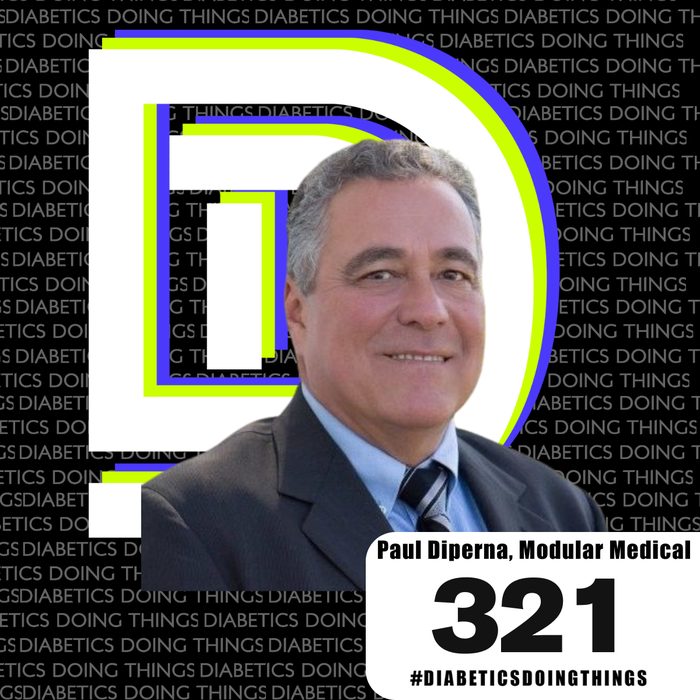
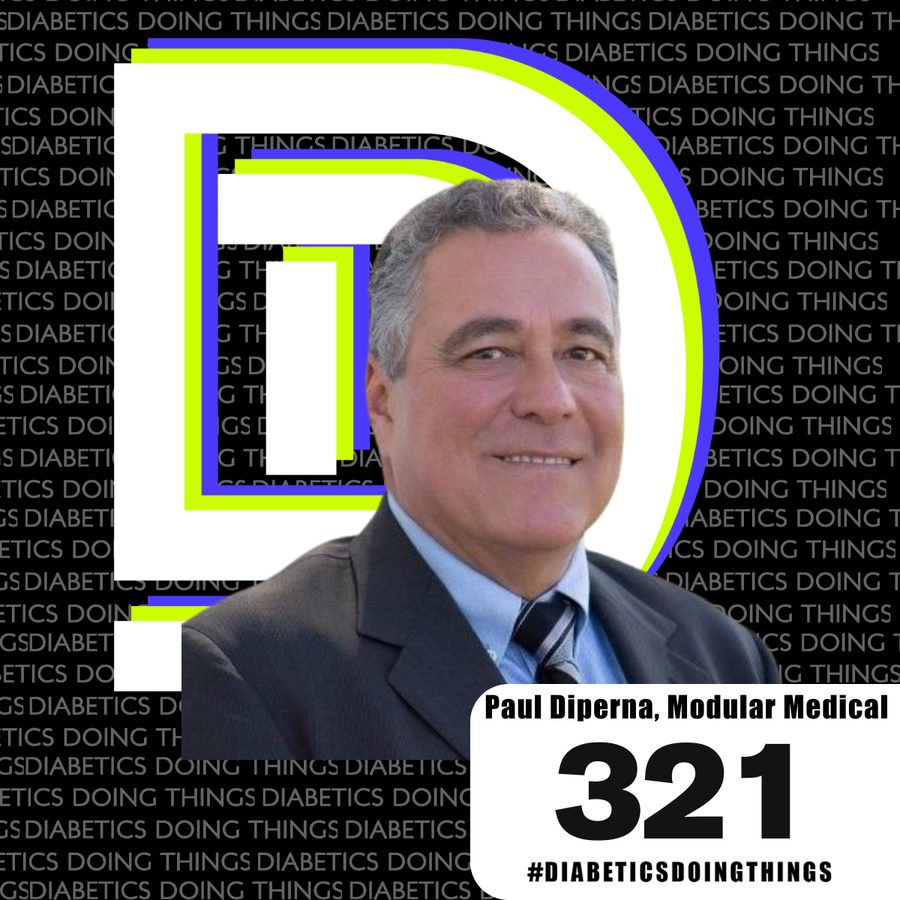
Paul DiPerna - President and Chairman of Modular Medical

Episode summary
Paul DiPerna is president and chairman of Modular Medical. He evaluated the MiniMed pump for Baxter Healthcare early in his career, then founded Tandem Diabetes Care and built the t:slim pump. At Tandem he found that even a simplified pump only reached about a third of people with type 1 diabetes, leaving the rest on multiple daily injections. Modular Medical's new product, the Pivot, targets that overlooked group: people who want to spend five or ten minutes a day on diabetes care, not two or three hours. The pump skips features like insulin-on-board tracking and carb counting in favor of a basal rate, one-button bolus dosing, and data the pump stores for the doctor. DiPerna and Rob also discuss patient shame, hybrid closed loop tradeoffs, and where drug development may be headed next.
Key takeaways
- Paul DiPerna says he evaluated the MiniMed pump for Baxter Healthcare before founding Tandem Diabetes Care and building the t:slim.
- DiPerna says even a well-designed pump like the t:slim only reached about one-third of people with type 1 diabetes, leaving two-thirds on multiple daily injections.
- The Pivot pump is built for people who want to spend five to ten minutes a day on diabetes care, offering a basal rate and one-button bolus dosing without carb counting or insulin-on-board tracking.
- DiPerna says a soft launch for the Pivot starts in September at ADCES, with a national rollout planned for Q1 of next year.
- DiPerna points to a Beta Bionics poster showing people with lower A1Cs can see worse results on hybrid closed loop, while people with higher A1Cs see the most benefit.
Chapters
- Introduction to Modular Medical and the Pivot
- Understanding the Pivot: A New Approach to Diabetes Management
- The Journey of Modular Medical: Lessons from Tandem Diabetes Care
- Meeting Patients Where They Are: Simplifying Diabetes Care
- Overcoming Resistance: Introducing the Pivot to Patients
- The Balance of Innovation: Addressing Diverse Patient Needs
- The Psychological Aspects of Diabetes Management
- Future of Diabetes Management: Innovations on the Horizon
- Launch Plans for the Pivot: A New Era in Diabetes Care
Show notes
In this episode of the Diabetes Innovators Series, Paul DiPerna, President and Chairman of Modular Medical, discusses the innovative Pivot product designed for diabetes management. He emphasizes the need for simpler solutions for less engaged patients, reflecting on his journey in diabetes technology and the challenges of balancing innovation with user needs. The discussion also touches on the psychological aspects of diabetes care and the future of diabetes management, including the anticipated launch of the Pivot.
Chapters
00:00 Introduction to Modular Medical and the Pivot
00:40 Understanding the Pivot: A New Approach to Diabetes Management
04:22 The Journey of Modular Medical: Lessons from Tandem Diabetes Care
08:06 Meeting Patients Where They Are: Simplifying Diabetes Care
10:53 Overcoming Resistance: Introducing the Pivot to Patients
12:59 The Balance of Innovation: Addressing Diverse Patient Needs
17:11 The Psychological Aspects of Diabetes Management
18:47 Future of Diabetes Management: Innovations on the Horizon
22:54 Launch Plans for the Pivot: A New Era in Diabetes Care
Resources:
Questions this episode answers
What is the Modular Medical Pivot?
The Pivot, formerly called the Mod 1, is an insulin pump from Modular Medical built for people who want to spend only five to ten minutes a day managing diabetes. It gives a basal rate and simple one-button bolus dosing instead of features like carb counting or insulin-on-board tracking.
Who founded Tandem Diabetes Care?
Paul DiPerna founded Tandem Diabetes Care and led development of the t:slim pump, which added an OLED capacitive touchscreen to simplify pump use.
When will the Pivot launch?
DiPerna says Modular Medical plans a soft launch in September at ADCES, with a full national rollout targeted for the first quarter of the following year.
Why did Modular Medical build a simpler insulin pump instead of adding more features?
DiPerna says even advanced pumps like the t:slim only reached about a third of people with type 1 diabetes. He built the Pivot for the other two-thirds who find existing pumps too complex or too time consuming.
Full transcript Searchable, with timestamps
Rob Howe: Welcome to Diabetes Innovators, a special series from Diabetics Doing Things covering the 85th Scientific Sessions. We're held in June 2025 in Chicago, Illinois. You're going to hear interviews from leaders of tech companies, people with diabetes, diabetes creators, researchers, and more on this podcast. If you want to learn more or hear more from this series, visit DiabeticsDoingThings.com slash Diabetes Innovators. Enjoy the episode. episode. Okay, let's talk about our partners who help support this podcast. Today, I'm going to talk about Type Zero, which is typezerohealth.com. It is a business run and founded by a person with type 1 diabetes, John Jensen, who's been on this podcast a couple of times. I've been using this product since 2018. I started training for a half marathon, which I ran in Dallas in December 2018. I was looking for a workout supplement, a pre-workout that I could trust not to spike my blood sugar. And so that's what I've got here in my hand is the clean pre-workout. I use the stim-free version, which doesn't have caffeine. And I trust it. And I've used it now. So 2018, it'll be almost seven years for me using this pre-workout. It really works for me because I can drink it late in the day. And most of my basketball leagues that I'm playing in now are late at night. So I might have a game from 7pm, 8pm, 9pm. And I can make sure that I'm able to get up and play and also be able to fall asleep later that night so I can wake up in the morning, go to work and meet the demands of my life. Type Zero has gone a step further this year in our partnership, and they've launched the Rob Howe stack, which also includes a couple of my other favorite products, creatine monohydrate, which I've been taking the past two years. And if you want to look up all of the good reasons you should be taking creatine, many scientists and performance coaches say if they could only take one supplement, creatine monohydrate would be the one that they chose. I agree not only for the physical benefits, but also the mental focus and clarity. It's good for your brain. Do yourself a favor and add creatine monohydrate to your stack. Something I've also added is this clean hydration and electrolytes pack. I'll show you one of the little sticks. These are a lot smaller than some of the leading competitive brands because they just don't have as much salt in them. And there's no additives either. So you're not looking at any carbohydrates, nothing that you need a bolus for. And hydration is an essential part of anyone who has diabetes should be making sure that they're hydrated. And it's not just about drinking water. You need salt, you need magnesium, you need a little bit of the vitamin C and some vitamin B. There's a ton of zinc, selenium, chromium, all of the good electrolytes in this supplement. You mix the stick pack with, you know, 16 to 20 ounces of water, helps you get hydrated. I've been doing mine in the beginning of the day to start my day and make sure that I'm hydrated. And it helps with your insulin sensitivity. It helps me have some clarity and make sure that, I'm not a very disciplined hydrator when I'm sitting at my computer all day. It's good to be reminded to make sure that you're getting your hydration in. And it's a little bit more interesting to drink than just water. So you can get these as part of the Rob Howe pack, or you can get them on your own. You can get them on Amazon or directly from typezerohealth.com. And when you order from typezerohealth.com, if you use code Rob Howe, that'll save you 20%. So they've got some great sales going on really regularly. So if you can't save more with a promo that they're running, use code ROBHOW and you'll always get that 20% off and your support helps them support the podcast. So if you are a person with diabetes who's looking for a reliable supplements company, that's not going to spike your blood sugar, it's going to get you into the mode to be the higher performer that you are, I recommend and I take Type Zero. I wouldn't recommend a product that I don't use myself. So please support typezerohealth.com, code ROBHOW and search the ROBHOW stack to see which supplements I take and get a good deal on those as well. Okay, let's get to the episode. I also want to take this opportunity to promote Diabetes Legends Basketball Clinics. As you guys know, the last couple of years, we've started to do basketball clinics all throughout the country under our Diabetes Legends Basketball Clinics name. We've gotten to introduce over 100 campers with type 1 diabetes to diabetes legends like Lauren Cox and Gary Forbes and more. We've got three clinics coming up this year, June 7th in Dallas, a very special event at Friends for Life Conference on July 11th, and then later in September, we're going to be returning to Denver. If you're looking for more information on the events themselves, you can visit diabeticsdoingthings.com slash events. And if you're interested in learning more about the Diabetes Legends Foundation, which we formed in 2025, to better support our ongoing initiatives and creating opportunities for kids with diabetes to have a great day with diabetes via one of our clinics, please connect with us and fill out a form on our website, diabeticsdoingthings.com. Welcome to the show. Why don't you introduce yourself for the listeners. Thank you. I'm Paul DiPerna. I'm the president and chairman of Modular Medical. Well, thank you for making time today. It's the 85th Scientific Sessions ADA Conference here in Chicago. This is our Diabetes Innovators podcast series on diabetics doing things. And I'm really excited to talk about Modular Medical and introduce Modular Medical to our audience and talk about that story. And also you as a diabetes innovator, even back to your previous background, you know, founding what later became Tandem Diabetes Care. So thank you so much for your time today. Okay, thank you for having me. So let's talk about Modular Medical. Modular Medical and the Mod 1 are new in the market. And from my perspective, like the news, making it down to patients like me is relatively new. How would you introduce Modular Medical and the Mod 1 to
Paul DiPerna: our audience? Yeah, we've rebranded the Mod 1 to call it the Pivot, and it will be the Pivot product. I like it. And what's different about it is, is we are really focused on helping people who are a little bit less motivated, a little less technically capable. Maybe they go to a general practitioner to get all the benefits of electronic, of technology and pumping. One of the things we really strive to do is to allow them to simply take their journey with multiple daily injections and make the step to pumping as small as possible. And the principal benefit they get is they then get a basal rate. They simply press a button for their bolus in meals. And best of all, all the information is stored on the pump. So therefore, we have a display algorithm. So therefore, the doctor for the first time isn't looking at scratchy pieces of paper, is instead has all the data right there to see what this patient is doing right and where the challenges are.
Rob Howe: Yeah, from what I understand, and, you know, there's a great gap to be met. And I think we can't talk about innovation on this podcast series or at this conference where, you know, we're seeing breakthroughs in research and breakthroughs in drugs and devices without addressing the need for options for everyone. And that's not just price, but it's also usability. And, you know, now that the pivot has sort of addressed these gaps, like how, you know, who is this for a person who's now on multiple daily injections and maybe has tried other pumps in the past and found them to be too complex or didn't work with them? How did you address that in the design?
Paul DiPerna: Specifically, we meet them where they are. There's people who want to put two, three hours into their diabetes care. They want to weigh everything. They carefully determine their grams of carbohydrates. They change their basal rate between every meal. And they do fabulous. And that's a great product for a subset of the market.
Rob Howe: I call them a type A, type 1. True.
Paul DiPerna: But what I really wanted to focus on is the rest of us, the people who only want to put five or ten minutes, wish there was a once-a-day pill, and are reluctant to put the time and effort in or incapable or simply don't have the time. They may be, you know, working-class people that are tired and kind of dragged to work and drag home. So the purpose of the Mod 1 product is if five minutes is all you want to put into it or ten minutes a day, you simply look at the meal as is the common practice. Of course, we want them to count grams of carbohydrates, but if they don't, If they look at the meal, they look at their glucose level and they make a decision to make it as simple as possible. Make it discreet, make it so they're not embarrassed and make it so that it's something that can be done by just about anybody. So the teachings to do it, the challenge, the time, the energy required to do it is minimized.
Rob Howe: And like you said as well, without compromising the quality of the data that they can then share with their care team, like without, you mentioned it, like scribbling their glucose logs together. I think we've all been there. What was my glucose three weeks ago? Well, let's just put something down.
Paul DiPerna: And they're all in the same color pen. Yeah, they are. I went to a paper years ago where they said 30% of the numbers written on a piece of paper are a lie.
Rob Howe: Yeah, it's like 99% of statistics are made up on the spot, that kind of thing. You obviously have been coming to these and you shared this with me before we hit record. You've been coming to scientific sessions for about 25 years. So how has that shaped your experience and even your experience founding Tandem Diabetes Care? How has that shaped the journey of Modular Medical and gotten us here to the pivot in the past 10 years? It takes 10 years to make an overnight success, right? So how has your experience in the space really shaped this product?
Paul DiPerna: Initially, I did the evaluation for Baxter Healthcare on acquiring the MiniMed pump, what's now the Medtronic franchise. And as I looked at it, it was dot matrix. It had up and down arrows. It was seven screens deep to do certain functions. And even I, in evaluating it and trying to work through the instructions for use as a technical engineer, was kind of confused and dazzled by what it took to do many of the functions. I then got involved with the potential Disetronic acquisition. We didn't acquire either. But it became obvious to me as I worked on things like my kid's iPods with the capacitive touch panel wheel that there was so many opportunities to consumerize medical products. So when I undertook the, founded and undertook the effort to do the T-Slim, I really wanted to incorporate electronics. I wanted to put an OLED-capacitive touch panel screen. I really wanted to make it so that with a series of icons, I really wanted to make it a simplified journey for people with diabetes so that they didn't have to go into these Medtronic various windows. And I did that to a certain degree, and it certainly has stood the test of time. It's still a very viable product in the world of diabetes. However, even that was too complicated, and all the things we're asking people to do to control their A1Cs kind of narrowed the market to roughly one-third of people with type 1 diabetes. And that always bothered me. What about the other two-thirds? And I would often ask endos, and I would ask clinicians, you know, what do you do with the people who aren't on a pump? And there was a lack of empathy. It wasn't as though, yeah, I do the best I can. It's like, this is the way to achieve an A1C of 7 or lower. And if you want to do it, great. And if you don't want to do it, we do the best we can. So that kind of ate at me as I did two other startups. And then when I thought about what I wanted to do, I said, I really didn't finish the job at Tandem. I would really like to do something that is focused on this subset of the market. Not necessarily trying to achieve an A1C of seven, but instead accepting the fact if I can get someone from 10 to eight or 11 to nine, if I can make a vast improvement in their life. These are the people that cost the healthcare system the money. These are the people who suffer, and these are the people that are mostly ignored. So I really felt obligated to focus. One of the great challenges at Modular is there's this giant pressure to add the classic features. Don't you have an insulin on board? Don't you have a carb counter? Don't you have all of these different features? but I've stayed true to it and said, no, these aren't the people who are going to worry about insulin on board. They're simply going to do the same practices before. However, they'll be getting a basal rate and we'll have all the data. So our thinking is with our pivot, the objective is it's very simple and it's a small incremental step from a multiple daily injection pen. And then based on what we learn, based on as they progress, we can close the gap. We can go closer and closer and add features as appropriate. Maybe it's a pivot to, maybe it's another product. But I think there's a whole series of incremental products that need to be done based on the motivation and capability of these users.
Rob Howe: Paul, you're speaking my language because I'm a member of the Church of Incremental Progress. And, you know, what gets measured gets managed. And so you're improving the quality of the data. You're reducing some of the burden. You don't have to do the injections. You also don't have the complexity. I think it is an interesting challenge to have to resist adding features. You know, we're here at the conference and there's amazing research about automated insulin delivery and CGM. And this product is inherently not those things. And so it is sort of reverse innovation where you have to make it's very popular right now to have a dumb phone where it's just a flip phone like, you know, we had in the early 2000s. Because it removes all the features that distract you and make you anxious and those types of things. And this is a little bit similar to that.
Paul DiPerna: It's very similar. Everyone loved the flip phone because you'd open it to answer and close it. Instead, while you're driving, you've got to kind of look where that foolish button is. I have friends who have the old original flip phones and have kept them all these years until one of the carriers forces them into a smartphone.
Rob Howe: Yeah, I think the happiest guy I know is still on a flip phone. So there may be something to it.
Paul DiPerna: But to me, the reality is that, and I've used this before, is we have people driving Ferraris and we have people on bicycles and we don't have anything in between. And sure, the product is limited in scope and limited in capability and it's not the ideal way to care for your diabetes. But it is so much better than what two-thirds of type 1s and virtually all multiple daily injecting type 2s do.
Rob Howe: I want to talk about those two thirds of people and those patients. And I think of them, you know, there's still a large amount of people, obviously, a majority of people with diabetes on multiple daily injections. But even if you slice that data up, there are people who are still using Novolin-R and 70-30 and like, you know, really. And rely on. And rely on from Walmart, right? Like things that we would consider at this conference would be considered almost, you know, taboo to discuss for managing your diabetes. And yet they are sort of members of the if it ain't broke, don't fix it majority. And so, you know, when you think of those two thirds, how are you or what's your plan to introduce this product to them? Or how can you overcome those, that resistance or that negative experience from devices in the past?
Paul DiPerna: So what I've found is as I talk to folks within the diabetes community, there are people who embrace the fact and understand there is a group of people that need something different. And then there's many people who just don't understand and why aren't you talking to a CGMS and where's your AID and they feel, you know, a pumping system is a pumping system. And I tend to embrace the people who understand that there's people with different abilities and different capabilities. And they're the ones who advise me on what to do and how to approach them and how this could work. I wanted to simplify, for instance, I wanted to simplify the learning curve such that in one hour you could easily learn the product. And therefore, a general practitioner would be comfortable with it. And also, I could teach a general practitioner in 20 minutes how the features work. So therefore, you overcome all the fears of getting questions on triple wave boluses and what's the spacing between pepperoni and cheese. So I really went down to the whole path, starting with the patient, to the clinician, to the actual person at a lot of endo offices that spreads the option up and describes them. If I hadn't done the tandem experience, I would never be able to do this because the investment community tends to want sex and sizzle and latest and greatest. And that's really what we're seeing is everyone competing with the latest new thing. This show is the antithesis of that. And instead, I'm going down market. I'm saying, OK, it does less. It's not quite as capable, but it's infinitely better than what many of them are doing today. So that's been the challenge throughout this journey of modular matter.
Rob Howe: It's interesting because, you know, one of the three things that I remember from my time in college, which is, you know, not to say much, but innovation is a creative destruction of the economy as we know it. So we're pushing forward and we're leaps and bounds ahead. We're seeing breakthrough technology. You know, there's a lot of sessions on AI. There's a lot of sessions on the impact of automated insulin delivery systems. But there's a lot of people being left behind. And like you said, there's those type A people with diabetes and maybe you're able to get those type A type results with this new technology without having to put that effort in and relieving that burden. But that's if you can adopt the technology. And so, you know, for me, like the I have to hold both things and I have to hold them in two hands. I'm excited about the innovation for at the forefront. But I also worry about that destruction of the people that it's leaving behind who are, you know, more comfortable with their, you know, their management that they have.
Paul DiPerna: today. So to me, hybrid closed loop is an innovation in control, mostly of your basal rate at night. But it requires all of the work and all of the effort and more versus what people were doing before. Before it was more variable, how much you're in compliance with the particular methodology of pumping. You come out with hybrid closed loop and it just puts a lot more pressure. There's a beautiful poster down below from Beta Bionics. And it talks about how if you're in control if your A1C is low, you actually will do worse. And they admit it. They're like, if you're a 6, you're going to be a 7 after you get on our product. And then they show the worse you are, the more benefit you get from that particular algorithm. You know, it's a compromised algorithm. And I really admire that because there is a subset of people that that is absolutely perfect for. And in between what's now hybrid closed loop, I don't know quite what beta bionics calls it. We'll call it a full closed loop. And then what I call a true closed loop, which it actually does everything for you. There's all these gradations that are appropriate for different people, depending how much, you know, how much time and effort they want to put in.
Rob Howe: Certainly. And I think it's interesting to think of patients that way of, you know, how much they want to engage with their diabetes and still get glycemic control that their care team feels good about. And I think like you were saying, you know, I don't know if this number has been updated and 99% of statistics are made up on the spot. I believe I saw that, you know, in the United States, the average A1c for someone with type 1 diabetes and adult type 1 diabetes is 8.5%. And, you know, the people who are hyper engaged, I think are so focused on, oh, I got a 6.5, you know, my glucose is out of range. I'm, you know, I'm a terrible diabetic and they don't have anything to compare it to. They don't, they don't know. And then like you said, that the meaningful differences in a person's life from going from 11A1C to 8.5, you know, in that average range are very meaningful, both short-term and long-term. And, you know, then also with the data on top of it that you can make a poster on the impact of, you know, those types of things with the same patient population going from multiple daily injections and manual logs to,
Paul DiPerna: you know, something where we can see. Some people do fabulously on multiple daily injections. They They do pre-meal, post-meal, before bed. When they wake up, they do perfectly well. So I don't want to put the bucket of your multiple daily injector, you know, a bad control of your diabetes. Certainly not. However, the reality is you're right. And it shows, you know, and the data shows from the CDC that young people who are pressed by their parents do well. Then you have a teenage young adult problem that skyrockets. That bell curve is very high. And there's endos who actually focus on that. And then it's reasonably good through the 30s and 40s, and then it spikes again as people get older, and then it eventually goes down. But different people at different points in your life. You may be an MDI in your 20s. You may be a pumper in your 30s. You may go back to MDI. You know, you're on this disease for years and years and years. You know, the whole carb counting thing is more for new people with diabetes. You can glance at a meal. You can glance at your CGMS, and you can come up with a very accurate number. And so we can't underestimate the capability of these people and the reality of how they actually care for themselves. So once again, I'm trying to meet them where they are.
Rob Howe: Yeah. And I think you talked earlier about the shame and the inconvenience of...
Paul DiPerna: There's a beautiful movie at Abbott. It's a commercial where they show a person... Above bias, right? Yes. And you show the poor guy, you know, getting the stink eye everywhere he goes. And that's the part of diabetes care that people don't understand and people don't appreciate. And that's one of the things I hope to alleviate because if I can get these people closer to their A1C goal and the family knows it, then they'll have more confidence in them. They'll feel better about themselves. It'll improve their motivation. So it's absolutely true. You know, the psychological part of caring for it and the people around you is an important part of the journey that we have to be sensitive
Rob Howe: to. Yeah, we've talked a lot about this week on this podcast about all of the different elements of a life with diabetes. It's not just your clinical care and your technology and your access to medication, but then there's the psychosocial and the access to insurance and dealing with providers and taking off work to go to the doctor and these types of things that really add up over time. And the burden of technology and your interactions with it can
Paul DiPerna: certainly add to those complications. Yeah. I created the pump so that it could be pre-filled with insulin, with the thinking being eventually when we have the generic insulin, we would pre-fill and just make it even easier for them. Take it out of the fridge, drop it in the controller, and you're off and running. However, it hasn't entered the marketplace. Interestingly, Lilly has a generic version of their own called it. And so the market has changed in a way I hadn't anticipated. I expected there to be entries, especially when there was governmental pressure to lower the cost of insulin. And therefore, we were prepared to do pre-fill just to make the journey of care for your diabetes even easier.
Rob Howe: Right. Taking out those extra steps and the refilling of cartridges and things of that nature.
Paul DiPerna: Right. And that hasn't happened yet, but I'm still very hopeful that we'll reach that point. And there's multiple chambers. You know, should you put GLP-1 in there? You know, is there combinations of the GLP and GIP? You know, what exactly would the other chamber do? Is glucagon the right solution? All of this is still up in the air as we evolve all these different drugs and their benefits, it's clear that probably in the future that we'll have a multiple drug regime to care for diabetes. Yeah, bi-hormonal, tri-hormonal pumps, so
Rob Howe: combination of other injectables or oral medication. A series of things, right. Yeah, it's interesting to think of, you know, what we know of the management of diabetes from the last 100 years to what the next 100 years could look like. And someone like myself who there's hypothyroidism. It's a once daily pill that cost very $9 was my 90 day supply. It's interesting to think that maybe someday that'll be very similar for managing type 1 diabetes. Sure. I want to talk a little bit about, you know, your over your career, like the developments of diabetes technology and innovation. And I don't know what kind of comes to mind to you in terms of where we are today compared to where we've been in your career and what's interesting,
Paul DiPerna: you know, in your mind. I think what's interesting to me is, is that the whole excitement of CGMS, the whole excitement of small patch pumps, the excitement of algorithms that do some of the work for you has kind of subsided. And it's almost at a show like this, it's almost in the backseat. It's back to drugs and the possibility of what they can do in combinations and such. So the incremental change from a technology perspective has subsided at this point. There hasn't been a real blockbuster the past few years. It's incremental improvement, And they're getting more into drugs. The fact that these, you know, like semaglutide potentially clears your arteries for, you know, various vascular diseases as opposed to just being a weight loss drug. And the fact that you weigh less improves all your cardiovascular things. So things are turning back towards more of a drug emphasis where the technology for a while was what was exciting in diabetes.
Rob Howe: You think more of that of like a pendulum type spectrum where it just swings one way for a while and then we come back with a bigger breakthrough and then it kind of continues?
Paul DiPerna: Yes, yes. People are doing a lot of research and interesting things, implantable sensors, implantable pumps, faster acting insulin, more concentrated insulin. All the pieces are there for a major innovation. Just no one has grabbed it and actually done that.
Rob Howe: Yeah, I can see through the conversations we've had this week, it's like there's a lot of things that are right now siloed, but eventually will come together in a therapy that is some combination of the group, technology and pharmaceuticals and all together. And maybe this pump that we're talking about that carries multiple hormones.
Paul DiPerna: Right. And all the different ways you can control your glucose and all the different ways you can reduce your risk factors. One of the things that I've been wondering while I watch these presentations is part of the emphasis before was to prevent the risk factors from occurring. Now we're finding all these therapies that can correct the risk, potentially correct the risk factors. It's almost like a pendulum where before you were always very concerned with your microvascular system. And now we're finding these drugs that can do something about it. So the evolution of diabetes could go in a lot of different direction.
Rob Howe: It really is an interesting time. I think we're learning so much about what we don't know about that little, less than one gram size cluster of beta cells that kind of starts this whole thing.
Paul DiPerna: Yeah. And the fascinating thing to me is 20 years ago, there was a company called Amylin. And they had Simlin and Bayeda. And they were rapid acting GLP-1s. And we formed Tandem. And we said Tandem is a dual chamber. It's going to have one of these GLP-1s. Is that what the name means? Interesting. It was a dual chamber product because we were going to both supply the insulin and the GLP-1 for weight control and lower your glucose and such. And it never came to fruition. But now as we gather more and more information, I'm realizing that it probably will happen.
Rob Howe: Maybe it was just ahead of its time.
Paul DiPerna: Yeah. It was. It was rapid. These seven-day shots are, I consider, an interim solution. And a more precise, shot-centric, appropriate quality will make sense in the future. So that's one of the innovations I think will happen. However, you know, everything is evolving quickly. We don't know where it's going to go.
Rob Howe: I like that as a prediction, though. That's really, really excellent. I want to pivot back to the pivot here. And when can we expect to see the pivot on the market and available for patients?
Paul DiPerna: We're going to do a soft launch in September. We're going to introduce it at ADCES. We're going to do a controlled quantity of people as we do the final polishing and refinement of the product. In January, Q1 of next year, we intend to truly roll it out nationally. And so the pivot's very close to everyone seeing it and being able to try it and see what's appropriate. We're refining our business model. We're refining how to get it to people, how to keep people on it. We've got a gamification game where you actually play a game to learn how to use the product. It's a new and novel thing. It'll take about 10 minutes. But the thought is that you don't want to hand people an IFU, and due to the FDA, it's 200 pages, and think that they're going to go home and read it.
Rob Howe: Certainly not.
Paul DiPerna: So the reality is, especially for our target market, we had to change the way you learn how to use a pump. We have to change the way we do service. We have to service these people in a different way. And we have to make the whole diabetes journey easier for these people. And hopefully it will improve their, you know, morale and self-being to live with this, you know, live with this disease condition.
Rob Howe: It's exciting. I'm looking forward to seeing it. And I think I'm really bullish on products for people with diabetes who have been historically overlooked. So thank you for the work that you're putting in there. And I'm looking forward to seeing the pivot when it comes out.
Paul DiPerna: Thank you. I'm looking forward to it.
About Paul
Paul DiPerna is president and chairman of Modular Medical, maker of the Pivot insulin pump. He previously did an early evaluation of the MiniMed pump for Baxter Healthcare and founded Tandem Diabetes Care, giving him close to 25 years in diabetes technology.