

"I Don't Have Diabetes Anymore" with Sarah Camrie

Episode summary
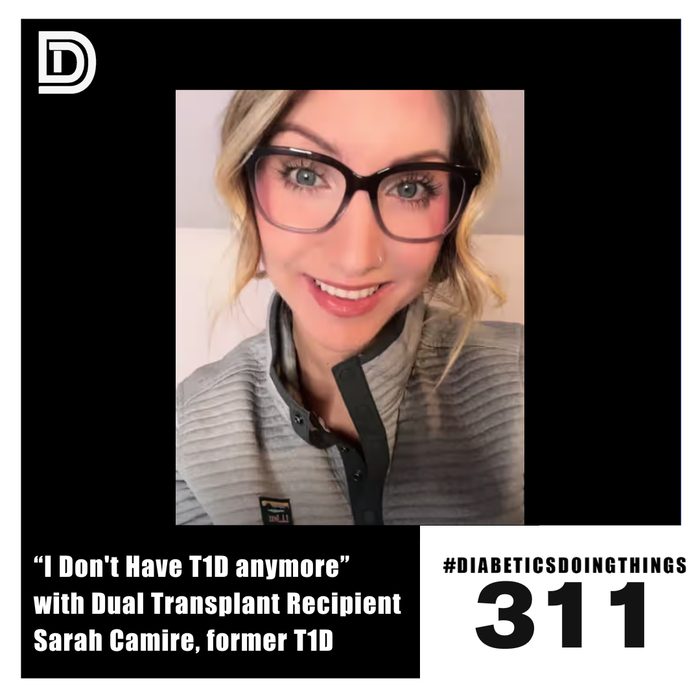
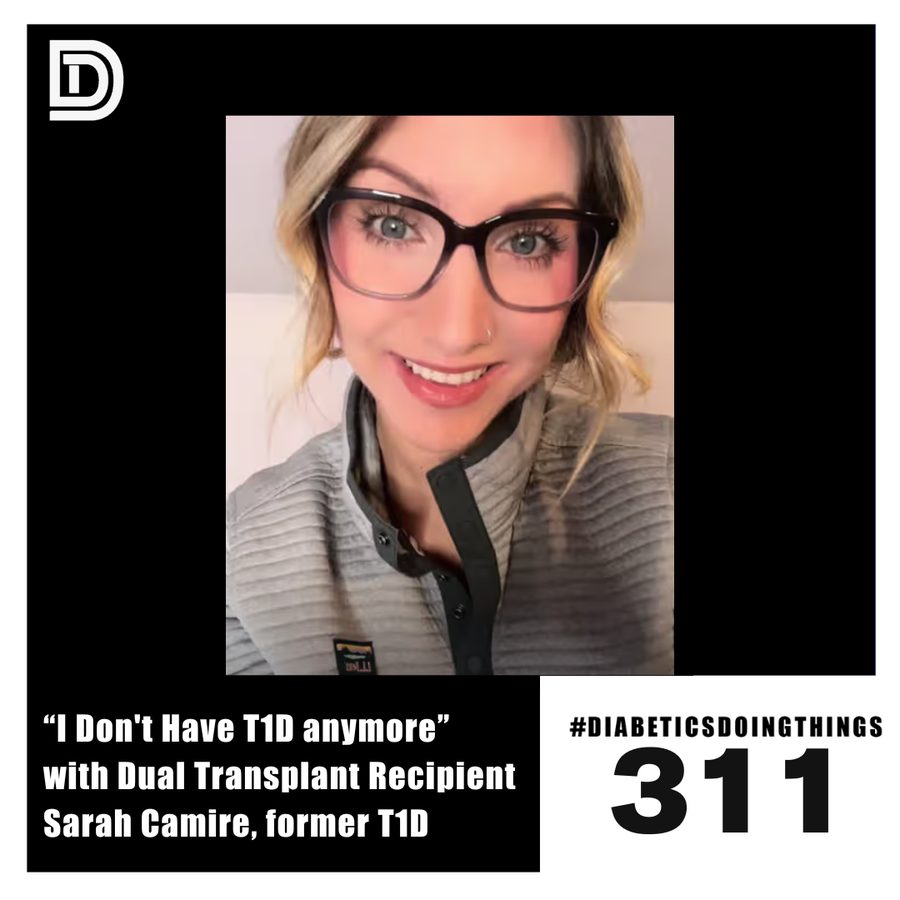
Sarah Camrie was diagnosed with type 1 diabetes at age two and lived with it for 31 years. She describes a difficult stretch in her late teens and twenties when she struggled with diabulimia for about six years, a period that ended after her husband pushed her to take better care of herself. Her second pregnancy triggered chronic kidney disease, and she spent over three years managing declining kidney function, including time on dialysis. In October 2024 she received a simultaneous pancreas and kidney transplant at Beth Israel Deaconess in Boston. She now lives without taking insulin and talks through the surgery's trade-offs, including lifelong anti-rejection medication, dietary restrictions, and the small freedoms she missed most, like taking a real shower.
Key takeaways
- Sarah Camrie went nine weeks without taking insulin after her October 2024 SPK transplant, with a 99% time in range even while on steroids.
- Her chronic kidney disease was triggered by her second pregnancy, and she spent over three years managing it, including time on dialysis, before the transplant.
- Sarah says she struggled with diabulimia for about six years in her late teens and twenties before her husband helped her change course, along with therapy.
- About 800 SPK transplants happen in the US per year; Sarah was the 18th done at her hospital in 2024.
- Sarah says the transplant isn't a fix to pursue casually: she tells type 1s to control their blood sugar so they don't end up needing one.
Show notes
Content Warning: Diabetes Complications, Diabulimia
In this episode of Diabetics Doing Things, Rob interviews Sarah Camire, a TikTok creator who shares her unique journey of living with type 1 diabetes for 31 years and experiencing a cure through a Simultaneous Kidney and Pancreas (SPK) Transplant in October 2024. Sarah discusses her life with diabetes from a young age, her struggles with diabulimia, meeting her supportive husband, and the onset of chronic kidney disease triggered by her second pregnancy. She elaborates on the complex decision to undergo SPK, the benefits and challenges post-transplant, and her new life without diabetes. The conversation touches on the importance of sharing her story to educate and inspire others, tackling misconceptions about the procedure and the trade-offs she's faced. Sarah's openness and positive outlook provide a profound insight into living without type 1 diabetes and the realities of organ transplants.
00:00 Introduction and Guest Introduction
00:54 Sarah's Diabetes Journey and Cure
01:49 Life After the Cure
03:13 Growing Up with Diabetes
05:14 Struggles and Support
10:52 Kidney Complications and Transplant Decision
14:35 The Transplant Experience
21:22 Life Post-Transplant
28:06 Reflections and Final Thoughts
Resources:
Questions this episode answers
What is a simultaneous pancreas and kidney (SPK) transplant?
It's a surgery that replaces a failing kidney and the pancreas at the same time. Sarah Camrie had one in October 2024 after her kidneys failed from decades of type 1 diabetes; receiving a new pancreas along with the kidney is what let her stop taking insulin.
Can a pancreas transplant cure type 1 diabetes?
For Sarah Camrie, yes: after her SPK transplant she stopped taking insulin entirely. She's clear it's not a routine option, though. Only around 800 SPK transplants happen in the US each year, and it's generally only considered when someone already needs a kidney transplant.
What is diabulimia?
Diabulimia is restricting or skipping insulin, often tied to body image or exhaustion with the disease. Sarah Camrie says she went through about six years of it in her late teens and twenties before her husband helped her get back on track, along with therapy.
What can't Sarah Camrie do after her transplant?
She follows restrictions meant to protect her new organs and avoid infection, including avoiding grapefruit, which interacts with her anti-rejection medication, and not reheating rice. She says these are minor trade-offs compared to having her life back.
Full transcript Searchable, with timestamps
Rob Howe: Hey there, Happy New Year from Diabetics Doing Things. It is January 2025, and this episode was the last episode we recorded in 2024, and it's important because it features someone who used to live with type 1 diabetes. We've never had anyone on the podcast who has either had a pancreas transplant or a beta cell therapy replacement that allows them to no longer have diabetes. So our guest doesn't have T1D anymore. Really, really cool. I felt like it was important to tell this story as I celebrate 20 years with diabetes because many of us are told at our diagnosis that a cure is 5 to 10 years away. I was told that. I know I see many people share that they were also told that. And it becomes really difficult over the years as time goes by when the cure is not out there or we read about trials that are successful but never make it to market for one reason or another, or really promising trials are put on hold, it can make you really cynical. I know I've gotten cynical about it at times, and I see that a lot. That's why I wanted to tell this story, to talk about C-words, other C-words, two in particular that people with diabetes don't always want to talk about, the cure and complications. We're going to talk to Sarah Camrie, who recently did an interview with the Boston Globe about her simultaneous pancreas and kidney transplant surgery, which is also known as SPK, which she was eligible for because of her complications of living with T1D for 31 years. In order for her to get the kidney transplant she needed, she also had to get the pancreas transplant. And we talk about all of that in this interview. She's also documenting the journey on TikTok, which is how we got introduced. And her account is you.can.call.me.sarah on TikTok. So if you searched, you can call me Sarah, I'm sure you'll find her. So if you want to go catch up on her videos, you should definitely do that. We've linked her account in the show notes for you to make it easy. Okay, and before I get to the interview, I also want to give you guys a content warning. We talk about diabetes complications and diabulimia specifically on this episode. So please use discretion as you listen. I hope you enjoy this amazing interview with the first person on the podcast who used to have type 1 diabetes. Sarah Camrie. Welcome back to another episode of Diabetics Doing Things. We are telling the amazing stories of people with diabetes from all around the world, and we've been doing it since 2016. We are publishing this in 2025, and this is a really important interview. We've actually never had anyone on the podcast who could speak to the topics that we're talking about today. So I met our guest on TikTok. The algorithm was algorithming. It found me like it does. And what we're going to talk about today, I'm going to introduce you to Sarah. She's you can call me Sarah on TikTok. And we're going to talk today about this very unique journey with diabetes and without diabetes that we're currently going through. So, Sarah, welcome to the show.
Sarah Camrie: Thank you so much for having me.
Rob Howe: It's great to have you here. So I'm going to spoiler alert here for our listeners who are probably in the car right now and aren't shuffling through their episodes. You lived with type 1 diabetes for 31 years. And in October 2024, underwent a procedure called SPK, which is simultaneous kidney and pancreas transplant. And as of today, we're recording this in December 2024. You're not taking insulin to manage diabetes. So we're going to call that the C word. We're going to call that cure. Your type 1 diabetes is, for lack of a better word, cured. And we're going to talk about that journey today.
Sarah Camrie: Yeah. As of nine weeks, I believe nine weeks ago Monday, I have not taken a drop of insulin. And, you know, I'm that C word again, cured of a lifelong battle and a struggle with something that really took over my life. So, yeah, it's that's where we're at.
Rob Howe: And we're going to talk about your diagnosis, but I just want to like just a micro moment before we dig into the full story. 31 years with diabetes. I'm sure you don't remember life before as you were diagnosed at two years old. Not having to actively manage your blood sugar for the last nine weeks, like all the other things aside, like what what has that been like?
Sarah Camrie: Very surreal, I would say. I am still wearing a Dexcom. I am still checking it very regularly. I'm very much a type A person. So I'm constantly checking my app, making sure. But I've noticed sort of over the past week or so, my time and range is 99%. That's on steroids, which everyone knows really messes with your blood sugars and with zero insulin. I've kind of accepted, okay, this is real life. This has really happened. And I need to just let things be things. Let them just kind of do their work, do their job, not be so much on top of it. But, you know, after 31 years, it was my life. So it's hard to just put that aside. It's just very surreal, I'd say.
Rob Howe: I couldn't expect it. That to me is it lands really, really hard for me. It's like to also the steroids conversation, which is another part of the discussion that we're going to have later about choosing to do the SPK, but to know that there's someone out there who had diabetes for 31 years and now is 99% time and range while on steroids and other medications. Wow, that's inspiring. So Sarah, let's talk about your life with diabetes. Diagnosed at age two, what do you remember about growing up with type 1?
Sarah Camrie: Oh boy, you know, I never felt different. I did take insulin shots. Back when I was diagnosed, I am in my 30s. So back when I was diagnosed, I knew nobody else with diabetes. You know, pumps weren't a thing, or at least for me, weren't a thing. I was taking one shot a day. My mom was having to navigate what her two-year-old ate in the morning. She would have to give me a shot and decide, plan out the day. Okay, she's going to eat these things. And with me having children of my own now, mine are older, and I still don't know what they're going to eat through the day. Sometimes I make a full dinner and they eat, you know, two bites. So that really blows my mind that my mother was able to do that and to manage it so well and keep it so well controlled. Me growing up, though, I just I was always able to do everything. My parents never really made any kind of fuss about it. It was just what it was. I never felt different, I don't think. There were moments I can think back to where I'd be eating snacks in class and some of the kids would be mad or jealous. and I have a very close, close friend now who was recently diagnosed later in life in her 20s and she and I joke about how she was so jealous of me getting to have snacks and back then I kind of took it to heart. It's all bad, but now I'm like, it's just such a funny story and now she totally understands and it's just growing up, I had a great childhood and never felt different. So I'm really lucky in that, I'd say.
Rob Howe: That's funny how the things we remember as kids and, you know, and friends where now diabetes is part of her life and she's thinking about, you know, those moments where she was jealous and now she really relates in a totally different way.
Sarah Camrie: She totally does. Yeah. And she's so nice about it. Just love her so much.
Rob Howe: She's got that new diabetes smell on her. She's still still figuring it all out.
Sarah Camrie: Yeah. Yeah.
Rob Howe: You mentioned in one of your TikToks the idea of like turning back time and that, you know, you've lived a long life with brittle diabetes and hypo unawareness. You know, talk a little bit about those moments where those of us who've had diabetes for a long time, you know, I'm about to cross 20 years here in the next two weeks. And there are moments where we're focused on other things or we are embarrassed or we're hiding or we're trying to fit in or we're just flat out rebelling against our parents and authority and all that stuff. So, you know, we look at the bell curve of A1Cs over the lives of patients with diabetes. And in those young years, it's typically the highest. So, you know, when you look back at where you are now, like, how does that land for you?
Sarah Camrie: It's a hard pill to swallow. That's how I'd probably put it. I talk to my mom about it a lot. She always says, you know, you can only go forward from here. Don't think about what happened in the past. You can only move forward and take better control each day. Move on. Do better. But, you know, in my late teens, early 20s, I very much rebelled. Very much didn't want to, you know, be diabetic. I struggled very hard with diabulimia for a long time. I think about six years. and it took meeting my husband and him telling me, you're perfect. Why are you doing this? You know, why do you, why? And I didn't really have a good answer for him. And he just said, well, I'm going to help you out. What can I do to help you? And I remember one of our first dates, he was the first time he gave me a shot. And at that moment in my life, I was taking shots maybe every three days, maybe. I was running so high and so bad. I was so sick, 24 seven. I don't even know how I was dating him, you know, so he really helped pull me out of that. And I'm very lucky. Lots of therapy also helped. But it's just that thing that a lot of young adults go through in different ways. Mine was probably a more on the more bad side of it, I'd say maybe not always that bad, but I definitely just denied it. Didn't really think that there was any much to live for. You know, I was just like, whatever, like this disease is what it is. I'm sick of having it. I'm just going to pretend like it's not there. And it just did all my damage. So if I could turn back time and just go back to that girl that was told by every single doctor and every single person I met, my parents, everyone, you're doing damage to yourself. You're going to regret this. If I could just go back and listen to that inner voice and say, they're right. Let's change things. Let's just start taking our shots. let's just start checking our sugar like we should, I would go back in a heartbeat because that would really prevent me from where I'm where I'm at now. Even though I'm in a good place, it would have stopped the seriousness of what I had to go through to get to where I am now.
Rob Howe: Thank you for sharing that. I, you know, I agree with your mom. Like, you know, you can't change the past, right? You can't go back. And if we could, we would all do things over. I want to touch on a couple of things because we've had Aaron Akers, who's a friend of the pod from the Diabulimia Helpline, which we'll link to in the show notes. So if you or somebody you know is struggling with Diabulimia, you know, please check that out. I want to go back, though, to your husband because he had a boyfriend at the time. We have heard so many
Sarah Camrie: stories. He's the best. I wish he could be on his podcast with us right now. He is the best.
Rob Howe: Well, maybe we'll have him on because he was I got to like really quickly meet him earlier because he was helping us with some tech support stuff. But we hear a lot of stories about the challenges of dating with diabetes, especially for young women, because diabetes is gross and it's there's needles and injections and scary. And, you know, it's weird to explain that to basically a stranger on a date, you know, for the first time when you're just trying to get to know each other. And I don't hear too many stories like the one you just shared, where, you know, somebody has is able to see you and hold space for you and your diabetes and also say, I can help. I can be there for you. I don't have diabetes, but I can help you. And that kind of support on the family side, you know, without it, you know, maybe we're not even having this conversation. Right. And so I think like, I don't know, to me, that just is really, we're talking about C words today on, on the podcast. Complications is not something that we like to talk about. The mental health complications, the physical health complications, you know, neuropathy, kidneys, eyes, you know, all of these, it's uncomfortable and it's, it's difficult to talk about. And we want to believe, and I think we've been led to believe, like, that doesn't have to be true for everybody. But at the same time, you got to leave room for it because a life with diabetes over a long period of time has complications. Because, you know, if we weren't...
Sarah Camrie: And it's just naturally, too.
Rob Howe: Yeah, exactly. Like, it has nothing to do with your control, right? And so... Right, yeah. Because we're all different. Everyone's diabetes is different. Everyone's response to a lifelong, you know, taking insulin and other medications, like, we have different responses. And, you know, the alternative is like we would be dead otherwise and so like you know all things considered it's not too bad so right and you know i see that from a very privileged place like i don't have any long-term complications currently after 20 years which i'm very grateful for but if i were to have one that doesn't make me less of a person down the road or doesn't make you a bad diabetic quote unquote for those things so going through those times and like coming out of them and going on the other side of it right like coming in and taking better care of yourself like finding um you know, the love of your life and having him kind of help you bear that burden and be there to support you. You did start to see some complications later on. So talk a little bit about how the kidney aspect of things came up for you and what those conversations were like.
Sarah Camrie: Okay. So the kidney issue, they say, the doctors say that my chronic kidney disease, CKD, was onset by gestation. So I touched on the fact that I have a family of my own now. I do have two kids. They're both elementary age, so they're young. But my second child, when I was pregnant, she was a micro preemie, but that was not due to anything wrong with her. She was perfectly baking in there. It's just my kidneys decided that they had enough. And for whatever reason, they started to fail. I had her very early, obviously. And luckily, she has no complications. She's beautiful and wonderful and perfectly. But that's when my whole neat process of this journey started. It happened right away. The CKD part of the journey right after pregnancy, right after birth, wasn't major. It was just something that they were talking about. They were letting me know, this is what's happening. Before you know it, you will be at stage five. You can manage it where it's at. But to be completely honest with you, the way that you're how it's dropped so suddenly so fast, it's going to continue to drop this time. So she's five now. I dealt with end-stage renal disease for a little over three years. So maybe two years, I'd say, post-birth. I was just living life normally and praying for the best. But I knew, you know, that lingering cloud was over my head. This is going to happen. So at that point of giving birth is when I started to really research and dive into kidney transplants, which led me to, you know, diabetes with kidney transplants, which then led to SPKs, PAKs, which all are pancreas in association with the kidney. And that's where I kind of started to learn about it because before that I never knew anything about it. Most diabetics don't. I would just say that's kind of the whole kidney aspect. It just started with that second pregnancy. And it's something that I've noticed a lot of women do go through when the pregnancy, being type 1 and especially for having it for so long, the complications that just arise out of having the pregnancy because it's so taxing on your body, it just, they start to appear. So a lot of people have that onset digestation complication.
Rob Howe: Well, and I think it goes back to when you have a type 1 pregnancy, it's classified as high risk for a reason. Like there's still obviously, yourself included, many, many, many examples of successful pregnancies with healthy babies and healthy moms. Oh, definitely. But there is complications associated with, you know, living with type 1. And so especially, like you said, over a long period of time, not to even exclude like hypo-1 awareness, which is also like a challenge, right? And insulin resistance and things of that nature, which are just symptoms of living a long time with diabetes. So while you're going through this process of learning about SPK and you, it becomes clear, right, there's something needs to be done about your kidneys. Like you're going to need to have a kidney transplant. And what I've learned from your content is, you know, like you said, most diabetics don't know about the various operations or procedures. I didn't know about the statistic that more than 10 people die every day waiting for a kidney transplant. I know I see a lot of dialysis centers here in Dallas. There's a lot where I live. I know that's another big part of some of these new drugs that are out for people to help preserve their kidney function and things of that nature, which is encouraging. But there's a lot of people who need dialysis and need new kidneys. so when it became clear that you were going to need a kidney transplant and learning about all of the other sort of obstacles that come into play with that how did that play into your decision to go spk because i also have learned your content is very educational again i encourage everybody to follow you at you can call me sarah on tiktok because you talked about steroids which most people living with type 1 know like are like the bane of a person with diabetes existence whenever you're on steroids like because you need them to get better or you need them to you know after a surgery or to recover but they are terrible on your blood sugars like just the amount of insulin you have to use to stay in range is tough so the pancreas transplant also helps you navigate that period where you have to be on steroids because the pancreas is doing its job and it has the ability to do that so it's a lot of questions all in one but talk about like how you learned about SPK and how you decided that was right for you and what all went into that.
Sarah Camrie: So for my region, every region is different in the United States. Just simply waiting for a kidney because there are so many people that need kidneys. The wait time is based on region and also based on blood type. Luckily, I have a blood type that is one of the more common ones. So that That was playing to my advantage, which doesn't really seem like it because it was still just for a kidney seven plus years for me to wait. And I did, while doing all of that research, find out that if you were to go the SPK route or the PAK route, typically your wait time shortens from seven years to two to three years. For me, I knew it would be a challenge to get on an SPK list. No one ever told me it would be easy. I've always been up for a challenge. So I started the process. Unfortunately, in Maine, where I live now currently, there is no hospital that does SPKs or PAKs, pancreas transplants. There is few and far between where you can find a place that will actually do one and can do them and have a track record of good, long-lasting result. Luckily, I'm so close to Boston that I started looking into the hospitals there and eventually found a, well, two of the most known hospitals in Boston are Mass General and the one that I was transplanted at, which is Beth Israel Deaconess. And Mass General's program actually shut down the pancreas side of things. They lost their surgeon. So just by a random turn of events, I made the decision to go to Beth Israel, which I'm so happy I did. But they have a great track record. And they just, I can't tell you enough how great and happy I am with them. It's just one of those things, you know, wow, the brain fog is really hitting me right now. Well, no. I'm thinking about everything I need to say. I'm like, what are the questions that he's telling me? But it's just it's one of those there's a side effect coming up of these anti-rejection meds that I'm on now. The brain fog is something that I really the only side effect. But it's an embarrassing thing. I'm learning to deal with it.
Rob Howe: But well, I'm glad that you because we talked about this prior to recording and I'm glad you brought it up because it's important, I think, to have in a long form conversation like that wouldn't show up in like an article or, you know, maybe they wouldn't publish it. It may be in like a traditional interview. But I think it's important because you have been really open about sharing the challenges and sharing the side effects. So a little brain fog on a long form podcast is not that big of a deal to me. So it may be a big deal to somebody else, but I am fine with it. And I would rather like have a real authentic conversation about it because it is complicated to think about and having to balance all this in your head while you're actually going through it. And, you know, you were talking about not very many hospitals do this operation because it's risky and it doesn't work all the time. And I think now we're in a place where there's more research and there's more evidence and the protocols or what have you are more successful. We know more about it. But even a few years ago, like this wouldn't have been something that was more widely used.
Sarah Camrie: Just not that common. I believe there's like 800 or so done per year in the U.S. And if you break that down based on the U.S. population, it's a very, very, very small amount, way less than 1%, way less than even that. And I believe for Beth Israel, they pump these things out. They really do a lot of them. And I was number 18 of the year. If that tells you anything, in mid-October, number 18. And when I was readmitted in November, I asked the surgeon, have you done any more? I said, no, you have been the last one. And this is end of November, beginning of December. I could be the last one of the year for them, which it's just not as commonplace. I don't want people to think my content, it's easy. It's something that is easily available for everyone. It's not. It's definitely something that was challenging to get, challenging to find a match for, challenging in many ways. Kidneys are a little bit easier to donate. It's just not as complicated as the pancreas. The pancreas is a very finicky organ. Yeah, I can co-sign that. very very cynically you would know so it's it's just one of those things when you transplanted it's really got to be healthy the donor thank god my donor thank god for them but they were very healthy and from what i've heard from my surgeons and from what i've heard from the doctors is this pancreas that i have is you know the kidney's great just because the pancreas is so good But they love to tell me how beautiful it is. They love to say how it's one of the best they've seen. Luckily for me, it was not outside of the donor's body for very long. It was a very fast donation and an implantation into my body, which being that the person was deceased, that is a very, very good thing. Because every minute that that person is gone, there's no blood flow. There's no circulation. There's all of these things that your body needs for your organs. I just feel very, very lucky and very blessed that I've been able to have that and it's been successful so far. But yes, there are complications even from the side effects from the medication.
Rob Howe: Well, let's talk about them because you are choosing to share your journey on TikTok, which I'm glad you are because that's how I found you. And the algorithm was doing its thing. But you were very open about, you know, sharing comments from people. you and I were talking prior to the interview about how we wanted to really make sure that we're not billing this as like a cure for everything that's like accessible to everyone and everyone should do. There were a lot of obstacles and a lot of real serious reasons why this was even an option for you. The big question is somebody asked or commented on TikTok and you responded like, was it worth it? Doesn't seem like it was worth, like it would be the trade-offs would be worth curing the diabetes. And I know obviously your situation was very different. It was needed. It was necessary. But if you're answering the question, like, should someone look into this? Your answer, I think right now is not unless you have to. Exactly. Yeah. Not
Sarah Camrie: unless you're at the point in your life that you need to. It's good knowledge to know. I wish I had known years before just so that I could have in the back of my mind, you know, one day if I ever get to this point. And that's what I hope that I bring to the type ones out there is let Let me tightly control my sugars so that I don't get to the point she's at because I don't want to be one of 800 people in the United States. You know, the chances of that for me are a lot lower, you know, and I just don't want everyone to think that if they get to the point that I'm at, that they're just going to be given this transplant because that's just not how it works. Unfortunately, a lot of things have to line up perfectly. I just really hope that people are able to take what they need from it, whether they're at point of being on dialysis and they don't know what their options are and they need this, I hope they can learn from what I'm offering and from what I've been through so that they can ask their doctors and make the approach and make the attempt to do the same thing I've done. Or on the other hand, just, you know, your average type 1 diabetic that's living healthily. I hope that they're able to see this and say, wow, I don't want to go through that. I don't want to have to live a life without swimming in pools. These things I can't do anymore.
Rob Howe: Without reheating rice, right? I think that was... So you've been like...
Sarah Camrie: They're such silly things.
Rob Howe: And you've been really awesome and open about sharing the list of things that you're currently not allowed to do. And some of those are just short-term and some of them are long-term.
Sarah Camrie: Yeah, some will go away. But there are a few that my transplant teams are just very adamant on. They're like, just don't do this. It's just not a good idea. The risk of infection is so high. You are so compromised. So some of them do sound a little crazy, but some of them like not eating grapefruit. Grapefruit directly affect my anti-rejection meds. People become toxic. The medication is a toxic medication. So too much of it is toxic. Too little is toxic for you as well. So, you know, consuming that specific fruit, just they found it directly affects it. And it's something that is hidden in a lot of things. So I have to be vigilant on that one. That one will never go away. But it's the trade-off, you know, you have to look at it like for me, I have life again. So I don't care. Like they could tell me, you know, you could never go outside again. And I'd be like, all right, I'm never going outside. I'm never going to have a tan again. I'm just going to be living, but living indoors. And I would be fine with that. It's just what you got to do. You got to roll with the punches. And I feel like diabetes in general, that's just, you learn to just adapt. And you don't know where you're going to have a low blood sugar. It can be the middle of the mall. It could be while you're driving your car. It could be at any time, at any moment, as we all know, and you learn to adapt. And I'm doing the same thing now.
Rob Howe: I'm just adapting in a different way. I couldn't have said it better. I think one of the things that in the community and clinical conversations people have, they're like, you can do anything you want with diabetes. The life that you want to live is out there. You know, my care team as well. Some people, I think, and myself included, like I have to make sure that we're making that inclusive because diabetes looks different for everyone. But now your to-do list or your can't-do list, rather, is kind of long. And so like, how does the you can do anything you want with diabetes
Sarah Camrie: language, how does that land for you now? It still lands. These things are so minor in my head. They really are. I have, you know, a couple of them kind of stink. Like I would like to go to the water park with my kids. They love it. I love it. I want to go. But over the past three years with dialysis, I had a catheter into my heart. It could not get wet. Let me tell you, the first shower, real shower that I took post-transplant was phenomenal. I had been dying for that. Just being able to stand under the water and be able to take an actual shower where my chest, where the catheter was, you know, is healed and it can be wet now was such a weird feeling. But But for those three years, taking my kids every summer to the water park, I just sat out and watched them. It's fine. It's just one of those things that, of all of the lists, I think might be the hardest for me because I would like to join my family and do those things. Luckily, we do have a pool in our backyard that I can get into anytime I want. A private pool is fine. But it's the risk. It's the, you can do it. A lot of people with transplants do all these things, minus a few, like the one I mentioned about the grapefruit. But they do these things. These things are not meant for you to stop living your life. They are just precautionary things to try to protect the organ. They are giving you these organs so you can live. So in my head, I'm not being stopped from anything. I still can do literally anything I want and even more now because I'm not sick. I don't have that gloomy cloud over my head of not being sure if I'm going to wake up in the morning. I know I'm going to wake up. My body is functioning perfectly. I'm going to be able to go out and do whatever I want. Am I going to be able to reheat my rice? No. It's okay. I'll just make a new pot. You know what I mean? There are such minute things to me that I have to live with now that I'm like, oh, it's nothing. It's really nothing.
Rob Howe: I am so encouraged by your mindset and your outlook. Hearing that story of like, you know, you getting to take a shower, a real shower. After three years. And like the little things. I heard recently a healthy person wants 10,000 things and a sick person only wants one thing.
Sarah Camrie: And mine was the shower for sure. Yeah.
Rob Howe: And to be able to wake up and like feel confident that you're going to be OK. Yeah. And I also think just the decision for you to share this very deeply personal thing on TikTok to a lot of strangers inviting unwanted comments. and very invasive type of things, like as a person who lives their life pretty publicly online, it takes courage. I'm really grateful that you did that because it's allowing us to have a conversation on this podcast for the first time about transplants and about a life without type 1 diabetes, a real life without type 1. And there are trade-offs, but also like hearing how your mindset and the things that type 1 diabetes and living with type 1 diabetes taught you is now you're able to apply to something a little different and give you that same outlook and rolling with the punches and continuing to adapt to live your life with your family and be happy and healthy. It's really encouraging. So thank you for doing that. I know it must not be easy. I'm sure there are moments where you're questioning it or it feels cringy or what have you. But thank you for doing it.
Sarah Camrie: Yeah. Yeah. No, thank you for acknowledging that. That really feels validating to me. Kind of questioned while I was really in the midst of things. While I was really sick, many times my husband getting calls from the doctor saying, this might be it. You got to get to the hospital. This might be it. I wasn't on that side of things. So that's that's something he would have to speak on. But for me, I just always tried to remain positive and try to find the sunshine in the situation. And what I always told myself was, if I make it through this, I'm going to make sure that my story's told, because there are so many people that do go through this, but have no knowledge. Like I researched it. I tried to find people on And there's a few here and there, but nobody really as open that I needed. So I really always told myself, you know, going through my life, being diagnosed at two years old, there's got to be a reason for this. And for me, I feel like the reason this this is becoming the reason there is somebody out there that needs to hear this. And I need to share it for that reason.
Rob Howe: Well, thank you for sharing it. And thank you for embracing that purpose. I really only have one more question for you. And it's a little bit trivial, but I've got to know because I've had conversations with people over the last 10 years and you will laugh. It's like, OK, if diabetes is ever cured, like what are you going to do? What is what's the one thing that you do? So now not having to inject for things, not having to worry about, you know, what your blood sugar is going to be four hours after you eat Chinese food or whatever the case is. Like, what did you what was your like, hey, I don't have diabetes anymore. Like, what did you do? What was your thing?
Sarah Camrie: Well, I have a little it's two parter for you. First thing was I ate a bag of gummy bears. Had to. First thing I ate post-transplant, I begged my husband, just go get me a bag of gummy bears. I want to see if this works. And I ate the whole bag. I had a little, like everybody has a spike in your blood sugar, a little spike, but it went back down to normal perfectly, very quickly within, I don't know, 15 minutes. So that was really cool. But my biggest takeaway is not the fact that I can eat whatever I want, whenever I want. It's that I don't have to eat when I don't want. because that was always something I struggled with because there was times my sugar was so low and I'm like, I don't want to eat anymore. I don't want to drink any more juice. I'm tired of eating all this peanut butter. And now it's not something I have to worry about. If I'm not hungry, I don't have to force myself to eat something just because I know I have that insulin on board. And that's been, it's probably not the best answer. No, that's a great answer. Not as great. You know, I'm not going to the moon or anything, But it's just something that's small that I've really noticed that I'm like, well, that's my the biggest takeaway from this for me has been I don't have to eat when I don't want to eat. And it's been really, really nice. A nice change.
Rob Howe: That is a great answer. That's what I was looking for. I think like, you know, for me, it might be as trivial as just like eating pizza. You talking about eating gummy bears. Like I haven't had my joke that I tell, like my bit that I do with people is that these are medicinal gummy bears. Like I think of them as medicine. I don't really think of, I haven't had a gummy bear for enjoyment in a long time. So yeah, that's really cool. That's really, really cool. And, you know, again, I am looking forward to having more conversations like that in the future. Thank you for being so open, Sarah. And we're going to link to your TikTok in this episode. And again, I hope that you, A, find more people like you who are willing to share their stories and encourage somebody out there who's been living with SPK and hasn't opened up about it to do that because I think when you're open about diabetes or transplants or whatever it is you're going through, connecting with those people in the community is such a huge thing. So it affects your quality of life for the better. And so thank you for leading the way on that. Well, thank you
Sarah Camrie: so much for having me. It's just another avenue for me to share the story. So I really, truly
Rob Howe: appreciate you. You as well. Well, everybody be on the lookout for this episode and give Sarah a follow on TikTok at you can call me Sarah. There's periods in between instead of spaces, but we'll link to her in the show notes. And thank you for listening to Diabetics Doing Things.
About Sarah
Sarah Camrie is a TikTok creator (@you.can.call.me.sarah) who lived with type 1 diabetes for 31 years before undergoing a simultaneous pancreas and kidney transplant in October 2024 at Beth Israel Deaconess Medical Center in Boston.