

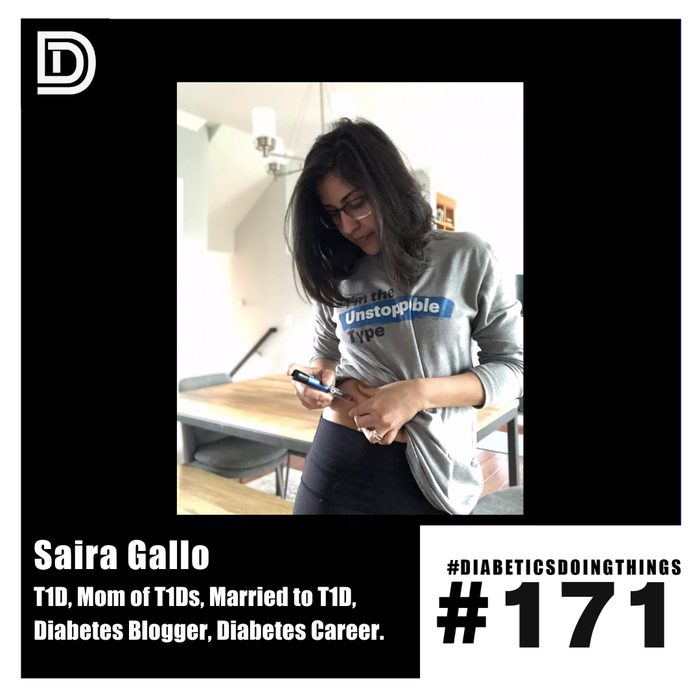
Saira Gallo T1D, Mother of T1Ds, Married to a T1D, Diabetes Blogger and works in Diabetes!
Episode summary
Saira Gallo was diagnosed with type 1 diabetes in fourth grade while living in Pakistan, after a long illness ended in DKA. She switched schools after classmates believed diabetes was contagious. Years later, serving in the Peace Corps in St. Kitts, she met her husband, who also has type 1, when he noticed her insulin pump. Before having children, the couple saw a genetic counselor about the odds of passing on diabetes and agreed they would have kids regardless of the outcome. Both of their daughters were later diagnosed with type 1. Saira talks about switching between looping and Control-IQ to manage the cognitive load of caregiving, splitting overnight and daytime duties with her husband, and relying on her parents and sister for backup.
Key takeaways
- Saira and her husband met in St. Kitts when he noticed her insulin pump and showed her his own.
- A genetic counselor told the couple their odds of having a child with type 1 were around 20 percent; both of their daughters were later diagnosed anyway.
- Saira switched between Loop and Control-IQ over the years specifically to reduce how much diabetes data she had to manage, not because one controlled blood sugar better.
- Her husband handles nighttime lows for the family because she sleeps through alarms, and her parents have the garage code to help when needed.
- Saira says managing her kids' diabetes has been harder for her emotionally than managing her own.
Show notes
We’re back and with a new format and new partners! Each week Rob and Eritrea will update you on all the goings on at Diabetics Doing Things, and integrate that into the show prior to our guests.
This week we talk about:
Trouble with infusion sets and what to do about them
Eritrea digs in on a recent laser treatment for her retinopathy
This week’s guest is Saira Gallo (@Type1basics on Instagram)
Saira lives with T1D in California with her husband and two daughters, all of whom live with Diabetes
Saira, Rob and Eritrea discuss, among other things:
Saira’s T1D Diagnosis
Early life with T1D, changing schools due to bullies
Meeting her future husband because he saw her insulin pump
Being married to someone with Diabetes while you have Diabetes
The decision to have a family, even with the risk of Diabetes
Raising a family with 4 Diabetics
Normalizing devices, lows and highs
Managing Burnout
and MORE!
Questions this episode answers
Can two parents with type 1 diabetes have a child without it?
Saira Gallo says a genetic counselor told her and her husband, who both have type 1, that their odds of a child also having it were around 20 percent. Both of their daughters were diagnosed with type 1 anyway.
What is it like when a whole family has type 1 diabetes?
Saira says mealtimes with her husband and two daughters, all type 1, are chaotic and someone is always checking who pre-bolused. She says her kids have even referenced pre-bolusing and lows in their pretend play.
How did Saira Gallo meet her husband?
She met him in St. Kitts while serving in the Peace Corps. He noticed her insulin pump and pulled out his own matching one, and they stayed close ever since.
Does having type 1 diabetes yourself make it easier to care for a child with it?
Saira says it helps her relate to her daughters, but she found caring for her children's diabetes far harder than managing her own, including nursing her infant daughter through overnight lows with finger pokes every 20 minutes.
Full transcript Searchable, with timestamps
Rob Howe: We got the background noise. We're in person right now. Yeah, it's so different. We don't ever do the pod in person. I'm actually having a really hard time. I don't know. I can't even make eye contact with people. Is that weird? Yeah, but that just says more about you than it does about them. Also, you don't want to just make vicious eye contact the whole time. I just don't do it at work now at all because I feel like we're not in person anymore. So I'm used to seeing someone on a screen. So now I have to make eye contact. I feel so uncomfortable. I'm like, oh my God, this is so intense. I was kind of talking to, and we were speaking about this before we hopped on the episode. Like we're burnt out. And I think a lot of it is just like the world in America, at least it's opening back up. So we're now having to see people face to face and traveling and you've been on, you know, you went on vacation. I've seen, you know, a lot of folks talking about burnout and talking about feeling like they don't understand what to post anymore and they don't feel. And you made a really great comment of like, we're all kind of like getting older. more responsibilities like less bright-eyed bushy-tailed I don't know you feeling that I mean I feel like okay so I oh my god I'm 28 now so I think when I started being a diabetic advocate I was like a CIT at a camp I was like 17 like this is so cool I'm so I'm so cool because I do this right and now it's just like this additional task I think you start doing advocacy yes for other people but also to like add to your resume to like build yourself as a person And as we're getting older and we're finding our careers, it's just like, okay, like, where is this going? Where am I going? And as the internet kind of molds and changes, we're trying to figure that out too. Like Instagram straight up saying like, hey, don't post your pictures no more because we don't care about them. Like, bro. We want you to make videos. Right. So it's just like, oh, I thought I was doing advocacy this way with my photos. Now I have to change because of some algorithm. So it's like annoying. Yeah. I don't know. It's interesting. I don't know. I mean, times they are changing. You know, it's just how that works. But yeah, I think advocacy journeys are different for everyone. And I think everybody has a different phase. Like you said, when you start out, you're super excited. Same thing with the online community. You meet other people who are like you and you feel welcomed by the community. And even seeing some people do that for the first time this week, now I feel like the people who were around when I did that and they're like, oh, I'll just wait. You don't even know what can of worms you're opening. At the same time, I still encourage people to do that. It's super important, but you got to, you know, pace yourself sometimes. And I think, you know, seeing some, you know, we talked to, we talked to Sarah today, Saira Gallo, the amazing story of her life. And you're going to hear some really just like heartwarming mother daughter stories, as well as like, you know, diabetes couples meeting in the wild, like insulin pumps being the first, like, you know, intro to somebody that you're gonna spend the rest of your life with. And like those things I think are really heartwarming. And I'm glad that we have those stories to share because otherwise it is really bleak sometimes, especially when diabetes, like you went on vacation and had a pretty serious diabetes hiccup. Oh my God. Okay. So last week we talked about the occluded sites and I was like, yeah, I'm totally gonna take care of this, blah, blah, blah, blah. And then of course I still went on vacation and I was like, I'll deal with it when I get back. Like it's fine. And then while I was on vacation, I had like four or five occluded sites while I was on the hike. So I, you were only gone for like less than a week. I was gone for five days. um so for you guys i went to arizona i went to page arizona to check out lake powell it was absolutely beautiful also kind of sad just to see the water level so down but climate change whatever um and then i got to go to horseshoe bend but i had occluded pump sites the whole time makes it really hard to enjoy it when your blood sugar is not doing so awesome like your blood sugar is kind of high i don't know about you i'm kind of a jerk one of my blood sugar is not the best like for sure i suck um and on top of it i thought texas was hot rob bro arizona is like it's the desert it's hell man it is 119 degrees in this hell like at least it's dry bro it was and my blood sugar is high so anyway long story short guys is at a bunch of occluded pump sites i finally got a good one um when i finally got a good site i had already reached out to a bunch of people i'm so grateful for the community um shout out kiyomi night uh over teronda is her username on instagram she's a really good friend of mine and she she was gonna hook me up with syringes if I needed them. Like it got that serious on vacation. Um, it's just frustrating, I think to have diabetes stuff come up, but it's part of life. It's, it's just something Saira said last night really like stuck with me. Uh, she said sometimes just in the background. And so I was really thinking about that because I was trying to take stock of my trip and like the whole point of it was to just go and be mesmerized by like the beauty of the earth. Right. Like just get outside. And in the link, like long scheme of things, like my diabetes made up a fingernail of like the trip like it was just in the background just one annoying thing to deal with because otherwise it was such an amazing time so i think maybe if you guys are feeling burnt out i definitely was like rob knows go somewhere go look at something beautiful go take stock of your life because i mean i don't know it's easy to feel really burnt out it isn't like i think we're all so used to over the past year year and a half now wow oh my god just being on our phones all the time and like always having access to this information. And I was, I was reading some stuff yesterday on Twitter. I mean, just some terrible shit, man. Like, and I'm, and I'm questioning, why do I have access to this? Like, this is becoming a burden to me. And even if this was my sole passion, I couldn't, this particular instance, it's like, there's nothing I could do about it. Even if I dedicated a hundred percent of my time and, you know, I had some low moments, not blood sugar related necessarily this week, but just low moments of like, even if I wanted and dedicated my entire energy and being to solving this particular problem, like it would not change. And that is really frustrating. And it's like, you know, I just wish I wasn't cursed with this information at the same time. I'm glad that I can have some sort of awareness about it. Um, but man, I don't know. It's, it's a, we're living in interesting times and I think everybody's tired. I think diabetes always in the background and sometimes like really forces its way into the foreground. I didn't tell anybody this, uh, but you talking about your vacation made me remember like we Erica and I went for her birthday to Mexico and the first day I had an I got an included site and I wasn't sure if it was you know those ones that are like kind of kinked or whatever maybe you're just insulin sensitive and I had tested and then I you know had some afresa so I used that because I just keep that for backups in case I go really high you know or something and there's something bad happens and so I was keeping that in line and then like Like it just wouldn't come down. It was like 400 and just like flat line. Like wouldn't come down, wouldn't come down. So I finally changed the site. I got things rolling. I was like, man, this like ruined my whole, I only had five days there. It ruined like basically a whole day. Yeah. And, you know, at that point, it was the first day of the vacation. I was like, I'm not going to let this ruin the trip. And I didn't think about it. You know, fortunately diabetes was in the background the rest of the time. But, you know, you got to, it's one of those things. Like I think people with diabetes are better at it than others because they know that they feel that chronic weight. And it's like, well, either I can focus on all this bad stuff or I can just kind of block it out and still do my thing. And I don't know. I think that's just a hard thing for anyone to understand. And it doesn't mean that diabetes is not important or that it's not difficult. But I just refuse to make it my whole life. I can't. I'm just not. Do you ever have chronic guilt? Like, do you ever, like, feel guilty for being sick? Like, okay, so there was this one point of the trip where we're literally walking up to Horseshoe Bend and my blood sugar is 105. five and I was like there's no way I can walk for 15 minutes and I'm not gonna be low look at my bag no juice box way to go Eritrea so now I gotta tell these two healthy people that we gotta turn around and go get a juice box and I just feel so guilty when stuff like that happens because I'm just like you stupid sick girl like why don't you plan better stuff like that I had to do that once in in LA and we were in an Uber and I was going out to dinner with my friends and we had gone like five minutes and I was like man we gotta turn around because I just don't have I think it was my, it might've been my insulin or something was like, I got a low reservoir. It was like too low and I had to go back and I was like, okay, I have this stuff in my bag here, but we got to go back. And it was just like a 30 minute detour and I felt guilty about it. Yeah. But I was with like really good friends that didn't care. Um, maybe we even walked. I don't know. It was something just dumb. But you still feel bad. I was with my husband and his best friend. I still felt awful. Like I was like, I'm sorry. I'm so sorry. I'm just like the whole time. So I think sometimes at sick people we feel guilty for being sick i don't know i mean sometimes i feel guilty for being able-bodied really like i you know diabetes really ain't shit to me like oh okay big dog i'm sorry my bad yeah i know i mean like and you know certainly i have my bad days and i have like my mood swings with low blood sugars and high blood sugars and such and i if i had to give it back i absolutely would return to sender yeah return like please give me my money back uh but i i'm you know i tell that line between be very grateful that i that this disease resonates with the way my brain works and it's just outputs and inputs and that's just how i view it and you know when i was younger i used to be like well you know if i had to get some chronic illness like at least it's something i can deal with you know and you know there are a lot of people with diabetes that also get other chronic illnesses that stack up you know i mean wild because your body's messed up. Yeah. And you know, truthfully, I'm not able bodied a hundred percent. Just like you said, I got to, I can't, there's times I just like, can't go do something. I remember the first time I had to leave like a party that I really wanted to be at early cause I didn't have any insulin left in my pump. And I was like, bro, there's no way I can stay here. I got to be out. Dude. So I'm going to tell you, I'm going to tell you guys this story. Okay. So this, not this time, this is the last story we'll tell. I promise you guys are probably sick of us right now. Actually, I think people like this. So this last time I went to San Luis, I went to Mexico to visit my family last November. It was when I was eating all the tacos and I was posting about it. We went to this ranch where I have a cousin who lives there. He has a lot of horses. And we literally, my family was like having an entire tequila showdown. Like lotteria, tequila, all of it. And I'm sitting there with five units in my pump. And I'm like, dog, we are an hour away from my grandma's where all my stuff is. What do I do? And so I look at my mom and I'm like, mom, what do I, like, we gotta go back now. And she just looks at me, she's like, drink tequila, you'll be fine. dead ass i had to ask one of my cousins to take me back but it's just you you miss those like diabetes sometimes makes you miss family moments and i'm just kind of like crap like yeah this sucks so yeah no i've been there with you low insulin in the reservoir feeling quite hopeless and just like i remember being and i think for one of them mine specifically i think i might have ripped a site out like it got it just you know caught on a door jam or whatever and the site came out and i just remember being like it was my improv level five graduation which like Like, you know, like the whole class I've been through with a year, we had gone through all the five levels and we were at my friend Javier's house and it was going to be a party. And I had to leave. And that was the end. It was one of those things where. Got in the way. It just got in the way. And it ruined that night. I mean, it didn't make. I just had that big FOMO, you know, and I think that's where FOMO from diabetes, I really cuts deep sometimes, you know. I feel anyway, sorry to be such a bummer. I think these are important things to talk about, you know, and back to that. able-bodied guilt. Like I can do, you know, I was a big believer in the, like, you can do anything you want. And I still, you know, for me, that's what makes me happy doing what I want to do. And that's like, you know, and not letting diabetes or anything else stop me. And I think that's a, that's a mindset that served me really well. And I think I had to remind myself of like, what's the worst that could happen this week. I watched, uh, I was, you know, I was going, I'm going through hard depression right now. I was just like, never really. Midlife crisis. You're 49. Yeah. I'm about to buy a convertible. A small sports car. Yeah, I'm about to buy a red sports car. You guys are going to see me like, yeah, no, that will not happen. But, you know, I think it's just something new that I'm dealing with. And so it kind of, I watched this video from Tim Ferriss. He gave this TED talk like four years ago, talking about depression, talking about, you know, his, he was talking about suicide thoughts that he had had and the things that kind of brought him back and centered him. And, you know, it was the thing that I talk about all the time. Like, what's the worst that could happen? Like the fear setting exercise. and I just it was just a good reminder of like oh yeah like I have the tools to deal with these things and I just need to remember that I do and sometimes the world gets swirling and we get burnt out and diabetes is a part of it sometimes just living in society is a part of it sometimes and I was talking to a friend of mine yesterday as well like we're the we're living in the most unique time as our generation of people and I mean you're on the younger end of like the millennial spectrum but like we grew up without technology and we learned it and now it's like an insane part of our lives and our parents didn't have that. They had to like grow all the way up before technology came out. Uh, and our, you know, the next generation, Gen Z folks have always had it. So we're kind of like toeing the line and man, you get, I got caught up in the middle of it. I was reading a shout out Ray Allen. His son has type 1, uh, you know, NBA champion Ray Allen. Uh, he was talking about, uh, on a podcast that when he is coaching kids and they like take a water break, the kids like go check their phones during the break. And I just was like, man, I I sound like an old head by like saying like, I would never let my kids do that. Like on my team, on my teammates. Well, there's an emergency. You're not, you're not being very thoughtful about their consent, Rob. Well, I mean, just like you're a basketball practice for two hours. You know what I mean? You never know. I don't know. I just think that we're living in a data driven society now. And like, and we talk about this in the episode with Sarah, like it can be extremely burdensome and it almost feels like we're in this competition with the next, like we're always like competing with the younger people with the next generation, what's coming out. And it's like, we're trying to be the smartest be smarter than them know everything figure out how to fix the climate because we've been living in this weirdo american dream that now we know is not real because we have all this data the ocean caught on fire last week i was looking at it like what is this the white people have opened a layer of hell into like the aztec culture is what i was thinking oh i mean like okay all of us it was because that was a mexican government pipeline i know it's all of us man like it's just capitalism knows no race bro the fact that there's power lines in Oregon that were melting last week and trees in Canada that were just burning down like everything is shit everything is shit right now like I and it's because we know too much you we shouldn't know about that no at this point we should change it no at this point there are you know there are some good things that are coming out of knowing so much information like even with climate change I think and a lot of people don't like her so I'm so sorry if you hate her but Alexandria Ocasio-Cortez is trying to start like a program where we literally have old people working to put back in like carbon emissions into the earth because the only way we're going to save the planet is if we do something about it like i don't know what the point of having kids y'all this bitch is about to blow up like it's hot on here it's hot can't afford insulin i mean it just all feels bad so it's tough and you know and i think you can get sucked into the swirl of like negativity and you know i try to still you know the hardest thing is like also the most simple thing that's the hard thing about hard things is waking up every day being grateful that you get an opportunity to just take a breath, take a step, do a job, you know, and then also just be, you know, have people around you that love you. And I think that I'm, I'm very fortunate for that. And that's another thing that we talk about in this episode with Saira is just the normalizing a tough thing and, you know, and also normalizing that it takes a village and that you do need help and that it is difficult and there's no one way to make everything work. And yeah, I don't know this, that's, that's what diabetics doing things is all about. It's like the things that we do, even if it's hard. Yeah. It's okay that it's hard. And also something that I thought was really cool about Sarah's episode was like, not only is like, there's four people there and there's still so many different types of diabetes management. So that just tells you again, there's not just one way to do this. Like there's so many different ways to drive this boat. So you just got to figure out what works for you. What's going to make you the happiest. What's going to, you know, I don't know, figure it out. Yeah. It's all good. Speaking of figuring it out, we are figuring it out, uh, here at Diabetics Doing Things. We're, you know, putting together a little bit more of a, of a regular cadence. So keeping it, you know, if Instagram doesn't decide it's going to change exactly what it's for. Maybe we can start a video podcast. I mean, I mean, that sounds easy to you. I mean, I'm going to be the one to make him do it. Yeah. I'm the one that has to do it, I guess. But you know, I think, uh, we've got type zero is, is a sponsor again of this episode and they're, they're dope and, and, you know, continuing to, you know, power me literally in my workouts and also power in the pod. And, you know, I think one of the things that we collectively are trying to figure out is how to navigate, uh, the sort of new, new, new normal where, you know, events are coming back. We got children with diabetes friends for life conference was this week, uh, or last week at Disney. And there was, you know, kids coming together and that was really the first, I guess, official kickoff of the diabetes event world coming back, uh, after like a virtual ADA and such. So that is going to be interesting. And I think you and I were just talking, we're talking like outside of the uh outside of the pod like man it's kind of tiring being out and it's like i got really used to being at home all the time and not having to interact with people and that's just a challenging new adjustment that we've got to make i'm excited for all the camps to open back up they were so life-changing to me so like when they were shut down i was so sad for those kids i was like man this is terrible this is terrible we got to change change for the children yeah and yeah i'm glad i'm excited for camps we talked a little bit about camps in this episode and you know ultimately I think this is just a really good episode about what happens when you all of a sudden diabetes takes over every aspect of your family life for the most part and like you still have to be a person you still have to be a parent you still have to be your own advocate within that and you know I think finding the way that it works for you and your family in the midst of all those things is something I really took away from a Saira interview so So if you want to know what it's like to have diabetes, be married to someone with diabetes, and have two children, both with diabetes, and what that's like living in the world, we have an episode for you coming right up with Saira Gallo. Welcome back to Diabetics Doing Things. Oh my God, I'm kicking off the show. It's Eritrea, and obviously I'm here with Rob, but we have a very special guest, Ms. Saira Gallo, an all-around amazing diabetic and diabetes mom and wife. welcome to the show thank you and i'm still here i just i think it's fun to let aritrea kick it off we had to have that happen at some point oh my gosh i'm so excited to have syra she's an amazing person i uh had the privilege of getting to know her and so i wanted to bring her onto the pod and get her to share a little bit about her story and her life and what it's been like to not only be a type 1 diabetic herself but to fall in love with a type 1 diabetic and then to have birthed her own type 1 diabetic. So it's just, I love it. I want to share it with everybody. Saira, you, I think more than anyone I've ever met, and I have met a lot of people with diabetes at this point, you embody a life with diabetes. Like you really are living it. It's ever present in your life. So I'm super excited to hear a little bit about that and also like relate to how much diabetes is too much diabetes sometimes. So definitely excited to chat about that as well.
Saira Gallo: yeah there's there's a lot to unpack depends on like what angle diabetes you guys want to talk
Rob Howe: about so let's get in on those angles let's talk about your personal journey first let's like share you know your your life with diabetes thus far and then we'll we'll bring in the rest of the
Saira Gallo: supporting diabetes cast as we get to them sure okay so i was personally diagnosed honestly i always like stop and have to think about it because it's been so long and i have to ask my parents not that long ago like hey when was it really and they couldn't they couldn't figure it out. They're like, we're not really sure. Cause nowadays, you know, like diversities are a thing. I was like, I don't know. I don't know what mine is. Um, it just wasn't a thing growing up. We didn't celebrate it, but, uh, it's been at least 25 years since I've had type 1, um, diagnosed when I was in fourth grade. So it's been a while. Um, and little sort of background. I was born in the States, but my family's originally from Pakistan. So that's where I was when I was diagnosed very different experience than the version of getting diagnosed in the states that I've heard
Rob Howe: from my husband. Well, let's, let's dig into it. What, how is it different? What do you remember?
Saira Gallo: Um, so what I remember is I was sick for a really long time and the doctor like was all out. She's just a kid that doesn't want to go to school. Not a big deal. Mom, like just may or go to go to school kind of a thing. Um, until I went into DKA and woke up in the hospital and they're like, just kidding it's not in your head you actually have type 1 and like I have this very clear memory of my dad like stabbing an orange with a syringe and I was like what is happening um and whenever I smell like alcohol swabs or insulin like I go back to like flashback to that hospital um so yeah that was kind of my my story but like what also happened is all the kids in my school thought it was contagious so I switched schools pretty much after fourth grade because it was like there's literally one friend that I still have who stayed friends with me because her mom was like, oh, hell no, that's not, that's not true. Um, made, she's pretty much still my best friend, uh, made her watch a video about like, this is what diabetes really is. It's not contagious, that kind of thing. So, um, a little bit of trauma, I guess, from like the fact that I'm still talking about it, that's still stuck with me. Um, some of that is cultural, you know, like there's inbox on there's like, it's, if there's anything wrong with you, whether it's, you know, mental illness or any kind of thing, like you don't talk about it. Um, but you can't really not talk about diabetes, especially when you're a fourth grader. It's like, and that was back when 70, 30, I think is what I started on one of those, one of those variations. It was like one of those blends. Yeah. You eat at the exact same time every single day, same number of carbs. You want one more cracker or tough? Like can't have it. This is, this is how much insulin you got in the morning kind of a thing. Um, so I was that kid that had to sit in the back of the class and eat cause it wasn't lunchtime, but that was the time that my insulin was working kind of a thing. So, um, that's my diagnosis story. And, um, my parents have always had a base here in the States. So we would come back to the States every summer and see, you know, see a team at CHOC out here in Orange County, um, get our meds for the entire year, pretty much like our strips and all that kind of stuff. Like we were lucky enough and privileged enough to be able to do that. Um, and yeah, that was kind of my early years of living with diabetes, I guess.
Rob Howe: man, I, I'm just, I don't know. I just feel honestly like uncomfortable at how those, like the kids at school, like how harsh kids can be. And they're awful. And I mean, you know, I remember, you know, I was really, this may shock listeners, but I was super gangly and awkward when I was in like sixth or seventh grade and even eighth grade, like, cause I was just growing so much. Like every day I woke up a different height than I went to sleep the night before. And I, You could not pay me enough money, all the money in the world to go back to that time and have to live through how awkward I was and how much I got made fun of. And so I just think of like you in that fourth grade classroom and like how quickly rumors spread and how difficult it is for children with diabetes to like, because when you're young, like those events are so big and traumatic and they seem like they're the end of the world. And I'm glad that you were able to move out of that environment. Obviously, like I'm sure it was super traumatic for you and your parents.
Saira Gallo: Yeah. I don't know if kids are innately awful. It comes down to parents as well. Like the parents, like are the ones that told them that. Right. And like the one girl who wasn't awful, her mom's the one that was like, no, no, that's not true. And like teachers need some responsibility too. Right. Like it, so like in the, in the off on the other side, um, my husband was about the same age when he was diagnosed, um, about eight or nine ish. And he found out in a routine doctor's appointment, like went to a well visit and like that's where they figured it out um and he did this thing when he went to went back to school where the kids got to like um check their blood sugars if they answered questions about diabetes right and so it's just like a very different like the teachers engaged the rest of the school in it and that sort of thing that just like it's just a very different cultural mindset like the teacher involved the kids and that sort of thing versus is like, I don't think kids are really wrong. Like bad people, I guess. Yeah. I'm just saying
Rob Howe: that I think all of us have memories where other kids were not very kind to us or like about our diabetes, because I feel like when you're different or it's something we talked about in the last episode, but people enjoy othering people. So it's like, when you're just a little bit different, it's, you know, it's easy, but also I want to say that point to those things, right? right absolutely and also like i just want to say that for for syra and your story i hear like repetitive types of stories from that type that community but i wonder if it's because the culture is so competitive like educationally if like the structure of the school is like that like we're all in competition with ourselves to be the best kid at that school like because it's like that my husband tells me the stories of when they went to school in pakistan his sisters were very like we got a best girl best boy like in harry potter like that's a real thing in pakistan Yeah. So I just, I wonder if the culture and the, the education around it is part of that,
Saira Gallo: you know, I don't know. Well, I think there's like a stigma. I'm kind of jumping ahead to my diabetes story here, but I served in the Peace Corps and work with the Diabetes Association in St. Kitts and that cultural stigma of like, there's something wrong with you. If you have diabetes was very real there too. So I don't think, like you said, it's, it's not, it's not um unique to box on it's not unique to the middle east like it's in a lot of different cultural um places i guess yeah and i mean it was it lives in a lot of different um cultures that that stigma of like you don't talk about anything that's wrong with you if you're not an able-bodied
Rob Howe: person like well and here in the united states like i think now we're we maybe forget how far we've come in a short time you know the the online community and sort of disabled online communities and visibility into communities like that because of social media and digital connectivity. I mean, it's great. I mean, 10, 12 years ago, the only diabetes exposure most people had in culture was like Wilford Brimley in the, in the TV ad, you know? And I think now, you know, we forget sometimes, especially those of us who are very plugged into the community, like, like we are at Diabetics doing things is, oh yeah, you know, you don't have to go that far, even here in the United States to find people who are totally, you know, live with heavy stigma about any kind of disability, but diabetes, especially. And I think even 20 years ago, there was significantly more and even 100 years ago, 70 years ago, when you just died, you know, there's so much, we've come so far in such a long, a short amount of time. And to just assume that the rest of the world has kept pace with us here in the US and other
Saira Gallo: developed countries, I think is just an oversight. Yeah. I mean, if you look at, I talk about this a lot about like the experiences that I had growing up with it versus what I know my kids are growing up with. There's like this overwhelming gratitude for like people that do speak up about their experiences, right? Like growing up, I didn't have examples of people like Sonia Sotomayor that are just like, you know, sitting there doing really great things or any kind of example of like doing amazing things with diabetes. Cause those people weren't around when I was a kid, right? Like my generation, the generation before me are the ones that are now doing those things, but as a kid, they didn't exist, or at least they weren't vocal about it because of that stigma. But now kids have those role models to look up to, even if it's just on social media, right? Like social media and just the internet in general allows people to connect and find people like them, which I think is really cool. Like the online diabetes community didn't exist ages ago because the internet didn't exist when I was diagnosed. So there's that. I remember children with diabetes when it first came out was like around you know when i was diagnosed it was like a thing and i remember back when there was like dial-up internet that was like one of the things i would do i was like go on to their now that i think about what their older website looks like i'm like they've gone so far but even then the value that they added at that point of like that community like they knew that even then um and that has just kind of like it's now on steroids right like the ability to be able to connect with people that are in your very unique situation is
Rob Howe: pretty cool. Yeah. And I mean, even children with diabetes friends for life conference is going on this week or this weekend, you know, and they're, uh, people, you know, now that, uh, COVID restrictions are being, uh, kind of lifted here in the U S like people are gathering again. It's like the first, I guess, really the first in-person diabetes event kind of coming back after, after the pandemic, uh, where, which we got to talk about as well as like, it's only after the pandemic in certain parts of the United States, the rest of the world is very much still dealing with it. But, um, yeah, it's incredible to see how far, you know, children with diabetes as an organization has come and how many people have been connected to each other because of that.
Saira Gallo: So the conference we went to last year was, um, not last year, whenever it was time is so weird
Rob Howe: now. Such a strange, like 2020, 2019 folding into each other. Yeah. Very weird. Yeah. I guess it's
Saira Gallo: two years ago at this point, but wasn't so much like the sessions and stuff like that, but it was like the kids running around in the halls with their like robot parts together and them like being like hey this is where my sensor is and this is where this is and there's just it's really sweet for the kids to be like oh my goodness there's so many people like me who who understand that stuff and I was talking to another type 1 mom friend who is and this is something I take for granted is the fact that my I can relate to my kids in this she's talking about how her kid um told her that she wishes somebody in her family had diabetes like her so they could understand her and another mom friend was talking about how she put a sensor on herself just so she could relate to her kid and I was like oh I don't I take that for granted that my kids see that on me all the time and that they just they always feel that like okay somebody gets me um I remember the first time like this was in the first like the beginning of my husband and I talking and I had like a really bad low and he was like I totally get it I know how you feel and I just screamed and I was like no you don't and then I was like wait actually yeah yeah you do because I was so used to like yelling at my mom or something. I'm like mean when I'm low, but, um, like yelling at her, like, no, no, you don't understand. But then I was like, oh wait, actually you, you do. Um, so yeah, just realizing I have that weird silver lining of having the thing that my kids have,
Rob Howe: like being able to relate to them. Well, and like, I, you know, forgive the, forgive the comparison. I like, you guys are like the incredibles. Like you guys are all just the incredibles, but diabetes, because you and your husband and your kids all live with diabetes and like the normalization of diabetes and robo parts and sensors and blood sugars and low, you know, lows and highs and count carb counting. That's the reality for all of you that you deal with together. So I want to rewind a little bit and let's, let's talk about, you know,
Saira Gallo: how you met your husband. Give us the love story. I want all the tights. This is what we're here for. okay he tells it way better than I do but um I was walking back into a meeting and I had like an old school Medtronic pump and so I was like bolusing for something and he was walking out so I wasn't I was looking up I was like walking in and pumping into my uh my my pump and he was like hey nice insulin pump living on an island where I was trying to teach people about diabetes and why it was okay to talk about it and so I was like how do you know what it is because like nobody on the island i thought i was the only one with a pump and so he pulled his like matching pump out and it was like that was it we just basically never really left each other's sides
Rob Howe: since then love it first pump oh my god sorry it was just sitting out there i had to take it you know come on that's so cool it's so cute it's like storybookish where were you sire because i know where you were but i want you to tell everyone because it makes it even more storybookish we
Saira Gallo: We were in St. Kitts and Nevis, well, St. Kitts specifically, because that's where I was serving in the Peace Corps. So we're in the Peace Corps together. He wasn't in the Peace Corps. He likes to take credit and say that he was an honorary member, but he was not. He was on island for work.
Rob Howe: So in my mind, you guys joined together at like different universities and then met there and fell in love. And yeah, so that's just how it works in my brain. But I just think it's so cute how you came from like opposite worlds, opposite places, similar realities though. And like found each other, like, Oh my goodness. And we've had like some dating stories and like marriage stories about people with diabetes on the pod before, but like, what were those, you know, obviously like when you are dating someone who doesn't have diabetes, there's all these like introductory conversations and there's all these like sort of anxiety about sharing when you have that, when you test your blood sugar, or do you go to the bathroom the first time you give an injection at dinner or whatever the case maybe, or if you're like me, you just like unload all of that unnecessarily on the person in the first five minutes. But, um, what was that like for you guys? Like, obviously it started with the pumps. So you guys were just kind of like hit the ground running after that, huh?
Saira Gallo: Pretty much. I was like, Oh my goodness, I'm going to rope you. Like I work on with the diabetes association here, like they're going to help me. And he was like, okay. Um, so we like met up for coffee, like a few days later, maybe even the next day. And I remember having, I remember the day I met him, I like went home and messaged my sister and I was like, I met this really cute guy and he has diabetes and she was like, marry him. I was like, it doesn't really work that way, but it did. Um, shows you how much I care about what my older sister thinks because I went and did what she said. But, um, yeah, we, I remember for some reason, I remember we talked about diabetic tattoos like pretty early on because it was like, it was just something he either he brought up or I brought up where it was like, Oh, have you heard about these tattoos that you can like scan for your blood sugars, which obviously isn't a thing. But, um, at that point it was something they were looking into. And I had sent him an email like, Hey, here's, here's the article. I read about it. Right. Like he was basically my first diabetic friend. Um, I had, I'd gone to camp and like been friends with people before as a second friend, but, um, like it was always, it always felt like it was a forced thing that my mom like wanted me to have a diabetic friend. And this time it was like, Oh, like it was just really different because I was actually working in the diabetes space and all sorts of things. But, um, yeah, shout out to your mom though,
Rob Howe: because like having a friend with diabetes, as we, as we all know now, uh, hindsight 2020, but having a friend with diabetes is such a huge life hack just to be able to have somebody to talk to. Isn't it like a stat? Like, isn't it like 30, we said it before on the podcast, Rob, it's like 30%, like a chance of you betting, being a better diabetic because you have a person to talk to or you're part of a community or something like that. It's a real stat. I'll have to find it as a producer of this episode. I'll have to find it. I can probably think of the stats on like how much our A1Cs have gone down since we met each other type of a thing. So that's the like, that's the stat that I use is you're like when you're involved in the diabetes online community or you read social media or blogs, you like you 100% of the time have a better A1C outcome than people who don't like you're in the survey and in the research study that I always quote. But yeah, it's, it's, uh, having a life hack or it's, it's a major life hack, having a friend with diabetes in person, online, whatever works for you. That's it's so, so cute. Yeah. If you run into someone with your same insulin pump on St. Kitts, you marry that person. That's, that's the, yeah, that's, that's the major life hack. So you guys like you're having your, you get married, like you're dating, you get married, you're having this life together and you then have kids. And then we get into the, you know well before you get into the having kids sarah do you mind if you like share the story and we can edit if to share the story of like with going to the genetic counselor and all that because i
Saira Gallo: thought that was so interesting yeah so actually going back to that conversation we had about uh tattoos we also i also remember throwing out there like oh because we talked about diabetic dogs at that point and we happen to have one now but um i had thrown out like yeah i would only consider getting one if my kids ever got it like that was always something that we both like had on the back of our head. So when we got married, you know, it's something we talked about from the very beginning. Like it's one of those deal breakers you want kids or not, right? Like you talk about that before you have kids and, or before you get married. And so when we were like, all right, I think we're ready. We went to a genetic counselor to be like, Hey, what are, what are the odds? Not just because of diabetes, but we have like some pretty not so great genes on both sides, like cancer on both sides, all sorts of autoimmune issues, like a bunch of things. So we're like, we got we should probably just figure it out before we bring more children into this world um so we did and the genetic counselor basically told us like that's not how it works um she basically told us we had nothing to worry about was like you guys are crazy for being here don't worry about it like not not a thing to worry about but then all the research that i read like i think ada or somebody else there's like these research days i don't know who they recruited in them. I'm really curious, but it had like all these stats on like, if you were a certain age, when you were diagnosed and like certain age, when you conceived all sorts of things, according to that, our chances were in the twenties, like 20% or something like that. So we're like, Hey, the odds are in our favor to, for our kids to not get it. Right. Um, so we went ahead and we had kids, but what I always like to tell people is that even if the genetic counselor told us there was like a hundred percent chance of our kids having diabetes, that was a conversation we had before even going to the genetic counselor was like what if that's what she tells us right um i'm a worst case scenario kind of person so like going into everything i'm like what what if this is what happens and he was like so what our lives aren't that bad like we met each other because of it all that kind of stuff like so what if they do it wouldn't stop us and that was kind of the thinking we had because we had also before even going to counseling been like you know if that is like the thing they tell us if it's like 80 chance whatever it is right um would we prefer to go through like adoption that kind of thing right like that was something we talked about and yeah we were basically like even if she tells us that our kids will get type 1 not the worst thing in the world like they'll survive so they say like our
Rob Howe: greatest fears lie anticipation right and so if you just go ahead i'm a big believer in like setting the worst case scenario and just sitting with it for a second like if you know like you said hey if there's a hundred percent chance, are we still going to do this? And if the answer is yes, then let's go. Yeah, pretty much. That's so cool. So that 20% chance or whatever, whoever, whatever percentage they threw out, it turned out to be a hundred basically. Cause you got it.
Saira Gallo: I think the chances were still whatever it was. Chances are still slim, but here we are. Yeah. We just have a bad relationship with statistics. That's what I tell people. Like, don't take us as a case study. Um, is cause I've had a lot of people ask, uh, recently like, Oh, you know, how old were you? All, all the, all the stuff. Cause they want to try and gauge with the likelihood is for the same thing happening to them. And I'm like, don't, don't look at me as that case study. Cause you can always find the case study you want on Google, right? Like you can always look for the person, the answer that you want. I'm just that worst case scenario, right? Like, don't look to me and assume that the same thing will happen to you.
Rob Howe: Also like neither one of my parents have diabetes. Diabetes is not running in my family at all. I'm the only person, I think same thing for you, Rob, right? Like it's not genetic.
Saira Gallo: from my husband. Like we had no history of it. Right. So like, um, I know it's supposed to go up when you have a history of it and whatever, but what I like to tell people is like, you could adopt a kid and the same thing could happen. Right. Like you don't know who it's going to hit, what cards are going to be dealt or not up to you. Right. Like, I mean, there's some things
Rob Howe: that are just out of your control in general. Right. And I think, um, I don't know, it's, it's a hard thing. Like looking back, it's like, nobody would wish diabetes on, on their worst enemy. You know, it's like, it's a very difficult burden to bear. And at the same time, you know, in the same breath, we can say, you know, are we still are living worthwhile lives? And, you know, we're, it's not a, it's not something that we have to be defeated by every day, even though it is hard. And I think like, that's the thing that I struggle with too. Like I used to be kind of like brusque and like with people be like, Oh, like, it's not so bad. You know, I can, it's, it's fine. Like I don't need extra attention or what have you. And, you know, while that was true for me, it's not true for everyone. And I, um, you know, I think those generalizations are very, you know, I just, I don't like to make them just because it's not, it truly isn't the same for everyone. And, um, you know, whether they have like the physical tools or the socioeconomic tools to, or to deal with it, um, that's not my place to say, and I'm fortunate that I do have them and that I'm in a good place to do that. But, um, at the same time, like, you know, I wake up and my feet hit the floor, my blood sugar goes up just like everybody else with diabetes. And, uh, and I know, you know, in the back of my mind, like, Hey, we're all dealing with that this morning. And that's just part of life with diabetes. And, um, you know, at least I know that there's people I can go to, you know, if I'm really having a hard time. I love that you guys had a plan before you guys even went to talk to the genetic counselor. Like, I love that there was so many conversations that were had where both of you knew each other, like you knew yourself well enough to know, like, no matter what, like, I still want to do this. So it just really reminds me of even sort of like kind of my foundation of life, which is like, what's written for you is already written like it's going it's it's going to happen so like whether you guys would have adopted or had your own babies like you decided to like if it was meant for you to be the mom of a diabetic like that was your journey and I it's been really interesting in these last few weeks to be watching you on the internet because I am so amazed by your candor just like how you carry yourself um in the pre in like in our pre-interview in our chill sesh this is exactly how cyber was like she's very calm cool collected see like you give me cucumber vibes all the time girl like I don't know what it is just chill just so like whatever comes my way I got it so have you always been like that or uh that's gonna
Saira Gallo: probably be laughing if he listens to this like he gets the I mean this is true for everybody right like your family gets the the worst side of you because you can be the most real with them ironically I was just complaining to him yesterday about how I feel like I get the worst side of my children because like mom is always that safe person right like they come home from school and they're like, I mean, they're not in school right now, but just in general, that's like the thing, right. Where you get to like let loose and be angry with mom. Um, and I think same thing goes with spouses, right? Like for the most part, you're like, you said for better or for worse. So here's my worst. Um, and you're like way different with people who can choose to not be around you. Right. Um, so there's that everybody's got like a, not as cool side. So like everyone puts their best foot forward on social media that kind of thing so there's always that caveat um i always tell people i remember we went to a disneyland meetup with type ones ages ago and my kids were having the worst meltdowns ever and i was laughing and i was like you guys this is the part you don't see on social media because i don't have enough hands to be like hey look this is the reality of living with two kids right like i'm not going to show you guys my kids meltdowns because that's messed up like that's um who does that but um yeah some people do i think i'm going to say shade amazing well i don't want to see my own kids meltdowns i don't want to see anybody else's that's just me fair yeah keep that out of my feed but yeah um point is i definitely have my
Rob Howe: moments i got you but with the diagnosis of your kids i know when when we when you told me that story for your first baby i think it was a little bit calm and cool and colette you are just calm and cool for those types of things sometimes well it was a while ago so she was diagnosed
Saira Gallo: so our older daughter was diagnosed when she was 10 months old. Um, I was not part of the community at that point. Like, I think the first mom I became friends with the type 1 was because of her diagnosis. So our, we had the same endo, we still have the same endo. And he was like, Hey, another kid was just diagnosed like a month ago. You guys should talk like, cause he, he knew the power of community at that point as well. We both still see him. He's amazing. We love our endo. um and yeah like we we met up and like I've basically still been friends ever since and we've both been really big on like even if our kids don't want to stay friends we're going to stay friends um but yeah I was not part of the community because it was like just you know I have I have JC and I had my husband I didn't need it because we lived it together every day right um but even though obviously my husband is a parent of a childhood type 1 so you would think that he would relate on the same level as dads are just totally different like we're just very different people in how we handled her diagnosis and everything right and in all honesty I handled the first diagnosis differently and he handled that one differently and then vice versa with the second right like he took one harder than I did and that sort of thing right like each of us responded differently to each one um so yeah connecting with another type 1 mom was still really important to me I remember first time I took him to a type 1 meetup this was before our second daughter was diagnosed he was like why are we going to hang out with a bunch of other type ones and I was like you don't understand like it's really it's really powerful and he's like I don't understand we got enough of it at home um and then we went and afterwards I was like oh okay that was that was cool um and same thing when I made a mom go to friends for life I was like trust me this is really important forget doing it for you it's really important for your kid right like for her to be around other kids is really important um and then when he saw her running around in the halls like with other kids like having a blast and just feeling really like we went to the pool and I everybody had like a sensor or something on and she was just like her eyes went went wide like just all the things he was like oh wow and then he connected with another dad there for the first time was like okay this was like I'm glad I came kind of a thing um so yeah I don't know why I went
Rob Howe: on that tangent I imagine your kid like showing up to the pool and all the Dexcoms and Libres and just like I've come to my people like here I've arrived like this is with her being at home with
Saira Gallo: a bunch of people that get right um ironically our younger daughter when she's she's always been to like type 1 nations and all all the things right like it's really normal for her um to see those things we after her diagnosis we were like outside somewhere and this random guy like pulls a pistol her sensor was the only one that was showing like you couldn't tell that the rest of us that type 1 and so he randomly like pulls his arm sleeve up to be like hey little girl i've got a dexcom too and she just looked at him like so what like she was not impressed he was like i don't understand like i thought i was gonna make this big impact on this kid and i was like oh it's not you she's
Rob Howe: just we just all have it like this is no really thought he did something he was like i'm about to make her day we're about to have a moment it's gonna be for me and for her and she really looked him like get your ass away from me sir I hope step away you know I hope that guy I hope he didn't like I hope he didn't like let that hit his confidence because you know like and for me as well like because I'm a grown-ass man and I am huge you know so like a kid I'm like their first thought is like why is this person so much bigger than my parents and like so I like why this mom and like dad and their daughter were walking on the beach and I was walking with my mom and I saw her Omnipod and her Dexcom and I was like I need to go like I've made this commitment in my life I need to like go say hello to this person. So I like ran up and I did that. And like the little girl was just like, Oh, like, so not about me talking to them, but their parents meeting the parents was really nice. And so, uh, yeah, I don't know. I, I, I give that guy props for like stepping out of this comfort zone and like making that decision to go talk to your daughter. And
Saira Gallo: at the same time, getting just viciously dunked on talking to him and like, it was fine. I'm pretty sure his feelings weren't hurt. Um, but yeah, it was just funny to me to be like, Oh,
Rob Howe: she just could not kill us. Your diabetes is not special, sir. We have four servings at home. Like no, thanks. Oh my goodness. Um, you talked about camp though. And like, uh, earlier that I know both of you went to diabetes camp, uh, and you know, just the impact that it can have to interact with other people who aren't your family and like really get outside and like enjoy yourself and like kind of have this breath of fresh air with diabetes. And that was something that I missed out on early on, but I got to see as like an adult now going to like speak at camps and be involved in camps. And that's the thing that it's like blows me away is like every day at dinner or lunch, like everybody sits down and they all go about their business and they all kind of like do their thing. And it's super normal. And nobody asks questions to each other about it. And they all just kind of go and if they share each other's low snacks, uh, we, we talked, uh, uh, you probably know Kenny Rodenheiser, a friend of the pod. We haven't had him on a podcast yet, but we'll get him there. I was like, I was like messaging him the other day. I was like, yo, we've been talking about you on the pod. We got to have you on. So we'll make that happen. But, uh, he was the first person that shared like low snacks with me. Like the first person with diabetes. I just remember like how, I don't know. I've been, people have given low snacks to me, like snacks, you know, of their own, but this is like a person with diabetes giving me their low snacks. And for some reason my just dumb brain assigned like more meaning to that. And I was an adult at this point. And it just like, I don't know, it just touched me in a way. I was like, wow, this is so nice. So I don't know. There's something about your snacks, Rob. I know I will share. I will share them. Absolutely. Uh, that's not non-diabetics. I usually don't have them.
Saira Gallo: I think it's the lesson learned. Oh my gosh. So at your house, Saira,
Rob Howe: when Rob was talking about how everybody sits down at those conferences and eats at the same time and like does their diabetes thing at your house what do mealtimes look like sara like what
Saira Gallo: is that she's shaking your head it depends it can be this is where i'm like oh this is uh makes me seem like i'm not calming collected because there's times where we have family we have dinner as a family it's a dinner as a family um and then the other days we're just like you know what we're just going to feed the kids first so we can sit down and eat properly um my kids are four and six So like our dinner is just as chaotic as if we didn't have type 1, honestly, like sometimes we pre-bolus really well. And other times we just like, oh shit, did you do it? No, I didn't. Oh, whoops. Like one of us should probably do it. So yeah, it just really depends on the day and who did what. And more often than not, it looks like yelling across the kitchen, like, hey, did you pre-bolus? What do you think we should do for this? Like, that's a very normal thing in the house. Um, I remember like a couple of years ago, just hearing my kids like in play referencing things like pre-bolus and insulin and stuff like that, just in their play. And I was like, this is not normal, but it's kind of cute, but kind of sad at the same time. Like she was like, oh, she's going low, mommy. You should really give her something. Oh, it's because I pre-bolused her. She was like, that was their play. And I was like, wow, like this stuff really there, they really are sponges.
Rob Howe: Um, well, that's what they know. Right. It's like, that's their lived experience. Like that's
Saira Gallo: normal yeah toys have lows exactly kind of a tangent but like i remember my kid ages ago when she was in swim uh lessons she had like her pod in her arm this one kid like pointed out and i was like what's that she was like it's my pod where's yours like she just thought it was such a normal thing she's like and then he started looking around on his body because the kid was like i don't know where is mine i was like this is kids don't start out being like me your kids are so secure. Like when they're that young, they're just like, not a big deal at all. And then as they get older, you start seeing them become more like self-conscious about it and that sort of
Rob Howe: thing. So yeah. I love that she shaded the other kid. She's like, where's yours? I love that. He was like, Oh no, where is mine? Like, what am I missing? Yeah. Oh my gosh. If they're playing diabetes scenarios in play, like, I think you're raising doctors or something or just future diabetics, whatever, but it's just so crazy. Like she's low mommy. It's intense. It's intense. Oh my gosh. For you, Sarah. And I'm sure, you know, maybe your husband might have the same answer, might have a different answer. And I know you, you work in diabetes as well. How do you manage like diabetes around so much? Is that, have you, you like, yeah. So, okay. So one thing to keep
Saira Gallo: in mind, I don't handle my date, my husband's diabetes for the most part. Like, yeah, I hope like, you know, when we're, when we're doing dinner and stuff, he'll be like, Hey, what do you think? How much, what did you bowl us for? That's that kind of thing. But that's not the same as having that responsibility over him. Right. Like, honestly, he has more of a responsibility at night because I'm like dead to the world at night. Whereas he's the one that like shoves a juice box in my mouth when I'm low. Um, so he, he handles nighttime. So that's one thing. Like I get to sleep. Cause I, I just, I hear the alarms all through the day. I don't hear them at night. like it's just how it is whereas he's kind of the other way around like he doesn't really respond to them as much in the daytime but then he'll he's totally on at night um also we have a village so like my parents literally have the code to get into my garage if they ever needed to and they have had to in the past um they take my kids every now and then like my kids just spent the night on like the day before yesterday um my sister has my kids every now and then and takes care of them And like, we have a pretty good system of like, because he's on at nights where he'll be like, Hey, I'm really dead tired tonight. I need you to be on. Right. Example, like when he, he used to travel a lot for work, like pre COVID. And so when he was not at home, I was up with the alarms all the time, but when he's home, I'm like, won't wake up, won't hear the alarms, that sort of thing. Um, and I guess kind of going back a couple of years, it was really hard pre, um, my younger daughter's diagnosis. I had noticed where there was days where my blood sugars were all in range, but hers wouldn't, wouldn't be in vice versa. It was like, I only had enough bandwidth to do good with one of us. And that was when I switched to using loop because I was like, I need something to reduce the burden. Cause this was pre aid systems really being a thing. Right. Um, she was still, she has just started, I think it was, it was pretty soon after she had started on pods or something like that. and um yeah nothing was automated so there's that and then now all of us are either looping around control iq or instead some kind of aid system and i think that's something that's really i mean i think it is talked about maybe not enough like the cognitive burden of having type 1 is like a huge thing right like and that's another thing that was really different when we were kids is pre-cgms you couldn't respond to something every five minutes right like you didn't know what your numbers were and there's only so much you could do so um but now it's like oh you have a number that you need to respond to or do something about all the time and so it's like a blessing and a burden right to like have the ability to do something and obviously long term that's a good thing but like from a cognitive load perspective it's a it's a lot um so there have been times where I have taken a break from loop and been like I'm just gonna go back to pens because I I can't handle all the data. I can't do that much. And that's actually why I switched to control IQ for a little bit right now, because it's less than I can do, right? I can't edit cards. There's certain things that you can't do at control IQ that you can loop. And that's part of why I did it because I needed a little less data to be able to control. And some more constraints
Rob Howe: to keep you just to relieve your brain. Yeah. Essentially. I heard this, I got, I was very fortunate to be in the room for a presentation from Dr. Fran Kaufman, who used to be chief medical officer at Medtronic for a number of years and his chief medical officer at Senseonics, I think as well after that. But she, legendary diabetes educator and endocrinologist. And she was talking about like the climb of like diabetes technology. Like we started to like go up this like more technology, more technology. And she's like, now we're sort of in this, like coming across the peak of relieving burden. So it's like, how does technology, like we're so focused on this and this and this, and now we're like coming down this other side of the hill where it's more automated. there's better technology and that it's like allowing that burden to be released at times. It sounds like that for you guys at the, at the house, like for the various members of the family with diabetes, like that, that has certainly been felt in the last few years for you guys.
Saira Gallo: Yeah, for sure. I mean, if I look at just the early first six months or first year of our older daughter's diagnosis, I remember that was pre me putting on her on a sensor, even though I had been on a sensor, I wasn't ready to put her on one. Cause she was tiny. Like I said, she was 10 months old. And I think part of me didn't want to see it on her and she was okay with finger pokes. Right. So it was like, okay, but, and I was still nursing her. Right. So I have this clear memory of like staying at my parents when my husband was traveling and like staying up all night, nursing her the whole night because she was low, like literally finger poke every 20 minutes or so, like just being here the whole time because it was like, and that's what that burden looked like at that point. Right. Like, I mean, you're tired as a mom, new mom as it is, but like that was a whole nother level of stress. Um, so there's, there's that whole, that period was really different than what it is right now where it's like, and part of that is age. Like diabetes is really different as a 10 month old versus as a fully grown man. My husband was like, you know, you were speaking to like your diabetes may vary concept, like physiologically it's hugely different in so many different people. Even if you're like the same age and all sorts of things, the way your body responds to things, or it's going to be really different. Um, And I think that was something I realized when, you know, just getting married to my husband, we would eat the exact same thing. And it was like, why are our bodies responding so differently? I did all the things you did. Right. But it was just way different with me. Right. And there's a theory that like, if you were diagnosed with DK, you have a different version of diabetes kind of a thing. Right. I'm like, I kind of see that between me and him. I'm still trying to figure out. We'll see you with my two kids. Cause one had DK and one didn't. So. Yeah. I remember
Rob Howe: and I am a known, and I've said it multiple times this podcast, a notable idiot about science. So I remember being, I went to the Barbara Davis center, uh, in 2019, which doesn't seem that long ago, but wow, it was. Um, and they were sharing with me some of the research that they've done, like preventing DKA in diagnoses for kids. And they tested like a large population of kids for the antibodies for type 1. And they were able to like prevent DKA and like 12 or 15 patients as they, uh, over the next few years, which was really incredible prevention research. But also they were talking about the like damage to the islet cells. Like they're able to capture some of them or, or, you know, encapsulation, whatever the, like, whatever the, uh, scientific terms are from that, like that you, you know, DKA does a lot more damage to, you know, especially at the very beginning of your life with diabetes, then if you don't go into DKA, DKA sucks, basically.
Saira Gallo: Pretty much. Nobody wants it. Can I have a t-shirt?
Rob Howe: Yeah. DKA sucks. Yeah. Like don't, that's, it really does. Um, man, I also, I want to just talk a little bit about like, we were talking about mental burden and like being a mom with diabetes of a, of a young, young, young person with diabetes, like treating a low, like nursing to treat a low. And just like, I don't know if you heard Eritrea and I just go completely quiet and both just, I almost cried. I literally like my eyes welled up with tears. Like I can only imagine you in the dark. Like I have friends who are new moms and some of them are type 1. And I can only imagine my best friend, like holding her infant, trying to nurse him back from being like low. Like, can you imagine Rob, like no juice, like
Saira Gallo: you can only get no gummy bears from your boob my guy like what is this and like are you pounding
Rob Howe: sugar to like try to get to metabolize it through like how does that i just think about my friends and i'm just thinking about you and it's like how like how did you do that like i said i am lucky
Saira Gallo: enough that i have a village most people do not have that i acknowledge like how extremely privileged i am in so many different ways but like there were enough times where my mom was like holding a juice box while I was because you I would I would always go low when I was nursing like lots of candy in the bedside next to me but there were enough times where my mom was like feeding me while I was feeding my kid like it doesn't it doesn't end yeah it's like super mom
Rob Howe: on another level like I've always thought that type 1 moms were amazing but hearing this like I'm low my kid is low and my mom is here helping me because like t1d moms don't stop like is
Saira Gallo: yeah it doesn't end no matter how old your kids my dad still texts me when I'm low it'd be like hey everything okay kind of a thing um I think for my mom it's like a whole different thing she was there when my daughter was diagnosed like it was like that same trauma for her where it was like this literally like I went through with my this with my kid and now it's now it's my granddaughter took the thing um you know she loves a lot of people with type 1 and I think it's like a whole different unique experience for her and just for my whole family right like you love your kids differently than you love your grandkids right I think it must it's way harder for her to have to like do all of the things for my daughter than it was for her to do it for me like it's just it's a really different experience I don't know if you guys have had any grandparents
Rob Howe: on the not yet we might have to have that we've had I had a um a I'll say a young man who had lived with diabetes for 65 years and we had him on the pod. Uh, but, and so he had grandkids, but, um, he, you know, obviously was, was the only diabetic among them in the, in the bunch. So, um, I want to meet someone now who's a grandpa or grandma with type 1 who has a grandkid with type 1, or even a grandma, grandpa who doesn't have type 1 with one. Cause that would be,
Saira Gallo: wow. I'd never even thought about that relationship. And hearing pre our daughter or younger daughter's diagnosis is a sibling's perspective because that's like a whole different ballgame right like I used to worry about our younger daughter a lot because I was like I can understand what my older daughter is going through because she has type 1 I don't know what it's like to be the sibling who doesn't have it at least that's what I was hoping I was gonna worry about don't have to worry about that anymore but um like I think a lot of people probably would care about that
Rob Howe: that's a whole different wow uh I know Dana Howe uh who formerly of beyond type 1 her her dad and her grandpa, maybe great grandpa, grandpa, and then it skipped her dad and it's to her. Anyway, there's some, there's some genealogy there in the family. I'll have to reach out to her and see if she'd be willing to come back on the pod and talk about it. Yeah. We were gonna have to do all kinds of additional family pods. I mean, I just, I guess I never thought about how those relationships as a family anyway, mother daughter relationship is so special, right? And that father daughter relationship, all of those relationships are so special. And I just never really thought about how diabetes could add another layer and then seeing how you interact in your unit with your kiddos and your husband is just so like, it's mind blowing to me. And I just feel like I'm learning a lot. Yeah. And I think like with that, like, as we kind of like start to wrap up like this, the interview side of things, like what, what would you say to new type 1 parents out there or parent or people who are, you know, looking to start a family with, you know, as, as people with diabetes, any advice that you would give? What would you say to me and Rob? Yeah. What would you say to us? You know what I mean? I'm trying to try to convince my wife that it's time to have babies. I want to, I want to some kids. Oh my gosh. Oh dude. I can't wait to see Rob as a dad. This would be great. So please give us all the advice. I guess it's two different things for
Saira Gallo: anybody that's like new to diabetes. Like it's, it's not always going to feel this hard, right? Like the metaphor of like, it's a marathon type of thing, right? Like you don't start out running a marathon. You like, you start small and like, eventually you get better at it kind of thing. It's not that the race ever gets shorter. It's just, you become a lot better at it, right? Like diabetes is always going to be, you know, as hard as it is and whatever, but in the beginning, you can imagine it's like insanely overwhelming when you don't know what car ratios are and just all of the things, right? Like we use a lot of different acronyms, whether it's like MDI or aid systems or whatever it is, right? like all of those just become ingrained in you later and it doesn't feel as hard. Not that you'll figure all of it out but you'll figure out what's important to you right like and that's especially in today's like social media age where you see people doing something right and it feels like they have it all put together but there's also all the things they're not doing that you don't see so I think that's really important right like you'll figure out what works for you guys and for your family and that sort of thing. And then for people that are looking to have kids, same thing that I kind of said in the beginning, like if you would do it, even if your kids did get it, knowing that no matter what, like, I think this is where my feed comes in, like the cards are going to be dealt, are going to be dealt, right? Like you can try, you can say you don't want to have kids unless your birth control doesn't work. Cause ha ha, just kidding. That's what was meant to happen for you. Like, um, yeah, I guess there's that, that kind of advice sort of, um, also I don't feel like my life is any less full, um, having diabetes or even with my children having diabetes, having, I will say though, that, um, my kids having diabetes is way harder than me having it like bajillion times harder. Um, you know, you love your kids more than you love yourself. You take care of them more in a different way than you do for yourself. So it's a different kind of hardship. Like having people you love with diabetes is very different than having it yourself. Um, but I don't know if that's helpful or not. No, I mean, you couldn't
Rob Howe: have put it, I couldn't have put it better. That was a hit different. I just, I love you, Sarah. You're so sweet. Thank you so much for sharing so much with me. You're a blessing. Thank you. Yeah, really. I, and thank you for being so open and vulnerable and I don't know, just God, this is great. You're cool as a cucumber, just like Eritrea said, like talking about like really complex, like difficult stuff. And thank you so much for sharing that with us. And your takeover was awesome. And I think just like seeing, you know, we talked about like having access to people on social media and like the impact that I can have, but seeing somebody handle a very difficult deck of cards with, with such grace. And you mentioned like the help that you have and it takes a village. And I believe that, but also you know, the grace at which you and your husband and handle all the challenges in your life is clear. And thank you. Impressive. So impressive.
Saira Gallo: Yeah. Thank you. You guys don't see the days where like, I mean, there's still days where we are like, this really sucks and this is hard and all of those things, right? Like there's some days, I think I saw this year before the takeover where like there's some days where diabetes is just in the background. And like, you know, there's a day where there's no side changes and there's no, you know, you figure out all the boluses and all the things, right? Or even if something happens, you've dealt with it enough where it's not a huge deal right and then there's days where like it feels insanely hard all of it's awful you're just like beyond over it all that kind of stuff and that happens to everybody whether or not you know you've been at it for years it's like diabetes doesn't discriminate and there's
Rob Howe: awful days and then there's like whatever days um i uh i had four sites like go occluded in like a week. And I, when the last one happened, like I almost, I had my pump in my hand and just for like a, just like a little split second. I thought like, what if I just hook this out the window? It was just like, I felt like that. I was like, you know, I'm not, I'm not quite at, I'm not quite there yet. I put it back in my pocket, but man, diabetes sometimes. It literally happened to me this past weekend. I, on my trip, I had four occluded pump sites. I had to send out like three SOSs to like my people of color with diabetes group, my like positive on glucose group like i sent out so many messages like who lives in vegas guys because your girl's gonna die like it's gonna be a wrap yeah diabetes is so frustrating and then for it just to clear itself up right when you're right when you're just like you're about to drive to the hospital going down like diabetes you rotten you rotten hoe but you know what we gonna fight one day one day you're gonna get yours diabetes one of these days get yours i've written my share of
Saira Gallo: Dear Diabetes, I Hate You, letters. All the time. Everyone has those. Not all peaches and roses. So, yeah.
Rob Howe: It's not. Well, Saira, thank you so much for coming on the show today and for being a part of this community and for being who you are above all. So thanks so much for coming on the show.
About Saira
Saira Gallo (@Type1basics) has lived with type 1 diabetes since she was diagnosed in Pakistan in fourth grade. She met her husband, also living with type 1, while serving in the Peace Corps in St. Kitts, and the couple's two daughters have both since been diagnosed with type 1 as well.