

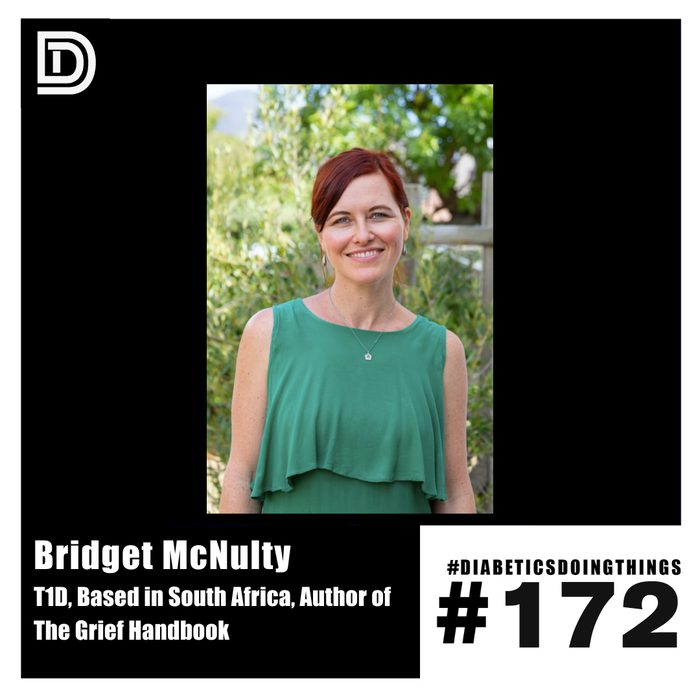
Bridget McNulty, T1D and Author of the Grief Handbook
Episode summary
Bridget McNulty is a South African writer who was diagnosed with type 1 diabetes at 25, three days from a coma, after moving to Cape Town for her first job. She and her husband co-founded Sweet Life, which grew from a print magazine into South Africa's largest diabetes nonprofit, and she later started the Diabetes Alliance, bringing diabetes organizations together with the national health department. The conversation covers her diagnosis, South Africa's diabetes education gaps, and the sudden death of her mother, who was diagnosed with four kinds of cancer and died thirteen days later. Bridget wrote The Grief Handbook afterward and talks about grief as a physical, hormonal experience, not only an emotional one, and about handling it one day at a time.
Key takeaways
- Bridget says grief is a prolonged stress response, and the cortisol it released kept her blood sugar high for months after her mother died.
- Bridget's nonprofit Sweet Life built a simple framework called TEEL: take your medication, eat healthy food, exercise a little each day, and lose weight if you need to.
- Bridget's mother was diagnosed with four kinds of cancer and died thirteen days later, which pushed Bridget to write The Grief Handbook.
- Bridget says two-thirds of South Africans fall in the pre-diabetes range, and diabetes is the leading cause of death among women in South Africa.
- Bridget recommends taking grief one day at a time, or even half a day at a time, instead of setting big goals for getting over a loss.
Show notes
Each week Rob and Eritrea will update you on all the goings on at Diabetics Doing Things, and integrate that into the show prior to our guests.
This week we talk about:
Response to a Pixar Character with Diabetes (plus fun discussion about Disney and Diabetes)
Discussion about getting bad credit scores from Endocrinologists
Reaction to Eritrea hosting her first episode without Rob
Rob talks about staying rooted in gratitude and Rob and Eritrea even do a quick gratitude exercise
This week’s guest is Bridget McNulty (@msbridgetmcnulty on instagram)
Bridget lives with T1D in South Africa!
Bridget and Eritrea discuss, among other things:
Bridgets T1D Diagnosis and how she luckily married in to a Diabetes Friendly Family!
The political climate in South Africa
The loss of Bridgets mom
The impact and levels of grief
Bridgets new book: The Grief Handbook - a guide through the worst days of her life
And much more!
SPONSORED! This episode is sponsored by Type Zero Health, a T1D owned business who make exceptional clean exercise products that don’t spike your blood sugar. Type Zero is the official exercise partner of Diabetics Doing Things and you can save 20% on your order from TypeZeroHealth.com by using ROBHOWE at checkout.
Questions this episode answers
What is The Grief Handbook by Bridget McNulty about?
It's a guide through grief, written after Bridget McNulty's mother died suddenly of cancer. It includes simple exercises and illustrations to help readers process loss at their own pace.
What is Sweet Life Diabetes Community?
Sweet Life is a South African diabetes nonprofit that Bridget McNulty and her husband started as a print magazine in 2011. It's now the country's largest online diabetes community and runs the Diabetes Alliance with South Africa's National Department of Health.
Can grief affect blood sugar?
Bridget McNulty says yes. She explains that grief is a prolonged stress response that floods the body with cortisol, which kept her blood sugar elevated for months after her mother's death.
What is the TEEL framework for diabetes?
TEEL stands for take your medication, eat healthy food, exercise a little each day, and lose weight if you need to. Bridget McNulty's team developed it as a basic foundation for newly diagnosed diabetics in South Africa.
Full transcript Searchable, with timestamps
Rob Howe: What up, what up? I'm Rob Howe. You are Rob Howe on the screen today. You're logged in as me. And you know why that is? Because you did this interview solo because my schedule got away from me. And so you, you know, this is your first podcast, like, solo debut. How do you feel? I feel like Kyrie without LeBron. You know, just like... Out in the first round? Oh my God. I was just like, why? No. So it was very unexpected, but I think that it went super, super well because I, she made it so easy. You guys, the people who come on our podcast are such amazing human beings that honestly, we're not really doing a whole lot. Rob and I are just the lucky person who gets to talk to this amazing person. So Bridget made it such an easy conversation. We flowed so well through it. I did miss you. There were some parts of the podcast, parts of the interview that you guys will hear where I'm like Rob has this theory or I really wish Rob was here because it was just like man like ah my buddy but we got this I don't need you I don't need to stay on the shoulders of a white man you know I really did uh I was like you know what Airtra has got this I felt bad that I had to spring it on you like your short notice or whatever but uh yeah you got it it was no big deal so I thought it was a test I was like is this a test like is this like a kill bill you know when he like throws the rice away from her because she I was like, this is a test. Well, I'm going to pass it. Like, I'm not scared of no podcast. Yeah, it was easy. You did great. So you're going to you're not going to hear me except for on the intro listeners. And yeah, let us know. Let us know what you think, whether we should let Eritrea do more of those. It's been an interesting week in diabetes. So I'll tell you guys, I have a little story. My brother came over the other day and said that he met someone who has type 2 diabetes. yeah um and this person was like diagnosed in an unconventional way just like in a place in their life where they weren't able to get all the information that they needed and is now trying to figure out you know how to navigate this diagnosis with no insurance in Dallas and so I've like put together like a package and I'm going to deliver it sometime next week and I've just kind of been thinking like what are some things that could really help you like because it's not his initial diagnosis like he's been diagnosed for some time and it's been like kind of neglecting it I guess um and so like what's some things that i could put together for him and through my interview with bridget she gave me this really great tip and it was like to tell them to there's it's like a fundamental foundations of diabetes that they have in south africa um and you guys will hear about on the podcast but this part was called uh TEEL and it's take your meds like eat your meals like you're supposed to exercise if you can and lose weight if you need to and i was like wow like what a great like little, just like acronym, like to put in the note that I'm writing for this person to think of. Um, and that also made me think like, Oh, if he has pills, like, let me get a little pill box. So I'm just out here doing some type 2 diabetes help support. I don't know. I feel like that community is so underserved and we need to help do our part as diabetics. I don't know. Yeah. And you know, somebody put this post up because the other big news thing that happened in diabetes this week, I think is Disney released a trailer and had a person wearing a CGM or like a pump infusion site. I guess you don't really know which one it is, but a site on their arm. And then they have like a pump on their belt. And what I'm looking forward to, and we're going to talk a lot more about diabetes and media, you know, in the coming months, but I was just looking forward to a person like not addressing it at all. Like just like, just like being a character and like having it. Cause I think that's where trying to explain and all the exposition that goes into, well, what is this thing? Or, Hey, why do you, why are you sweaty? Always, you know, gets in the way of that. And that is a lot of our lives, like diabetes interrupts our lives a ton. But also we're not just, just devices and not just stuff. So somebody made a post about how it's not just a person with type 1 diabetes, it's a person with diabetes and we don't know anything about them. And yet, because we haven't heard it. And I agree with that. I think T1D looks like me, T2D looks like me. People with diabetes look very different. You can't really tell. And it's not always a weight thing. It's not always an autoimmune thing. It's sometimes a combination and sometimes genetics and a lot of times genetics and a lot of times just a tough thing. So it was cool to see that representation. Also, my favorite part of it was that she, or I also don't know, I think it's a non-binary kid you can't really tell if it's a girl or a guy maybe looks a little bit like a girl but um they were playing with a tech deck like a little skateboard on the desk and I was like that is the most me thing I've ever seen I just remember being in high school like a dumbass just flicking that little skateboard on a desk uh and I was like wow seeing a kid with a tech deck who has diabetes like wow that's uh why why didn't you cast me Disney I'm gonna take a photo today and I'm gonna I'm gonna put it on uh with that Pixar filter from Snapchat oh my god it's gonna be so so cringy it just normalize kids being kids like if you have diabetes you're still a child you should still be like I guess you're right like whenever a diabetic is um introduced in media they are usually centralized around just being a diabetic and it's so cringe like I just I hate it like every single time it's like that's all they can be is a sick person so to see like you said a child just playing with some like little bullshit fidget toy instead of it being like her touching her his or her pump thing or whatever um I did see that post you were talking about I think the point of the post was that we don't know if the child has type 1 or type 2 right yeah so it's like a lot of people were sharing like type 1 representation like we're getting type 1 like we're getting type 1 rep and like again this is a way of othering type twos and being like you guys are not a part of our club when guys we're on the same club it's one club it's called diabetes and we're all in it so can we just stop gatekeeping cgms and pops like stop gatekeeping a thing in media also y'all love disney i don't know like y'all got y'all people went bananas for that i was like man y'all got chronic illness breeds disney's disney adults but you know what we shouldn't talk shit because a lot of disney adults are friends of the pods i know yeah every i and i clown all y'all disney people i love disney as well i'll go see a disney i love some pixar movies i love a disney thing you know do you i subscribe i subscribe to disney plus i'm a disney plus you know subscriber mandalorian that's my shit you know star wars it doesn't really count did you watch raya when it came out that movie you have no idea what i'm talking about i do but i didn't i didn't watch it no rob is a frog i'm about 50 50 on disney stuff like you know i'll watch it i watched that's so raven like on wednesday fire bring back that's so good justice for the famous jet jackson though okay so that episode that i watched was like her getting engaged in a nigerian prince or no not a nigerian prince random country made up wakanda country prince and it's so funny episode four no season four episode 12 watch it so good um shout Shout out the Proud family. Y'all remember the Proud family? There's a Ramadan episode. That episode made me cry when it came out. I was just like, oh my God, representation. Also- Shout out Smart Guy. Oh yeah, La Cienega. What? Why did I never get that at La Cienega Boulevard days? Like that, I'm dead. I hate myself. Like I just, and yeah, Tahj Mowry on Smart Guy. You know, I have a whole theory about the Mowrys. The sisters are not friends because they don't like each other stuff on Instagram. Sorry. This is just like a random conversation at this point. Sorry, guys. It is, you know, taking it back to diabetes, Tahj Mowry was in a show called baby daddy with Derek Theler who has diabetes. There we go. Derek Theler has diabetes. Who's that? Derek Theler. You don't know Derek Theler. He's been on the pod, friend of the pod. He's nobody crucified me. He's a real hunky white dude. American film actor. He does look kind of hunky. Yeah. He's, he's real tall too. I didn't really didn't realize how tall he was. He's like my same size to this man. His dogs are cute. He's great. He's great. Uh, and he does a lot of stuff for JDRF too in LA. He's like real, real into walks and he and his sister both have diabetes. You should listen to his pod. It's great. It's from like four or five years ago, but he's awesome. Big, big fan. I'll pull it out of the vault, the archives. So go back. Yeah. He and I went to Pompas grill. Shout out Pompas grill. Uh, if you're, if you're in the Grove in LA, that's where you got to eat. And, uh, yeah, real ones. know Derek is a real one. He's dope. Oh my goodness. Okay, Rob. Anyway. Yeah. So like what's going on this week? I, you know, last week I talked about being a little bit down, feeling like kind of depressed. It was like a tough week. And you know, I got that good therapy on Saturday. I got that good medicine, that talk therapy. And you know, this week I've just tried to be really grateful and you know, some shit is going to be thrown your way. As you know, sites are going to fail. Carbs are going to be miscounted. That insulin might be resistant. You might have to go somewhere you don't want to go. You might have to move out of a place you don't want to, you don't want to move out of, but if you just be grateful and you, and you count your blessings. And I think that's like the most basic, you know, live, laugh, love response, but I just live, love, laugh. Yeah. You know, like I, I just, I don't know. I rooting myself in gratitude this week for being able to live the life that I do have, being able to, you know, I have a wife and family who love me and amazing friends and a cool business. And I get to do this podcast. Like, I don't know, like even the simplest basic things that sometimes to me feel so heavy and so burdensome and they feel like work. Even I had a Medtronic call yesterday with my Medtronic team and there was like 12 different people on the call and the energy was just great. I don't know. there's just, uh, there's good vibes in the air. You just got to find them. And you gotta, I think we, I, I personally have just been beat down by bad news. And I think we all are feeling that way and there's still bad news and there's always going to be, but you gotta be grateful for what you do have. And, um, so I don't know. I'm grateful if you listen to this, I'm grateful for you. Uh, give me a shout out. Uh, if, if you are, this reminded you to be grateful for something. uh there was an exercise i learned i think it was through headspace and man shout out headspace uh i i did like non-stop for a year i probably should get back to it just to balance myself out but maybe that'll come around but um yeah it sounds like if you liked it and it was helpful i want to say that even if even though you're coming even though sometimes it feels like you're super super privileged or whatever i think you should still be allowed to uh somebody once told me it's okay to cry you just still have to try like it's okay if it's hard it's okay if you are down for the count and you just need to take a cup like take a break you know what i mean like i think about that sometimes when i do these workouts now and i'm just like you know how you take breaks in between the reps because they're so fucking hard like they're supposed to be hard so take those 60 seconds or take that breath in your life talk to your therapist do headspace whatever to bring you back to like who you are which is like a grateful kind person who just wants to like live their life which is like what we're all trying to do really out here. So yeah, that's beautiful, man. Yeah. I mean, all that to say, uh, because I, it's existing in the culture big time right now, just look who creeping, look who crawling, still balling in the mix. It's me. I'm back here. Uh, you know, shout outs. I'm still tipping out here. Y'all I'm still tipping. I've been tipping. No, like that huge white boy in Texas, the Texas tech polo. Yes, absolutely. That lives rent-free in my mind. Cause that is, I mean, in another life that could have been me. Oh, that could have been you. I'm sure. I'm sure. Oh my goodness. I'll share this story. This doesn't matter to anyone, but I'll share it with you. Uh, it like 2012, 2011, uh, I graduated from college. I was still living in like right near my college with some of my friends. And we had this big house and one night we were all just like hanging out, nothing to do. I'm like, yo, y'all just want to like bump, still tipping on the back porch. And we were just bumping Swisher house and Mike Jones really loud around like a campfire and just like that. I, so when I tell you that literally five people sent me that video yesterday, I was like, damn, this is, this is, this content is made for me. So yeah, if you don't know what we're talking about, I'm sorry. Uh, tell us about our guests. Like we, we have this amazing, we have this amazing, you've already talked about the, uh, she's an author. She's from South Africa. Uh, her name is Bridget McNulty. She's an amazing human being everybody comes on our podcast is amazing first of all um but she has a non-profit organization called sweet life in south africa and it is the biggest uh non-profit in south africa about diabetes and they like created this thing called the diabetes alliance and they like sit on a board with basically everybody important in south africa to create systemic change for diabetics like it is like what she's doing is i told her that she's like the kylie jenner of south africa which she thinks is hilarious but like to me she disrupted their diabetes industry she was like no we are not getting the right information to the right people and we need to do a better job and she's doing it man diabetes alliance that sounds like some avengers stuff i like that i was about to say she's scarlett johansson in this just black widowing it all up like and she's so like such a just a beautiful person uh really awesome um the interview is great i think you guys are gonna love it she tells all about her diagnosis and then we talk about the book that she wrote which is called The Grief Handbook. It is out July, I believe July 14. So it's out now. You guys can get it on Amazon. And it's a guide through the worst days of your life. Because sometimes I think what she talks about a lot in the book, and what resonated with me is that there's sad shit that's going to happen all the time. Like all the time, you could be grieving a loss without even knowing it. Like you could get in a car accident and be totally fine and be sad about the car that you lost, because you had plans, shit that you wanted to do in that car, even if it was just a car. And I'm So grief is always going to happen because we're always going to have situations where we lose something. And I don't think we talk about enough how to navigate that grief. Like, yes, there are times where it's going to be a big grief, like the loss of a parent, the loss of a child, the loss of a loved one. But then there's other grief, like something that I really think about all the time is, and I think we talked about it before, is that loss of your future life that you've planned out for yourself when you're diagnosed with diabetes, whether you're a child or not, and like how you navigate that grief is so important. And I don't think we talk about it at all, ever, we just kind of ignore it. And that's weird. Well, I think it's also what's interesting to me is culturally in the West, we move on from things too quickly, I think, without recognizing that they're over and celebrating them for what they are. And like you said, that car thing really reminded me of when I had my first car that I really loved was this orange Mazda 6. And I have black rims on it. I wanted to be, I was ready for Dom Toretto to invite me in the family. I was trying to be family. And when it blew up, like the engine block cracked and like, you know, it was a sled after that. And I remember after I got, I got a new car, like I had to ride my bike for two weeks to save a paycheck to get, to get a down payment on a car. Cause yo, my credit was busted because of diabetes. We got to talk about that another time. Like I didn't even know it was like a medical bill. We got to talk, we got to, we got to get a panel going about that. That is some trauma bought me a rolls royce anyway sorry no okay yeah it was the opposite of that i basically my credit score was 500 which credit first of all abolished credit score second of all why am i with a 500 credit score i love it so i had to ride my bike for two weeks i also had to get the bike from my ex-girlfriend who had it at her house so i had to like the eggs and i had not talked to her since we broke up anyway trauma was down bad i was down bad i was riding that bike Like, and anyway, when I got to, when I finally got the car, I like was like, Hey, can I like see my old car and like get my stuff out of it? And they were like, sure. So I got like a couple things out of it and I like tested it. I was like, goodbye. And I just remember, uh, my friends called it the Mazda sex because it was, it was hot fire. It was hot fire. And we were, you know, 18, but, um, everyone can relate to that though. Like, I think, so I totaled my first car and his name was Tony and he was maroon Tony Stark miss him every day he was a really nice Honda cross like the crossover the weirdo Honda that they made anyway the point is that he died and when he died it was only like eight months after I got him and I was so sad I had so many plans for this bitch like I had so I was gonna live in it I was gonna take it places I was free from my parents and no that's not what happened so I think that when you lose something you go through these feelings and I don't think we really talk about like nobody in school ever is like how to cope when something sad happens they're just like here's life do it how you can like and not to get back to live laugh love culture but don't cry because it's over a smile because it happened it's a real it's a real thing like bear with me like don't completely tune me out yet like don't really tune me out like it really is like back to gratitude you had that weird honda crossover and it died you know i had a car there were two tens in the trunk we played a lot of still tipping on it. Uh, you know, I had the windows down. It had, I had a cold air intake on that mug. I swear I was ready to be Paul Walker's stunt double. I was so ready for it. And you know, then it, then it went away and I had a car that wasn't as cool as that one afterwards. Cause that's all I could afford, but it was way better than that bike. That bike was trash. Did you get it back to your ex? Here you go. No, it was mine. She just had it. And, uh, she had used it like while we were dating. And then, uh, yeah, I had to like walk it down to seven 11, shout out seven 11 and air pump it up on the air pump. And then I got that thing going. I wrote it, I wrote it to work for two weeks. My legs were strong. I was so strong. I wish we had a soundboard. I would play the ghetto, the ghetto right here. Like that sounds like the trailer park. It was some ghetto stuff. I remember calling my dad and I'd be like, yo, what, what can we do? And he goes, i'm sorry homie i can't help you i gotta let you suffer through this you done did this to yourself so you're gonna have to suffer so get your oil changed uh get your oil changed your credit yeah check your credit uh and you know and if if a doctor's office uh tells you they're gonna clear a bill with the collections agency make sure that they do it because they might not have done it oh that happened to me we do have to talk about we're gonna talk a lot about this on another Let me make a note. Yeah, make a note. So anyway, back to gratitude, back to all of that. I think I would challenge all of you guys right now before this episode starts. I want you to think of someone that you don't like and hope that they're doing well. Oh, f**k. And just hope that they're doing well. Wow. Okay. So do that right now. Think about somebody you don't like or that someone has wronged you and just hope they're doing well. Hold a space in your heart that they're doing well and let it go. Let it go. Okay. You're going to hear this amazing interview coming up. And this has been Diabetics Doing Things. Enjoy Eritrea's first new episode. What's up guys? I got a very important announcement for you today. Not only is this episode sponsored by Type Zero Health, but Type Zero is now our official fitness partner of Diabetics Doing Things. And that's exciting for me because if you can hear and actually mixing up some type zero NO booster in my shaker cup right now, because I'm about to go work out like I normally do late in the day. And what I want to tell you first about type zero is that for people with diabetes, you can get the boost and the pump you need to crush your workout without having to worry about spiking your blood sugar because type zeros and NO booster is clean. It's caffeine free. It uses natural ingredients, no artificial flavors or colors, and it doesn't spike your blood sugar, but it gets you the pump you need. It also doesn't have caffeine. So I can have it later in the day, like I am right now. It's about 5.30. I've just gotten through my workday and I'm about to go hit the gym. I use it when I play basketball, when I go on a run, when I hit the weight room, which I've been doing a lot lately. And I've been using it to help me shift into workout mode while I'm at home. I get that shaker cup going, mix it up. I'm using the cherry limeade flavor right now. You got to check it out. TypeZeroHealth.com for more information. If you use TypeZeroHealth.com, Use code ROBHOWE. That's my name, Rob Howe. No spaces at checkout and you can get 20% off. Type Zero is a T1D-owned business and you know how I love T1D-owned businesses. Check out episode 132 for my interview with the founder of Type Zero, John Jensen. You can hear his story there. Also, check out Type Zero's clean nitric oxide supplement. I've been taking it for a few weeks now and it has really powered my recovery. Again, no caffeine, just beetroot, pine bark, arginine, and citrulline, which are natural ingredients. It helps me recover, which is a big part of how I implement my training these days. I've got to be able to recover. I take on a lot of mental, non-physical strain. And then with my workout schedule, it's hard for me to recover and bounce back. And this has really helped me. I even left a review on Amazon with a photo of my whoop strap where it shows month over month how my recovery increased after I introduced the clean nitric oxide supplement. So check that out. Again, typezerohealth.com, the official fitness partner of Diabetics Doing Things and use code ROBHOWE for 20% off at checkout. All right, back to the episode. Welcome back, diabetes fans. It's your actual host, Eritrea Musa. I'm so sorry, or Eritrea Musa Khan. This is kind of a surprise I am interviewing today alone, but welcome back to Diabetics Doing Things. I'm so excited for today's episode. I have Ms. Bridget McNulty on the show with me. Yay. All the way from Cape Town,
Bridget McNulty: South Africa. Welcome Bridget. Thank you. Thank you so much for having me. I'm so happy to be
Eritrea Musa: here with you today. And I'm excited to have you. We have so much to talk about. Before we even started recording, Bridget and I were already going ham because we have a very good relationship, already good friendship. So I'm just excited to have her here and to just really dig into your story. Yeah. So all the way from South Africa. Geez. So are you from Cape Town? Is that where
Bridget McNulty: you were born and raised no I was born and raised in Durban which is about a two-hour flight away and actually as like a framing for our conversation it has been the weirdest and most intense and hectic week ever in Durban this week we had civil unrest breaking out on at the beginning of the week on Monday and my dad still lives in Durban and many of my friends do so it has been a super a stressful week so my body's been flooded with cortisol haven't been sleeping properly blood sugar is not being particularly happy but I'm very happy to be here now and like taking a pause it's it's early evening here so it's the end of the week it's a good time to exhale oh man um so it's
Eritrea Musa: so interesting before we got on the call you started telling me about the civil unrest and I actually I had not seen it on twitter it's not been on the tiktok so I mean can you tell us a
Bridget McNulty: little bit about what's going on I'm not really even sure so we're not really even sure either it's the there've been intense riots and looting since the beginning of the week so people have taken to the streets in fury and ransacked shops and attacked ambulances and stolen oxygen tanks we're in a third wave of COVID at the moment it is unreal gunshots like like explosions it's it's things that my friends who are there at the moment kept using words like unreal and unbelievable and war zone it's it's just so intense and no one really knows like so I don't want to get into the details because I'm not a political analyst but it is political and it's about our former president Jacob Zuma who stole a lot of money from the country and was finally convicted and as the jail fell closed on him all hell broke loose um but it's it's just it's such a helpless feeling being at a distance and and like the shock and disbelief i feel like the whole country's in a state of collective grief at the moment and that the diabetics here in durban i just posted earlier we managed to find a solution earlier today people who need insulin and we're gonna go pick it up from their pharmacy and now the pharmacies have already cleared out so there is a solution that i just posted today um wow so Thank God for social media too. Hey, what would, what did we do in the before time?
Eritrea Musa: Yeah, no, seriously. And we're going to get to how you have your, you know, your platform and this society that you have in South Africa for diabetes and all of that before we get there, I guess let's, let's go backwards a little bit. Let's go back in time, rev up the time machine. Tell me about your diagnosis and your type 1 and how that even
Bridget McNulty: started. So I was diagnosed when I was 25 and it was a very dramatic diagnosis. I was a apparently three days away from a coma, they told me. I had just left home and moved to Cape Town, just got my first full-time job. I was working as a features writer, real simple. It was like the world's best job. I had a little scooter that I was zooting around town and lived in a little garden cottage. I was having my first novel published. It was like dream scenario all around. And then on top of that, I started losing weight. And I was like, well, this is amazing. I can eat whatever I like. And the weight just drops off. What a joy. But we all know where this one's going. and then the exhaustion followed. Oh no, spoiler. There's actually a magical solution. Exhaustion followed and the foggy head. And it's so funny because it took me so long to get diagnosed because I didn't have a doctor here and I didn't have someone I could trust and just like pop into and say, hey, I'm not feeling well because I'd only just moved into a new city. And yeah, by the time I was diagnosed, I ended up in ICU for five days and then it just took forever to feel normal again afterwards. but after a while I did and my then boyfriend now husband his brother is a top one and so he was completely unfazed by it like literally gives me no special attention at all which I would sometimes like and so we settled into a rhythm fairly easily and we had always wanted to do this big six-month trip around Southeast Asia and South America and we decided we were going to do it anyway and so we went on this big trip and we used it as a kind of like a positive awareness that even if you're diabetic doesn't mean you can't travel doesn't mean you can't follow your dreams you can still do everything it was awesome and while we were on that trip we decided we should start sweet life so in the beginning we started as a magazine which was so lovely and i'm ambitious very passionate about print i love print and it was a quarterly magazine beautifully designed mark my husband is a designer and it the the whole purpose was to show that it's possible to live a healthy, happy life with diabetes because all the information I was given in the beginning was so depressing and negative. And it was all like, here's a list of the complications. Would you like to join this horrible club? And I was like, no, bro, no one wants to join this club. But obviously my membership was already in. And then we did five years of the magazine. So 20 issues. And, um, we always had a Facebook page and a website, but then we moved everything online and at first I was so sad to to lose the print magazine but actually online you can have conversations you can ask people stuff and respond and it becomes actually a community and so we've been going for 10 years this year and we are now Sweet Life Diabetes Community which is a non-profit and a public benefit organization and yeah we can get into that later I can talk about sweet life all day long oh my god it has ended up being it's yeah it's ended up being positive because because i don't think you can start something like that if you if you haven't lived through it and if you're not living through the challenges of type 1 every day like or of living with diabetes every day because it's for type ones and type twos yeah absolutely um it
Eritrea Musa: sounds like your husband was your first like big supporter like i know that the special diabetes attention wasn't there because he has a brother with diabetes but to me so it's this is just what I'm hearing when you can tell me if I'm wrong or wrong all the doctors and medical opinions are just like okay now your life is on pause and your husband was like actually not at all I have a brother who lives a completely normal life you will be fine baby I got you so it sounds like he was the first guy to be like actually you can do whatever you want and I'm gonna show you you can
Bridget McNulty: yeah he even and I didn't even know that he articulated it he just didn't give me special attention so like we had a book a trip booked to malawi um maybe two or three i got diagnosed in october and we were going for christmas we were going for christmas and new year to this like super deserted island on late malawi that took a two-day passenger boat but like a very very budget pass it was like a yeah steamboat that you like slept on the top deck of and the plan was to go there and hang out on the beach and learn how to scuba dive and I was like this sounds like a perfectly reasonable thing for someone who's been diagnosed with diabetes to do for two months and he was like well why wouldn't it be and I didn't have an endocrinologist yet so I didn't have anyone to be like maybe not the best time and then to make matters even more insane you had to be on malaria medication and I for some reason went on Lariam which makes you slightly crazy like the side effects are gentle psychosis. I don't think they let you use it anymore. Cause it's, it's like,
Eritrea Musa: I was going to say we've never heard of it in the U S what is that?
Bridget McNulty: It's been like, so this was a long time ago. This was like 15 years ago, but even at the time it was like, like don't choose this one. There are many other ones that don't make you feel crazy. And I remember sitting at the bottom of Lake Malawi and looking up and feeling like the water was pressing down on me. And I was like, I don't know if this is what scuba diving is supposed to feel like. and then when I told my endocrinologist when I finally got an endocrinologist and I was like yeah I went scuba diving two months after being diagnosed he was like are you insane and I was like no one really seemed that fussed about it at the time so I think that's kind of been my attitude with diabetes like why wouldn't I be doing everything that I wanted to do we've done loads of hiking we've walked 500 kilometers of the Camino de Santiago in Spain like I just don't see why it should stop you from doing anything but I think that's easier when you're diagnosed
Eritrea Musa: older too. I think so, but I don't know. I was diagnosed at eight. And I really wish Rob was here. He has this theory about how those first conversations that you have when you're diagnosed are so, so important to like how your mind forms its ideas of what you can and cannot do. So it sounds like, yeah. So even though you were having all those, like maybe not so uplifting conversations, you had someone in your corner and you had a built-in diabetic best friend, because like if you had questions you could just ask your brother-in-law do you guys still like connect over that and is that like y'all's little thing he doesn't talk about it that much because
Bridget McNulty: he was diagnosed I think even younger than you like six but it was it was completely not effective for him like he's just like it's just this thing I have to do he he like really doesn't treat it
Eritrea Musa: as a disability at all no no no it's a man thing they compartmentalize they're like diabetes is just like this, it's just like having hair. And I'm like, listen, man, it's not like,
Bridget McNulty: he doesn't chat about it much, but it was very helpful to have that. Like I always knew that if, like, I remember calling him the first time I had a low and I was like, my blood sugar is low. What the hell am I supposed to do now? And he was like, eat something sweet. And I was like, be more specific. What does that mean? I was so excited when I first discovered that you could eat sweet stuff when you went low. And then of course, I'm sure everyone does this like completely overreacted and binged on all the things I've
Eritrea Musa: been missing. I know people still do that for like years at a time. Like people do that forever. I think I've been diabetic long enough now that like a 50 is so bad. I'll just share this, but I don't feel low at 50. That's bad. I don't feel low until I'm like 41 or 40. I have like no low symptoms, but I used to like save all my sweets for then. So like if I was 70, I'd be like, now I'm going to eat some Starburst if I was 65 is like now I'm going to have some ice cream so I probably am experienced enough that I just like keep my snacks for when I'm low but um anyway diabetes is fun it can be fun um so from there we're it can it can we're having a fun conversation um I love the community aspect I'll take that absolutely and it seems like you're like a community leader you've always cut you give me leader vibes with with just how you are but But so what, so the magazine was the inspiration, right? Like I already work at a magazine. So I want to like create a newsletter for diabetics. And then from there, just five years later, it jumped into, let's take this online. Or how did we navigate? So it was online the whole time, but it was, it feels like a long time ago.
Bridget McNulty: So it was 2011 that we started, but that was like in tech years, that was several lifetimes ago. Like the fact that we started a Facebook page was revolutionary at that stage in South Africa because, because Facebook took a while to get here. um but the the community aspect so so what really shifted for us was when we became a non-profit because then we had all the information on the website but we were kind of in this in-between zone of like well who are we speaking to because south africa's got the diabetes situation here is just so complicated and so messed up and half of all people with diabetes are undiagnosed which i think is is fairly consistent in many countries but our pre-diabetes numbers are bananas it's like two-thirds of the population are in the pre-diabetes range and it's the number one killer of women in South Africa a non-lisle completely manageable condition is the number one killer of women in South Africa which blows my mind so once we realized once we got those stats we were like why is this not front page news first question second question how is a manageable condition So it's type 2 diabetes and preventable if you catch it early enough. How is this killing more people than anything else? And so that's really our focus is on diabetes education that's accessible and that's getting to the right people and that connects with people in the right way. Because we have 11 official languages. So you can't just be putting everything in English and our health literacy levels are not very high. And so we have to kind of strike this magic balance. And we've started working with the National Department of Health in the last couple of years. And it's just so exciting what's possible. And I think that's what's kind of glorious about South Africa. We've all been reminding ourselves of the amazing things about our country this week because it's been such a hard week. But one of the things that is really special about here is that I got a meeting with the head of non-communicable diseases, the director and the deputy director of non-communicable diseases at the National Department of Health by sending an email. I was like, I'm from this nonprofit. Please can we meet? and they were like, yes, here is a meeting date. Like we don't have a lot of hierarchy and it's easy if you have entrepreneurial spirit, it's easy for you to actually make an impact. So as part of my work with Sweet Life, I started the Diabetes Alliance and it's the first time all the companies, organizations and associations working in diabetes in South Africa are all sitting around the table together with the National Department of Health, which is thrilling. It's like such an awesome opportunity because it means that people aren't doing good work in silos which they were doing before they just didn't know what everyone else was doing now we can all work together it's so rad and so there's just there's enormous problems but there's also enormous opportunities and we're kind of uniquely placed in that we've got the website we have south africa's largest online diabetes community largely on facebook and then supported by the website our website is like a diabetes Wikipedia for South Africa written super simply we have experts but then we you know like endos don't really talk English so we translate what they're saying into easy to understand language and then sometimes we turn into stories and videos and interviews there's just all this really kind of juicy diabetes education that we're engaging with at the moment and we're able to make a direct impact which is such a gift actually it's really meaningful yeah and you're
Eritrea Musa: You're literally like, there's no middle. Cause like you are the diabetic, you're the diabetic person collecting the diabetic information to spread to more diabetics. So it's, I'm, I told you the Kylie Jenner of your space. I told Bridget this before we got, and she was like, is that a good thing? And I was like, yes, you've completely disrupted the diabetes space in South Africa. It sounds so revolutionary to me and absolutely what, literally what we're trying to do in America, but it's just so hard because we have so much bureaucracy and like you said just paperwork that you have to do before you can get a meeting with
Bridget McNulty: somebody um so now that you got you have all interesting tell me so I studied in the states and I loved my time in the states and I did a creative writing degree and then I left and came home and wrote and published a novel when I was 25 and all my friends who had done creative writing degrees with were like tell us how you did this don't you have to be in like literary magazines don't you have to publish short stories in literary magazines before you can get an agent and then the agent goes knocking on doors at publishers and I was like no I sent my manuscript to a publisher and the publisher was like oh we like your work let's publish it like I think it's it's difficult when it so there are many things about America that you guys are like streaks ahead of us um but but because it's so vast and literally enormous like you just have so many people, but also because it's so established and first world, there's no shortcuts. Whereas South Africa, because we're still third world, there's a lot of shortcuts. And if you're-
Eritrea Musa: Sorry, Bridget, I have to interrupt you here. You're a developing nation. We don't say third world anymore. Don't we say third world?
Bridget McNulty: We definitely still say third world. I love you. In the third world, we still say third world, but maybe we're not supposed to. You're right. I don't know. I don't want to get in trouble. No one canceled me anyway.
Eritrea Musa: You can cancel me. No, I think you're right. there's no shortcuts here like it's very maybe only like you know the shortcuts are also established like within privilege and the infrastructure and blah blah blah we could talk about that forever but it just sounds like there's a little bit more um direct change that can be made in South Africa because you can bring everybody to the table and say like okay let's build a new table together because this table sucks so um so what are some things I don't want
Bridget McNulty: I don't want to say it's easy. Like we've, we've now the whole of last year, we did this huge diabetes education deep dive. We, we created what we believe is a solution that everyone agreed to. It's a WhatsApp based diabetes education platform, but now it's going to take the whole of this year to get like a prototype together. And then we still have to test it. And then the department has signed off. It's going to take like, things are going to take years, but at least it feels like we're moving in the right direction, which is awesome.
Eritrea Musa: yeah we're taking steps to get something accomplished I mean education seems to be the number one problem in our community I feel like there's so much misinformation that is spread so like the non-diabetics get stuff that's like not even true and then they like project that onto us and then we're just like constantly and then we're constantly like fighting their misinformation without actually informing the people who are being diagnosed so it's like this battle or war that we can't gauge or win or lose we're just like in i'm kind of obsessed with
Bridget McNulty: foundational knowledge at the moment like i feel like if we can just create the building blocks and all agree on the building blocks and we have now agreed on so we have we we're working on a framework called TEEL (T-E-E-L) because when i spoke to all the diabetes specialists i could find and i was like what what would you tell someone with diabetes if you could just tell them you could tell them the three most important things and they all kind of said the same thing and so it's t is take your medication e is eat healthy food exercise a little each day and lose weight if you need to so that's our foundation now and then we can build on that but otherwise you're just there's so much information and where do you start and where do you start building and how do you know which bits to break down and so we're just trying to start from from the bottom i'm literally
Eritrea Musa: writing it down take your meds eat your food exercise exercise healthy food okay lose weight
Bridget McNulty: if you need to and then we have one tip attached to each so like take your medication a lot of um type twos on metformin we're complaining on our group that it gives them diarrhea and so we were like we asked the enders what to do and they said well if you take it after your dinner that's often it reduces side effects so that's the take your medication tip the type 1 tip is to irritate your injection sites because we all know we should be doing that and we don't do that and two percent of south african diabetics are on pumps so everyone else is on injections mdi and then exercise what do i know eat healthy food is full half your plate with vegetables that's the only tip yeah exercise a little each day is a half hour walk every day and the l for lose weight is if you're doing small habits can make a big difference so if you're ready doing those things then just switch out fizzy drinks for water and you're well on your way
Eritrea Musa: so that is like fizzy water like fizzy water works my my favorite thing ever um yeah I wrote this down because I actually so sidebar is like totally outside of our conversation but my my brother he met this random type 2 diabetic guy I think like this person like did some mechanical work on his car and so my brother came over and he was like what would you tell a brand new diagnosed like type 2 like what can I help him yeah he was like can I help him like get a meter and so like I you know, made him like a little pack, but then inside my brain, I was like, I don't know what to say. Like I wanted to write them a card. And so I'm still writing it. And so now this is what I'm going to put in the card. Like it's, it's four things, buddy, TEEL. Like just, this is your foundation for figuring it out. It's not a bad plan. I like it. I like it. Yeah. Cause then once
Bridget McNulty: you've got that, then you can get more sophisticated and you can add in deeper knowledge and that kind of thing. But if you don't have those four ingredients, you're screwed. So, so let's just get those right. And those are really big behavior change for a lot of people.
Eritrea Musa: Yeah. I think the, somebody a long time ago, I want to say it was Elle Woods, but if I was wrong, legally blonde, but if I was wrong, I'm wrong, I'm wrong. But she's like building blocks, like the fundamentals are the building blocks of fun. So like, you can't enjoy your diabetes if you don't have this, but that makes so much sense to me because like diabetes sucks. Like you're never going to enjoy it but basically like you can't enjoy your life if you don't have these fundamental building blocks of diabetes yeah yeah get it thanks thanks I'll use that you're welcome um but talking about everything nothing so you have your society you're doing the non-profit thing in South Africa um you're also like a mom like you have your your kiddos your wife your daughter um like tell me a little bit more about like your family life and things
Bridget McNulty: like that so i am the youngest of four kids i have three older brothers and we all really like each other which feels kind of like a miracle um we all grew up in durban and now we all live in cape town all the kids and my dad is in durban my mom died two years ago um and we can talk about that later but it was very sudden and very traumatic um yeah no we can talk about it now it's okay we can talk about your mom now yeah let's talk about your mom so she's an amazing person let's talk about your mom she's an amazing person so my mom died very suddenly she she was totally fine she was a healthy 72 year old and then suddenly had these weird symptoms that didn't make sense she had like acid reflux and sore feet and i was like well i don't think i don't i can't find like i was being dr google and being like these two things do not relate to each other and the doctor kept telling her she was fine her gp and then she suddenly lost a lot of weight and got very tired and so we got worried and sent her off for a battery of blood tests to a specialist physician and they came back saying she was full of cancer and so she was rushed to the hospital and turned out to be four kinds of cancer so she had an esophageal tumor that had metastasized her stomach liver and brain and the day we were told that the doctor used the words the worst possible scenario which doctors are not prone to do and she had a stroke that day and died 10 days later 10 days after that so 13 days from the day she was given the diagnosis she died and my brothers and my dad and I were just reeling and like you said I'm a mom as well my kids were not yet three and not yet five at the time so they're now almost five and almost seven and we all made that so I was already I flew to Durban the next day as soon as we got the initial diagnosis and then all my brothers and all the kids made the exodus but it was like a very badly scripted movie how over the top things were so there's six nieces and nephews all together one of my nieces got or including my kids one of my nieces started vomiting uncontrollably and couldn't stop for six days and so she was in hospital my poor brother was going from her like the pediatric ward to the cancer ward and back again and all the other kids got rotavirus which is this like horrible vomiting and diarrhea bug and so they were all sick and then the day we brought my mom home we brought her home for a week the week that before she died and the house next door to us that had been standing for 30 years it's our childhood home the house next door the day we brought her home they brought in a wrecking ball and earth movers and demolished the house and started ripping up mature trees and I was like symbolism is a little over the top this was a movie I'd be like come off it and then two days before she died her dog who I had bought her as a replacement daughter when I left home committed suicide by jumping in the pool you told
Eritrea Musa: me that you so you told me that before and I laughed because I did not believe it like it was the first conversation Bridget and I ever had she tells me the story and I'm like that's the
Bridget McNulty: but everyone remembers I'm like bro like all that stuff is hectic too but that was the final straw okay well tell us how the dog she was a yappy sausage dog cherry I loved her she was a yappy sausage dog who was always yapping to get attention and she could swim and one night like late evening she went down to the pool and jumped in didn't make a sound and didn't try to to him and we were just like oh my god and like trying to hide it from the kids the next morning and we had to do like a little service for her but distract them all it was just it was like one horror after the next and then my mom died and then we came home and I was like well now now what am I supposed to do and we were so close because I was the only girl but we were also like if you see pictures of her like we looked very similar we dressed similar we like shared clothes and jewelry and like the daily checkings yeah she was my compass and so I read I'm a reader and a writer and so I read everything I could find and I just grief books are just kind of sucky like they were either very depressing or religious which I didn't want or deeply philosophical which my brain just couldn't handle because when you're grieving your brain gets so foggy yeah or like grief counseling books and I just wanted something to be like oh this is so hard this really sucks I'm so sorry and like here's some space for you to vent a little because you go a little crazy well I definitely did and other people said something like like there's things that you just can't get over like little details that you just latch onto and can't get over and I think it's so important to write that down but it's hard to look at a blank journal and be like okay like let's just yeah let's let me begin at the beginning that's too scary so so I couldn't find the book that I wanted and so I wrote it and it's I think it's beautiful it was
Eritrea Musa: no no no no it is so first of all I want to say first of all I want to say that Cherry knew what she was doing I saw no she did she knew apparently pets often commit suicide before their owners die because that she knew she was like listen Bridget don't worry about me I got me don't worry about me just take care of mom yeah I'll be I'll be up there so that I oh my god she's up there waiting she was waiting for her to because you know how like it actually made us feel so much better like you bought her as a replacement daughter because like okay maybe maybe because I've been through my own grief like sometimes I think about like my baby and I'm like I'm not so much worried about how much I miss them but I'm more like what if you miss me like I hope someone's there with you so it's like it makes me think that Cherry was like don't worry like I'll go first so that I'll be here to catch her when she gets here I got you Bridget like okay so first of all your book is I'm gonna say the f word this book is fucking beautiful and it's so good um I cried so many times um and it was not because I was sad it's because I was understood like there were so many parts of the book that I just like was like oh my god Bridget like at the beginning you talked about
Bridget McNulty: how it gives me goosebumps it's exactly what I wanted like you talked about how like you would
Eritrea Musa: walk down the street and you would see people who have a mom and you or like you would gauge their age when I so when I first saw angry when I first lost my baby I broke a tv so there was a it was a diaper commercial there was a fucking diaper commercial and I was just like having a regular day like regular day living my life actually kind of like one of the good days in my grief yeah and this fucking commercial just like I don't even know what they said but it was just seeing people will be so happy about a baby. I had, um, I was using an immersion blender to make mashed potatoes and I literally just like threw it at the TV and broke the TV because I was like, I just, just stop. We couldn't watch TV for so long. So when you wrote about it, I, first of all, I am very lucky to have both of my parents. I am super blessed. Um, for a long time, lost a baby for but for a long time I had a lot of friends who did lose their parents and um reading this I man I just I love you guys so much it made me go call like I hugged my mom so much when I finished this I just like gave her the biggest hug and was like I love you so much and I'm so sorry because like we don't control anything like I feel like when I was done with this I was like all we have is now like all we have is this second right now in front of me let me try to appreciate it and hold it for as long as I can because then it's gone um but yeah and what's so beautiful
Bridget McNulty: amazing here oh thank you and and what what's so beautiful about that attitude is that then when someone dies because that's the other thing is we never talk about death and we don't talk about grief but it is guys newsflash the one inevitability everyone is gonna die we really need to stop being so weird and awkward about it and so that's what I'm trying to do with this book too is just be like let's talk about this let's let's make it not so much pressure on the person who's grieving because i don't know about you but i felt like i was given like an allocated period of time that i could be messed up and then everyone was like okay get over it get over it three months yeah yep slap on a happy face and if you don't feel like that which you don't because three months is an insane amount of time to be able to get over something then the pressure is all on the person who's grieving to make other people feel less socially awkward how whack is that but that wasn't actually my point my point was that what is so beautiful about that attitude of let's let's tell the people we love that we love them let's be in the moment is that then when someone dies you're not left with all this crazy regret and like oh i wish i'd done this and And that has actually been a really beautiful legacy from a mom because she told us how much she loved us obsessively. Like she would just randomly of a Tuesday morning send like the most beautiful message, just being like, I'm so lucky to be your mom. And I just want to let you know that I think you're doing a great job. And I'd be like, oh, this is lovely. But when she died, like, so she couldn't speak after she had the stroke, she couldn't speak properly. She could still say, I love you, but she couldn't speak properly. and it didn't matter as much as it would have if I mean we felt cheated but it it's not that there was anything to say like none of us had anything that had to be said because it had all been said and that's a beautiful way to live life and to end life I think but the the thing I love about the book and it was such a gift for me to write because it was such therapy to get it out on the page and to feel as if I could chart some kind of pass through the waters but then I'm not an illustrator and so I draw the I drew these terrible illustrations so I can draw really good like stars hearts flowers and rainbows I peaked at eight and I was amazing at eight like my pictures at eight were beyond anyone but then that was it like that's as far as my talent reaches and so I just got a sharpie and was like drawing up these pictures of what I thought it should look like but then I got this local Cape Town illustrator Lauren Fowler to turn them into real illustrations and it makes such a difference because she's just so good and it feels to me like the the actual physical print book feels understanding because it offers a space to feel as shitty as you want to and and it's so hard to talk to people about grief too not only because they're so awkward but because you see the sympathy in their eyes and then you're like oh my god I am a basket case
Eritrea Musa: like but I mean it's like it's so sad because it's like a way and I talk about this all the time but humans love othering like like when when when they when you're like oh my mom died okay well that hasn't happened to me but like girl it's gonna happen it's gonna happen to me it's gonna happen something that my parents are in Mexico something that we say as Mexicans is like we're all gonna eat shit one day which is bad like that's not the way we should say it but like Like it's true. So it's about, and you never know when, like, that's the thing is like, you lost your mom when you lost your mom. She'd been alive for 73 years. And then you lost her in 13 days. You know what I mean? And like, for some people you know, I lost a friend when I was 16. We were both 16 and he passed away and I never got over it. Like I still think about him all the time. And it's just, and I read your book and I was like, this is why, because grief is not linear. like it's not this straight perfect beginning to end you can't achieve it you can't be like tick
Bridget McNulty: I'm done like it doesn't ever go away you know what's the most helpful thing to me about age because I felt very cheated that she was only 72 years old and my dad kept saying that he felt cheated out of a decade with her and that was one of the things we couldn't get over that like she was fine and then she was gone and so why didn't she get to live longer and I was reading I don't if you've read any of Cheryl Strayed's work she does that dear sugar column and she's put them all into a book called tiny beautiful things it's beautiful you should read it okay people write in with these impossible problems and then she like creatively unpacks them it's so beautiful and one of the guys who written was a dad who said his son had been killed in a car crash when he was 22 years old and he just couldn't move on and I was like I feel you right how how how are you supposed move on and she writes in this beautiful letter but in the middle of it she says your son's life was 22 years long your son's life was 22 years long your son's life was 22 years long and i was just like that's it like you get a length of life and it sucks if it's not the length you wanted it to be but the buddhists believe you get a certain number of breaths once you've taken that certain number of breaths your ticket is up and you go and it helps to not feel so angsty about it like I felt like something was wrong like the world was tilted wrong yeah and that really helped me to just be like okay this is just something I think it's something
Eritrea Musa: you write about too it's like how does everything just keep going when my world has completely fallen apart like like you called your mom your compass like I so get that like I but you know when I talked to my mom about this because I did I I really did talk to her because I was so sad Bridget I was just like oh my god she was like honestly it sounds like her mom did a really good job of preparing her for her to go even though Bridget didn't see like even though you didn't know that she was getting you ready for her departure like that's all your parent really can do for you is like prepare you for them to leave this earth and like my whole life my mom has always just said like when I when she because I've always asked her like what do I do when you die and she's like bury me like don't worry about it just bury me and so when I told her about all this stuff she was just like her mom did a really good job like she should know that like her mom did a great job with her and that like she's leaving something like this is your mom's legacy yeah her name is Edna so shout out Edna thanks Edna she's probably in Panama right now like she's so funny but anyway um I feel like this is your mom's legacy like you are oh my god
Bridget McNulty: and my kids and like my son's name is the same as her dad's name and he was born three days before and yeah my daughter and her was super close beforehand and and there's such joy in that and then also like it's everything is tinged with oh they had such a short time together but what is also interesting to me from a diabetic perspective is the physical aspect of grief that I had no idea about and the the fact that and I kind of only put two and two together when I started doing research for the book, but the fact that grief is a prolonged stress response. And so your body is flooded with cortisol and we all know what cortisol does to blood sugar. And so for months, my blood sugar was just high, no matter what I did. And, and like in the beginning of, I was just coasting and getting through the days, but even when I started trying to like get back into routine and eat the same boring meals and all that, it's just, your body is like, your blood sugar is not a top priority and that yeah like and then you're adding high blood sugar on top with all of its bouquet of high emotion and exhaustion and all of that it's like a yeah it's a double header there's so so
Eritrea Musa: this thing the thing about this handbook is that I felt like it was also kind of a workbook like there were things to color there were things to add there's this uh a couple pages in where Bridget starts talking about like your your laundry list like what are the things that you have to accomplish so that you can, you know, survive because you're kind of grief is a type of survival mode. Like you're just trying to make it so that through this season of your life or this huge change that you're going through. So I found it so interesting how you gave the reader therapy or not some really actionable items for them to be like, do these things, because if you can do these things and you can like kind of ramp yourself up to getting back to being a part of your own life, because I feel like when you're sad, you take a backseat to yourself. Like you're just like, the grief is in the front seat. The grief is driving you everywhere. And maybe even guilt a little bit. I feel like grief and guilt kind of go together because it's like, I feel guilty. I'm not doing what I'm supposed to do as a mom. I'm not doing what I'm supposed to do as a wife right now because I'm so sad.
Bridget McNulty: Maybe I'm not doing grief right because we have this weird idea that you should just be able to move through it really quickly and then emerge shining in you from the other side. And that there's a lot of that.
Eritrea Musa: or that grief has to be defined by like and you talk about in here too like by just death because it's like you can grieve other things like covid like that let's talk about the grief of of of
Bridget McNulty: losing a year of our lives like let's talk about that and also I think there's an and there's something about that's also why this whole situation this this week in um South Africa has felt so familiar is it's so it's the grief of something happened that you something happening that you never imagined could happen because even though we know conceptually that people are going to die we don't we don't know how and we can't we can't imagine it but it's also to me so there's that like shock and disbelief but to me it's the future you had mapped out in your head being ripped away from you and I think when you lose a child that must be even more profound because you've got this whole vision of your future together and then that's gone and and I think there are smaller echoes of that in like you said in like COVID that like none of us get to got to do the things we wanted to do and we're on like a year and a half now we're in lockdown again a year and a half in and there's the same kind of flavor in unemployment and like if you get
Eritrea Musa: retrenched or divorce or what about is there the same type of flavor in a diabetes diagnosis because as a person who was diagnosed at 25 were you like did you grieve the loss of that life that you
Bridget McNulty: thought maybe you'd have that's so interesting I haven't thought about that at all I mean I suppose it is the kind of thing because it's the yeah it's the your future and it's the ground that you thought was stable like I do remember very acutely feeling as if my body had failed me and I was like, I didn't even know my body could fail me. Like it had just been something I had taken for granted forever that would always be there and always work. And then suddenly I was like, this is a profound failing. Like if I can't trust my body, what can I trust? And so it is the same thing. It's the ground you thought was solid, not being solid at all. And how do you accept that and move on from it? And that's why I wanted the exercises to be simple too, is that I think society and and this is like international society it's not based on a country gives us big lofty goals and then we fail them if we're struggling in life in any way and then we feel worse about ourselves while we're struggling so if we can just give ourselves like tiny manageable tasks that's all you're gonna aim for and so that's why one of the strong themes is one day at a time and anytime someone is struggling with type of these I always say to them one day at a time and sometimes one day is actually too much and you've got to be doing like half a day at a time and I think it's so important that we talk about that and that we don't only present the bright shiny versions of ourselves who have spectacular time and range don't struggle with diabetes and it doesn't stop you from climbing mountains it can both not stop you from climbing mountains and be really hard and that's fine like that's part of the package yeah no I think that you're
Eritrea Musa: right? We talk about a lot in the podcast, how like there seems to be an attitude of almost like toxic positivity in the disabled community where it's like, if you're not killing it every single day, you're not doing a good job. And it's like, bro, we all live on like this spectrum of having a hard time. Like we're literally managing a chronic illness that we will never get better from. So you're doing a great job. Like the fact that you woke up today, you're killing it friend. that's how I feel about it like you got a workout in cool didn't get it in cool thing who cares are you here today that's what I care about you and you keep time yeah or if you didn't try today you could try tomorrow or the next day or next year like it's your life live it to the best that you can do like um but yeah the book is called the grief handbook a guide through the worst days of your life Bridget McNulty you're an amazing human being I cannot wait for your takeover your blog is I can already like I can imagine what it's going to be I'm very anxious about
Bridget McNulty: the takeover I'm kind of an Instagram uh noob I know you have a private account I was like no no I have a real one too I've got a public one too I'll follow you from the public one so for years I had a private account because it was just like what was it my my brothers was kids and skies mostly and I was like yeah that sounds good I take photos of kids and skies mostly but no i have a real one now i have a i have one that i started for the grief handbook mrs bridget mcnulty okay because i love instagram because you can like do little thoughtful reflections on life which i've really enjoyed and then you have a Sweet Life one too, SweetLife.org.za but i'm a new in that i i i can do the writing bit and i can do the photo bit but like i've only just learned how to do stories and reels and all that jazz so i don't even low
Eritrea Musa: expectations no no no my expectations are my expectations are just to get Bridget on the internet because honestly you are fabulous don't even worry about reels and tiktoks and all that
Bridget McNulty: we don't we don't even do that I got so overwhelmed by the amount of noise I like opened the app and went oh it's a lot of dancing it's a lot of talk too much stimulation for me I'm like, let's just dim the lights a little and talk slowly.
Eritrea Musa: TikTok is a brand new monster that I won't even, I get on there, but it's just honestly bullshit. But I'm so happy you came and I'm so happy we got to have this conversation. And I will list all of Bridget's information in our show notes. Thank you guys for listening. Please pay attention to her takeover. It's coming up. Keep it locked as Rob likes to say.
About Bridget
Bridget McNulty is a South African author and diabetes advocate living with type 1 diabetes since age 25. She co-founded Sweet Life Diabetes Community, South Africa's largest diabetes nonprofit, and wrote The Grief Handbook after her mother's sudden death.